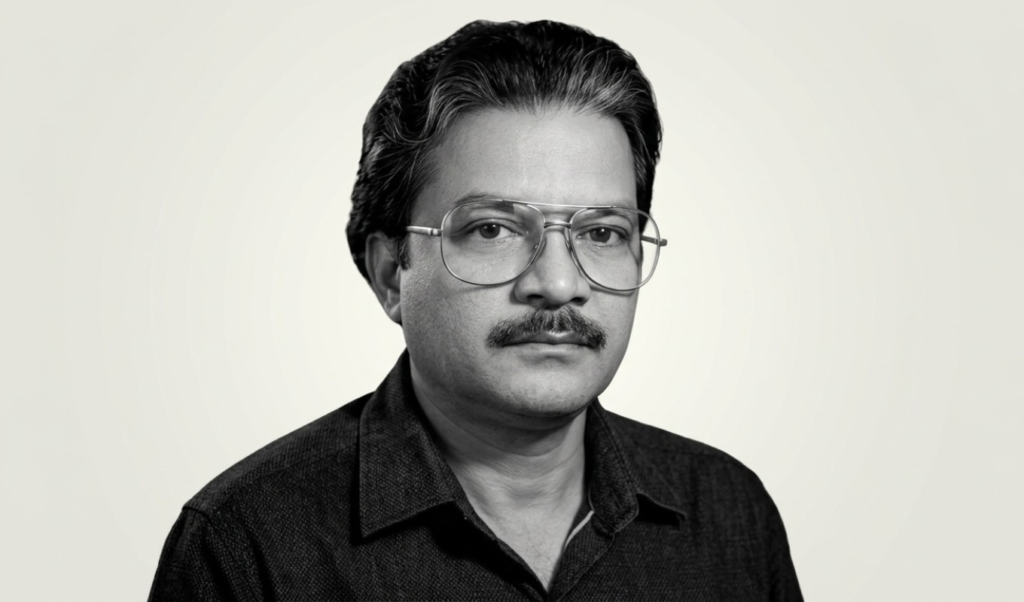
Nitun Kundu was a legendary figure whose creative universe comfortably accommodated diverse artistic disciplines. He was simultaneously a painter, designer, sculptor, entrepreneur, and innovative inventor. From the expressive hues on his canvases to the vibrant pulse of his sculptures, and from refined design aesthetics to the vision of a pioneering industrial enterprise—Kundu left an indelible mark of intellect, philosophy, and creativity across every chapter of his life.
Born on 3 December 1935 in Dinajpur to Jnanendranath Kundu and Binapani Kundu, he developed a deep passion for art early in life. He financed his own education by painting cinema banners—a testament to his self-reliance, resilience, and talent that would continue to inspire throughout his career. In 1954, Kundu enrolled at the Dhaka Art Institute (now the Faculty of Fine Arts, University of Dhaka), completing his five-year institutional course in fine arts in 1959.
He subsequently joined the US Information Center in Dhaka, where he served until March 1971. However, his artistic spirit could not remain confined to a conventional career when the Bengali nation called for liberation.
Artist of the Liberation War
The 1971 War of Independence marked a defining epoch in Kundu’s life. Serving as a designer in the Department of Information and Publicity under the Provisional Government of Bangladesh, his strokes and layout designs became visual weapons for national freedom. His iconic poster bore the rallying slogan:
“Ever-Vigilant Muktibahini of Bengal.”
Through his art, Kundu proved that a paintbrush in times of crisis ceases to be merely a tool of aesthetic expression—it becomes a symbol of resistance and collective emancipation. His political consciousness was deeply rooted in the 1960s autonomy movements and secular, left-leaning ideologies, shaping a lifelong commitment to social responsibility.
From Fine Art to Industrial Design
Following independence, Kundu bypassed conventional employment paths to immerse himself entirely in creative entrepreneurship. In 1975, he founded ‘Otobi’, which grew into one of Bangladesh’s premier furniture and interior design corporations. Through Otobi, he did not merely build a commercial brand; he elevated public taste and modern lifestyle aesthetics, seamlessly bridging the gap between fine art and industrial utility.
A Versatile Painter and Sculptor
Kundu held four solo exhibitions in Dhaka, Chittagong, and Rajshahi, alongside participating in numerous national and international group exhibitions between 1956 and 2001. His mastery spanned diverse mediums—oil, watercolour, acrylic, etching, serigraph, pencil, and ink. While his early works favoured figurative expressions, his visual language progressively evolved toward abstraction, focusing on the translation of emotion and form.
Beyond the canvas, Kundu executed several landmark public sculptures and architectural monuments across Bangladesh:
-
Shabash Bangladesh (1991): The monumental Liberation War memorial at Rajshahi University campus.
-
Sampan: The iconic traditional boat sculpture at Chittagong Airport.
-
Kadam Phul Fountain: The floral water sculpture outside the Ministry of Foreign Affairs in Dhaka.
-
SAARC Fountain: The landmark kinetic water installation at the Sonargaon road intersection in Dhaka.
-
Mother and Child (1975): A seminal early sculptural work.
Graphic Design, Engineering, and Legacy
Kundu’s creative footprint extended into national awards, trophies, crests, and medals. He designed the official insignia for the Ekushey Padak, National Film Awards, President’s Gold Cup, Asia Cup Cricket, and Bangladesh Television’s Notun Kuri talent search. He was equally adept at pavilion architecture, stage setup, lighting design, publication covers, and corporate logos.
Uniquely, Kundu possessed the dual mindset of a sensitive artist and a practical structural engineer. He routinely designed machinery components, structural joints, and custom lifts, integrating technology with artistic vision. In recognition of his extraordinary contributions, he was honoured with the National Fine Arts Award and the Ekushey Padak, among other accolades.
Nitun Kundu passed away on 15 September 2006. On his death anniversary, he is remembered as an artist who did not merely paint pictures, but envisioned the aesthetic spirit of a rising nation. His legacy endures through his canvases, public monuments, and enduring impact on Bangladeshi art and culture.