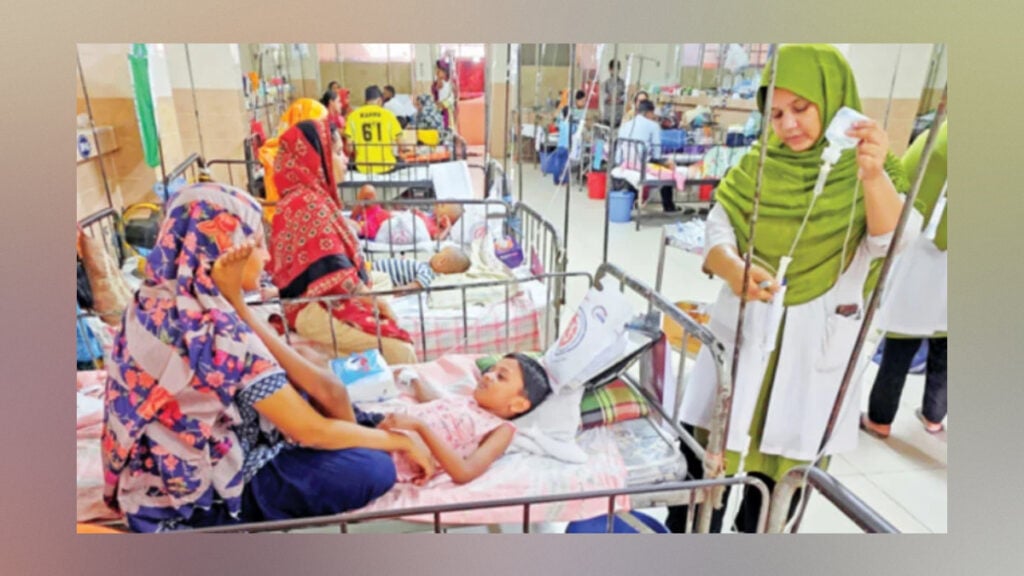
Bangladesh is facing mounting pressure from a sharp rise in dengue cases, with hospitals in Dhaka and other parts of the country struggling to accommodate the growing number of patients. At Mugda General Hospital in the capital, 187 dengue patients were receiving treatment on Monday against just 60 designated beds. With no beds available, some patients have been placed on floors and verandas, while in some cases more than one patient is being treated in a single bed.
The pressure has intensified as the country recorded its highest single-day hospital admissions for dengue this year. In the 24 hours to 8am on Monday, eight people died from the disease and 1,733 new patients were admitted to hospitals, according to the Directorate General of Health Services (DGHS) dengue bulletin.
Entomologists are now warning that the situation could deteriorate further in October, raising concerns for hospitals already operating under considerable pressure.
Death toll reaches 157 this year
Between 1 January and 14 September, 53,570 people have been admitted to hospitals with dengue across Bangladesh, while 157 people have died from the disease. Of those deaths, 60 occurred during the first 14 days of September alone, highlighting the rapid rise in fatalities this month.
Of the eight people who died in the latest 24-hour period, three were from Chattogram Division, four from Dhaka Division and one from Mymensingh Division.
The situation at Mugda General Hospital illustrates the strain on the healthcare system. A visit to the hospital’s dengue ward on Monday found patients receiving treatment not only in designated beds but also on floors and in corridors. The shortage of beds is making it more difficult for medical staff to monitor patients and provide medicines and other necessary care efficiently.
Dr Nurul Islam, deputy director of Mugda General Hospital, said the number of patients had risen alongside the spread of dengue. He said additional beds, doctors and nurses were needed to cope with the growing demand.
For many families, finding a hospital bed has become a challenge in itself. Nurjahan Begum, a resident of Matuail in Dhaka, said her 20-year-old granddaughter Jahin had been suffering from dengue for more than a week. When her condition worsened, relatives tried to have her admitted to hospital on medical advice.
They reportedly visited three or four government and private hospitals but could not find an available bed. Jahin was eventually admitted to Mugda General Hospital, where she is receiving treatment on the floor because of the shortage of beds.
Pressure spreading beyond Dhaka
The increase in dengue admissions is not confined to the capital. According to DGHS figures, among the 1,733 patients admitted nationwide in the latest 24-hour period, 191 were from Barishal Division and 191 from Chattogram Division. Another 388 came from areas of Dhaka Division outside the city corporations.
Dhaka North City Corporation recorded 170 admissions, while Dhaka South City Corporation recorded 143. Khulna Division reported 302 new admissions, followed by 110 in Mymensingh, 145 in Rajshahi, 86 in Rangpur and seven in Sylhet.
Of the 53,570 people admitted with dengue this year, 49,375 have already been discharged after treatment. A further 1,282 patients remain under treatment at hospitals across the country.
August recorded the highest monthly number of dengue cases so far this year, with 20,536 hospital admissions. Forty-three people died during that month.
The latest figures indicate that the health system is facing pressure on several fronts at once. Government hospitals are dealing with overcrowding, while private facilities are also seeing increased demand. In some locations, hospitals are having to treat more patients than their normal capacity allows.
Authorities consider expanding hospital capacity
The DGHS has said steps are being taken to increase the number of beds in government hospitals. Where necessary, patients may also be referred to private hospitals to ensure they receive treatment.
Professor Dr Prabhat Chandra Biswas, director general of the DGHS, said patients would be sent to private hospitals if government facilities faced shortages of beds or other resources. He added that hospitals had been instructed to expand their bed capacity according to their ability.
The health authorities are also seeking to strengthen treatment facilities outside the capital. Instructions have been issued to reinforce healthcare services at upazila level in areas experiencing a higher incidence of dengue.
Reducing the flow of patients towards Dhaka and ensuring that people can receive treatment closer to their homes is one of the health sector’s stated priorities.
October could bring a fresh surge
The possibility of a worsening outbreak in October has added another layer of concern. Entomologist Professor Kabirul Bashar said on Monday that a forecasting model used by his team suggested dengue conditions could become more serious next month.
He was speaking at a seminar on a strategic action plan for dengue prevention at the Sonargaon Hotel in Dhaka. According to him, tests conducted at different times have shown that Aedes mosquitoes can also bite at night.
Aedes mosquitoes often attract less attention during the cooler months because they are less visible than Culex mosquitoes, but this does not mean the risk disappears. Professor Bashar stressed that people need a better understanding of mosquito behaviour to respond effectively to dengue transmission.
He said Bangladesh has 126 mosquito species, with colonies of seven to eight species present in the country. Dengue has become a persistent public health challenge, making mosquito control a key part of any long-term response.
Local Government, Rural Development and Co-operatives Minister Dr Abdul Moin Khan, speaking at the same event, said fighting dengue was far from straightforward. Although the disease may appear manageable at first glance, controlling its spread requires sustained efforts.
Bed expansion alone will not solve the problem
Public health specialist Dr Mushtak Hossain said increasing hospital beds could provide temporary relief, but it would not address the source of the outbreak.
He stressed the need to eliminate mosquito breeding sites, maintain effective mosquito-control activities and improve public awareness. Strengthening systems for detecting and treating patients at local level is also essential, he said.
The scale of the challenge becomes clearer when this year’s figures are compared with recent years. In 2025, 102,861 dengue patients were admitted to hospitals across Bangladesh and 413 people died. In 2024, hospital admissions stood at 101,214, with 575 deaths.
The situation was considerably more severe in 2023, when 321,179 people were admitted to hospitals with dengue and 1,705 people died.
The latest surge therefore comes against a backdrop of repeated large-scale dengue outbreaks in Bangladesh. With September already recording a sharp rise in deaths and experts warning of a potentially worse situation in October, the pressure on hospitals is likely to remain a major concern.
Expanding treatment capacity may help hospitals cope with immediate demand, but health experts argue that controlling Aedes breeding grounds and strengthening prevention at community level will be crucial if the country is to contain the wider outbreak.