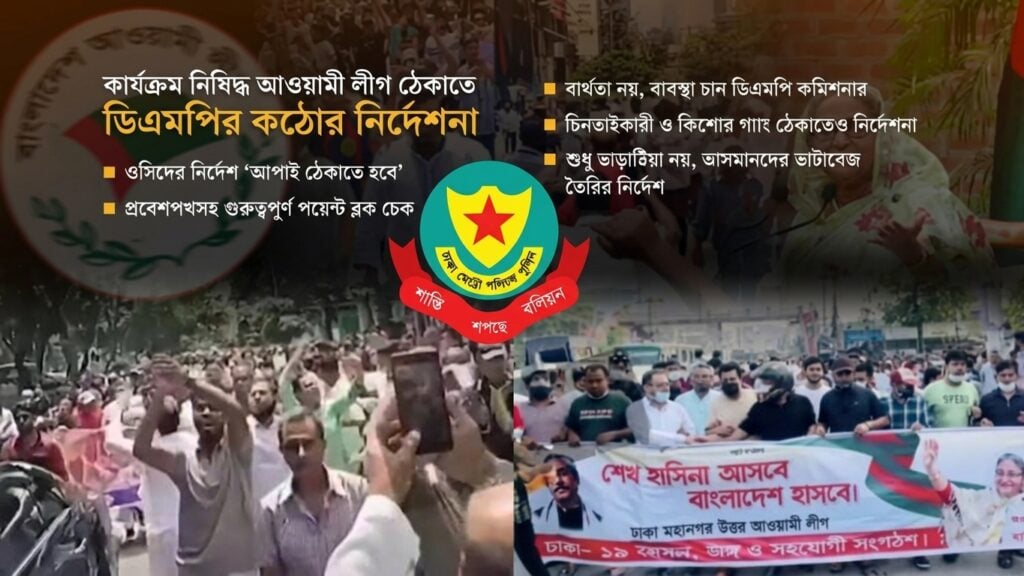
Dhaka Metropolitan Police (DMP) has instructed field-level officers to take responsibility if political marches, gatherings or other disruptive incidents occur within their jurisdictions, stressing that law enforcement must focus on preventing such incidents rather than responding only after they take place.
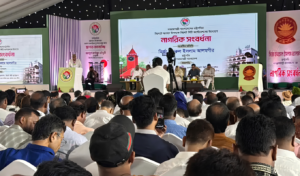
The directive was issued at the DMP’s monthly crime review meeting, or crime conference, held on Monday (14 December). The meeting reviewed crime trends in the capital during August and discussed measures for maintaining law and order in the coming days.
Under the new instructions, the officer-in-charge (OC) of the relevant police station and the deputy commissioner (DC) responsible for the zone will be held accountable if a march or untoward incident occurs in their area and operational shortcomings are identified. Their performance in maintaining security will also be assessed by DMP headquarters.
DMP Commissioner Mosleh Uddin Ahmed chaired the meeting, which was attended by additional commissioners, joint commissioners, deputy commissioners of the Crime Division and OCs from all 50 police stations in the capital.
Officials said the discussion placed particular emphasis on intelligence gathering, inter-agency coordination and preventive policing. Police stations have been told to collect intelligence in advance about possible marches, gatherings and disruptive activities and take precautionary measures before such events develop.
AFM Anwar Hossain Khan, deputy commissioner of the Detective Gulshan Division, said the recent incident in Gulshan received considerable attention during the conference. He said no individual police officer had been held solely responsible for the incident. Instead, the meeting examined where intelligence gaps had occurred, why preparations could not have been made earlier and how similar situations could be prevented in the future.
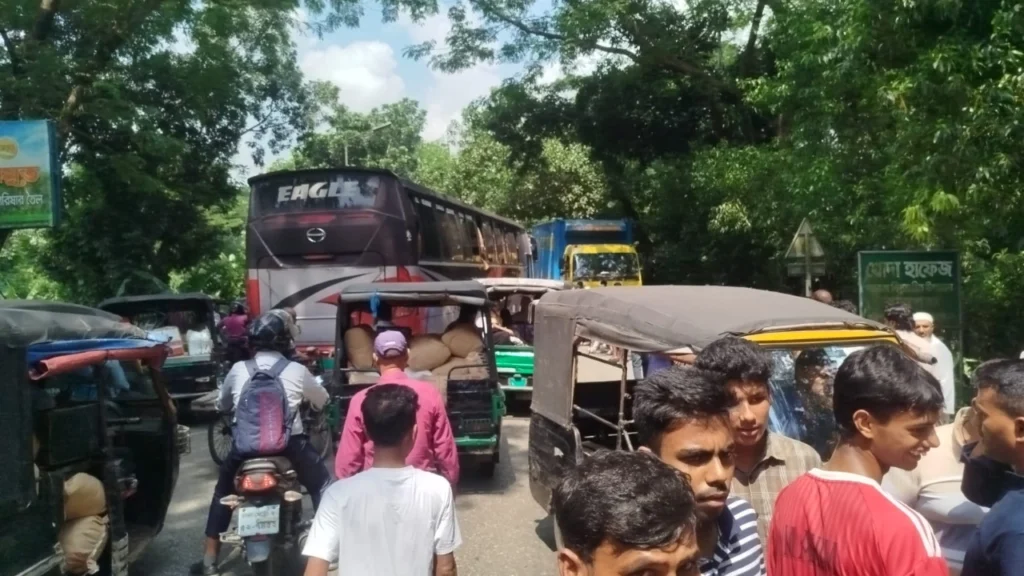
Following the sudden march by Awami League activists in Gulshan, instructions were issued to strengthen surveillance at entry points to Dhaka so that people arriving from outside the capital cannot engage in disruptive activities. Security measures at important locations and night-time checkpoints are also to be strengthened, including block checks where necessary.
Officials were told to gather information about suspicious individuals before any offence occurs and to take action in accordance with the law when necessary.
Police received intelligence only minutes before march
The meeting was told that police received information about last Friday’s march in Gulshan from an intelligence agency only eight minutes before it took place. Gulshan police immediately moved to prevent the gathering after receiving the information.
However, officials discussed the practical limitations of attempting to contain a large gathering with such little preparation time. The incident was therefore used to underline the need for earlier intelligence collection and faster communication between security agencies and field units.
The conference also made clear that local police cannot avoid responsibility by placing the blame solely on intelligence agencies. If a march or other serious incident takes place within a particular police station’s jurisdiction, the OC and the DC of the relevant zone must take primary responsibility for managing the law-and-order situation.
A Crime Division official who attended the conference said the commissioner had made his position clear: if a particular unit or officer fails to perform effectively, changes could be made in that area. Negligence and unprofessional conduct would not be tolerated.
“Where the work is not being done, there will be changes,” the commissioner was quoted as saying.
Greater coordination among intelligence agencies
The conference placed particular emphasis on coordination between intelligence agencies. Police were instructed not to rely solely on their own sources, but to maintain regular communication and exchange information with the Directorate General of Forces Intelligence (DGFI), National Security Intelligence (NSI), Counter Terrorism and Transnational Crime (CTTC) and other relevant agencies.
If information emerges about a possible march, gathering or act of sabotage, it should be passed promptly to the relevant field units so that preventive measures can be taken.
At the same time, officers were warned against harassing innocent people in the name of preventing political gatherings. The meeting instructed police not to arrest anyone solely because of their previous political affiliation or because they were known to support a particular political party.
Instead, people directly involved in a march should be identified through specific evidence, including photographs, video footage and information-technology-based analysis, before legal action is taken.
An OC of a police station said image and video analysis would be particularly important in identifying people directly involved in such activities. He said no one should be detained or harassed merely on the basis of political identity or suspicion.
Police personnel were also warned that disciplinary action would be taken if officers demanded or accepted financial benefits by threatening people with arrest.
Focus shifts to preventive policing
Several officials said a significant part of the commissioner’s instructions concerned “preventive policing” — the practice of identifying risks and taking action before a crime or security incident occurs.
Rather than relying primarily on arrests after an incident, police have been instructed to collect advance intelligence, identify vulnerable areas and monitor the movements of individuals considered relevant to potential criminal activity.
The commissioner also directed police to regularly collect and preserve information about guests staying in residential hotels and other hotels across the capital.
An additional deputy commissioner-level officer from the Tejgaon Division said police had also been instructed to verify information about new tenants and update records concerning existing tenants. Particular attention is to be given to suspicious sublets, temporary accommodation and people who have recently arrived in Dhaka.
Community policing was another key issue discussed at the meeting. OCs were instructed to maintain regular communication with local representatives, respected community members, community policing groups and residents.
The aim is to create a local environment in which residents can quickly inform police if they notice unfamiliar individuals, suspicious movements or unusual activities in their neighbourhoods.
OCs ordered to remain at police stations
The presence of OCs at their respective police stations also came under scrutiny during the conference.
Officials discussed recent incidents in which the OC of Tejgaon Police Station was not present when the Home Minister visited, while the Inspector General of Police Ali Hossain Fakir and the DMP commissioner also reportedly did not find the OC at Paltan Police Station during a visit.
Following those incidents, Tejgaon Police Station OC Kyashainyu Marma and Paltan Model Police Station OC Mohammad Mostafa Kamal Khan were withdrawn from their positions.
A joint commissioner-level official said the incidents had prompted stricter instructions regarding the presence and responsibilities of OCs. Officers in charge are expected to remain at their stations during duty hours and perform their responsibilities with due seriousness.
They have also been instructed to wear the prescribed uniform while on duty. If an OC has to leave the station because of an emergency, the reason must be recorded in the general diary and responsibility should be formally handed over to a senior officer.
The conference also stressed discipline within police stations. Any negligence, disorder or unprofessional conduct could lead to accountability measures against the officers concerned.
Crackdown on snatching and youth gangs
The DMP has also ordered intensified operations against snatching and youth gangs in the capital.
Police personnel are to be assigned duties on an area-by-area basis, with particular attention to preventing security gaps. Officers have been instructed to identify crime-prone locations and increase patrols and surveillance in those areas.
The broader approach outlined at the conference is to combine intelligence-led policing with visible patrols and closer engagement with local communities, allowing police to respond to emerging risks before they develop into larger law-and-order problems.
Arrests following Gulshan incident
The conference was also informed that joint operations by the Detective Branch and local police had resulted in the arrest of around 50 to 70 people in connection with the Gulshan incident.
Officials said some of those arrested had travelled to Dhaka from outside the capital. Among them were people from areas including Bogura, Gopalganj, Alfadanga and Harirampur, with several reportedly working in different professions in Dhaka.
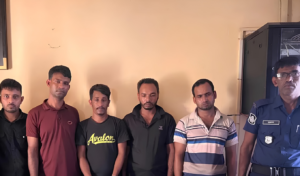
Five waiters from a Chinese restaurant were also arrested, according to information presented at the meeting. Officials said people working as security guards and autorickshaw drivers were also being examined as part of efforts to identify individuals allegedly involved in the incident.
The latest directives indicate a stronger emphasis within the DMP on early intelligence, coordination between agencies, accountability at police-station level and preventive action. At the same time, officers have been told that enforcement must be based on specific evidence rather than political identity, with safeguards against arbitrary harassment or arrests.