Tsunami warnings across the Pacific Rim were lifted on Wednesday, enabling millions of people who had evacuated coastal regions to safely return home. The alerts had been issued following one of the most powerful earthquakes ever recorded, which struck off Russia’s remote Kamchatka Peninsula, causing fears of devastating tidal waves across numerous countries.
Earthquake & Tsunami Overview
| Event | Details |
| Magnitude | 8.8 on the Richter scale |
| Location | Offshore, near Kamchatka Peninsula, Russia |
| Tsunami Prediction | Waves up to 4 metres (12 feet) across Pacific coastlines |
| Aftershocks | Multiple, including one of 6.9 magnitude |
| Volcanic Activity | Klyuchevskoy Volcano erupted post-quake |
Affected Nations and Responses
More than a dozen countries issued urgent warnings and took extensive precautionary measures:
| Country/Region | Evacuations & Actions | Outcome |
| Japan | 2 million evacuated; Fukushima nuclear plant temporarily evacuated | One fatality (woman drove off cliff) |
| Chile | 1.4 million evacuated in a record-setting mobilisation | No casualties; 60cm waves observed |
| Ecuador / Galapagos | Three-metre waves predicted; sea level fluctuations observed | 1-metre surge; no damage reported |
| Peru | Closed 65 of 121 Pacific ports | No reported damage |
| Hawaii (USA) | Flights to/from Maui cancelled | No significant waves or damage |
| Russia (Severo-Kurilsk) | Tsunami submerged fishing plant; debris swept into sea; water reached WWII monument 400m inland | Moderate damage, light injuries |
Russia: Epicentre and Most Affected
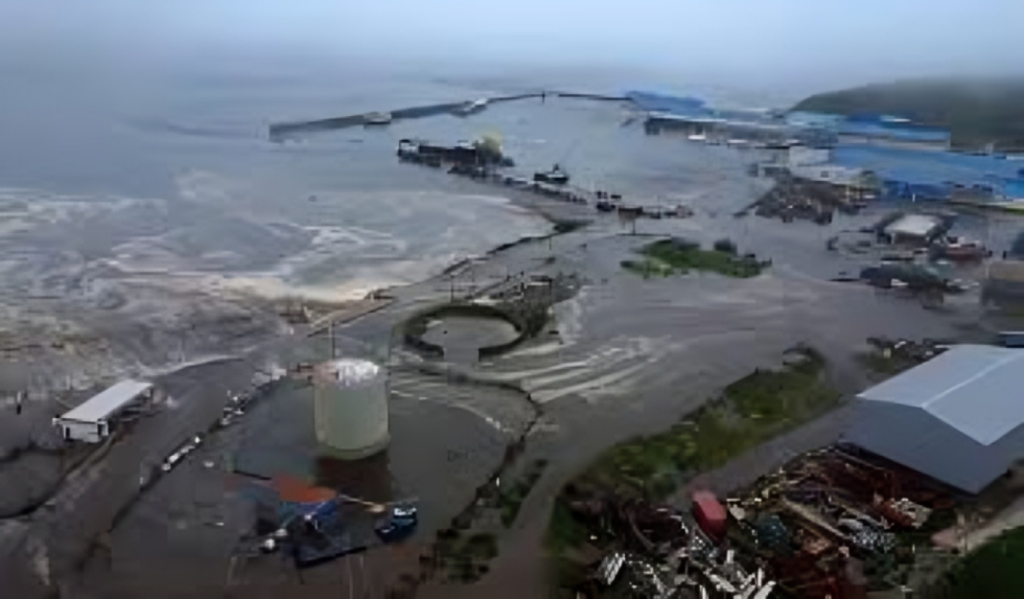
Russia bore the worst of the tsunami’s impact. In Severo-Kurilsk, waves surged inland, submerging a local fish processing facility and flooding parts of the port town. Video from state television showed debris and buildings being swept into the ocean. Mayor Alexander Ovsyannikov confirmed the surge had reached as far as a World War II monument, situated some 400 metres from the coast.
Russian scientists also reported that Klyuchevskoy Volcano, located on the Kamchatka Peninsula, erupted shortly after the quake, with lava flows and explosive activity seen on the western slope.
Russia’s Geophysical Survey stated:
“Red-hot lava is observed flowing down the western slope. There is a powerful glow above the volcano and explosions.”
Global Reaction and Preparedness
The earthquake triggered tsunami warnings across the Pacific, including in:
- Japan
- The United States (Hawaii and West Coast)
- Peru
- Chile
- Ecuador
- The Galapagos Islands
Although storm surges and unusual sea behaviour were reported, major destruction and mass casualties were avoided due to swift government responses, timely evacuations, and early warning systems.
In the Galapagos, for example, national parks were shut, schools closed, and tourists were promptly removed from sightseeing boats. By late Wednesday, locals had returned to daily life.
Isabel Grijalva, 38, a resident of Santa Cruz, Galapagos, said:
“Everything is calm, I’m going back to work. The restaurants are reopening and the places tourists visit are also open again.”
Scientific Assessments and Future Risk
| Agency | Key Observations |
| US Geological Survey (USGS) | Rated the quake among the 10 strongest since 1900 |
| Kamchatka Regional Seismic Centre | Identified it as the region’s most powerful since 1952 |
| Aftershock Prediction | 59% chance of an aftershock exceeding magnitude 7.0 in coming week |
While the Pacific region faced a major geological event, timely evacuations, coordinated international alerts, and heightened preparedness helped avert large-scale human casualties. The swift downgrading and lifting of tsunami warnings have allowed millions to safely return home, though seismic vigilance remains high in the wake of ongoing aftershocks and volcanic activity.