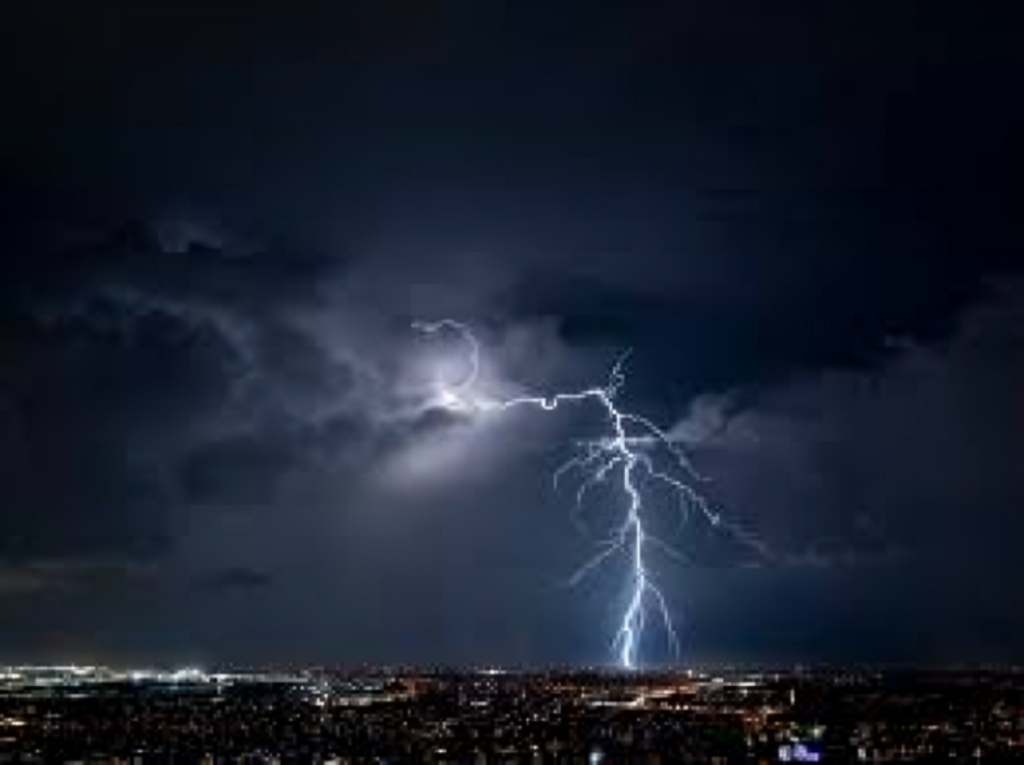
A new world record for the longest single lightning flash has been confirmed by the World Meteorological Organization (WMO): a “megaflash” stretching 829 kilometres (515 miles) across the United States, from eastern Texas to near Kansas City. This phenomenal atmospheric event occurred on 22 October 2017.
The announcement, made on Thursday, reaffirms the extraordinary reach and power of lightning, and its potential to affect areas far from its parent storm system.
Record-Breaking Lightning Events
| Event | Distance / Duration | Date | Location |
| Longest Distance Flash | 829 km (±8 km) | 22 Oct 2017 | Texas to Kansas City, USA |
| Previous Distance Record | 768 km (±8 km) | 29 Apr 2020 | Mississippi to Texas, USA |
| Longest Duration Flash | 17.102 seconds (±0.002 s) | 18 Jun 2020 | Uruguay and northern Argentina |
The 2017 megaflash, previously overlooked, was identified during a re-analysis of satellite data from a powerful storm system. The flash greatly surpassed the 768 km megaflash from 2020, also in the US, which had held the official record since its certification in 2022.
What is a ‘Megaflash’?
The term “megaflash” refers to a single flash of lightning that extends across hundreds of kilometres, often well beyond the thunderstorm that generated it. The 2017 storm produced multiple such flashes, three of which were closely analysed to establish this ground-breaking category.
Professor Randall Cerveny, rapporteur for weather and climate extremes at the WMO, explained:
“Lightning can travel quite long distances away from the parent thunderstorm. That is why some people talk of a ‘bolt from the blue’ — a lightning flash that seemingly comes out of the clear sky.”
Scientific Process and Verification
The record was certified by an 11-member international committee of experts from:
- United States
- Brazil
- Germany
- Spain
- Nepal
- Israel
The analysis was made possible by satellite-based lightning mapping, operational since 2016. Although still a relatively new tool, experts believe that with an additional decade of data, researchers will begin to uncover patterns in lightning’s intensity, frequency, and geographic behaviour.
Dr Michael J. Peterson, from the US Severe Storms Research Center, stated:
“We will be able to observe even the rarest types of extreme lightning on Earth, and investigate the broad impacts of lightning on society.”
The Deadly Beauty of Lightning
While lightning inspires awe, it remains a significant global hazard. The WMO emphasised the need for universal early warning systems for hazardous weather events, aiming for full planetary coverage by 2027, lightning included.
WMO’s Most Notable Lightning Records:
| Record | Details |
| Longest Flash (Duration) | 17.102 seconds (2020, Uruguay/Argentina) |
| Highest Death Toll (Indirect) | 469 people in Dronka, Egypt (1994) – Oil tanks ignited by lightning |
| Highest Death Toll (Direct Strike) | 21 people in Zimbabwe (1975) struck while sheltering in a hut |
WMO Secretary-General Celeste Saulo concluded:
“Lightning is a source of wonder but also a major hazard that claims many lives around the world every year.”