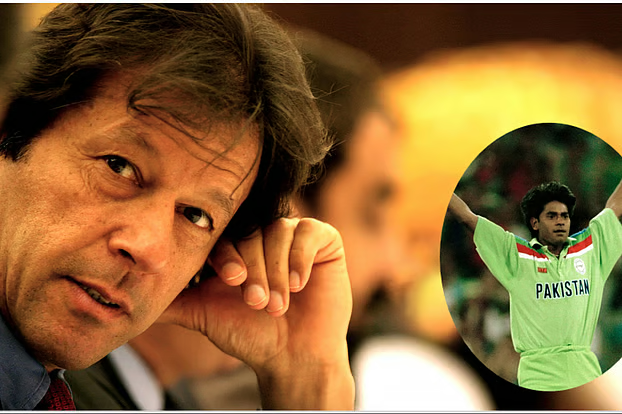
Sitting at a breakfast table inside Melbourne’s Langham Hotel, Aaqib Javed reflected on the defining chapter of Pakistani cricket history with a striking sense of reverence. At the time of the interview, he was serving as the head coach for the United Arab Emirates national team during the 2015 ICC Cricket World Cup. Yet to the global cricket community, Aaqib Javed remains forever etched in memory as the fierce right-arm fast bowler who helped bowl Pakistan to glory in 1992. When the conversation turned to that magical campaign, one figure towered over every anecdote: Imran Khan.
Whenever people discuss the landmark 1992 World Cup triumph, Aaqib sees just one face in his mind’s eye. Pakistan’s historic victory, he insists, was forged almost single-handedly through Imran’s uncompromising leadership. While commentators frequently praise Imran as an inspiring figurehead, Aaqib distils his influence into three foundational qualities: absolute honesty, fearless courage, and unyielding hard work. Honesty earns unconditional respect; courage empowers a captain to make agonizing decisions under pressure; and relentless effort sets the benchmark for an entire squad to follow.
The psychological impact of Imran’s presence was never clearer than before Pakistan’s crucial group match against Australia in Perth. Pakistan’s tournament hopes were teetering on the brink of collapse, and morale in the dressing room had hit rock bottom. Enter Imran Khan. Within thirty minutes, he fundamentally transformed the collective mindset of a shattered team.
Addressing his visibly demoralised squad, Imran calmly declared his unshakable belief that Pakistan would still win the World Cup. His initial remark left the dressing room stunned, with players quietly wondering if their skipper had lost touch with reality. Yet, his tactical and emotional rallying cry was masterly. He urged his pacemen to attack the Australians relentlessly, warning that a defensive mindset would guarantee total destruction. He demanded aggressive field placements—two slips and a gully—and instructed his bowlers to unleash bouncers and out-swingers without fear of conceding runs.
Imran laid out the road ahead with surgical clarity: beat Australia, comfortably handle Sri Lanka, defeat New Zealand as they routinely did, and stride directly into the knockout rounds. By the time the players crossed the boundary ropes at the Western Australia Cricket Association (WACA) Ground, self-doubt had vanished, replaced by an intoxicating surge of confidence.
Throughout that grueling tournament, Aaqib shared the new ball and routinely bowled ten overs on the trot. The main bowling load fell upon a lean attack consisting of Aaqib, Wasim Akram, and leg-spinner Mushtaq Ahmed, especially after Waqar Younis was ruled out with a severe back injury just before the tournament. Imran himself was battling a debilitating shoulder injury that severely limited his bowling rhythm, forcing him to adopt a defensive, run-restricting role while demanding purely wicket-taking aggression from his young charges.
Imran was far from a vague orator who relied solely on fiery rhetoric. His leadership was built on precise, individualized tactical directives. He positioned two slips and a gully for Aaqib, demanding out-swingers mixed with deliberate bouncers. He pulled Wasim Akram aside and instructed him to bowl with maximum pace without worrying about no-balls or wides, focusing purely on intimidating the opposition. Before Waqar Younis was sidelined, Imran’s mandate to him had been equally direct: target the stumps with unadulterated pace.
It was this clarity of vision, tactical courage, and uncompromising standard of excellence that transformed a struggling team into world champions—and why, in the eyes of those he commanded, the word ‘Leader’ belongs in a class of its own.