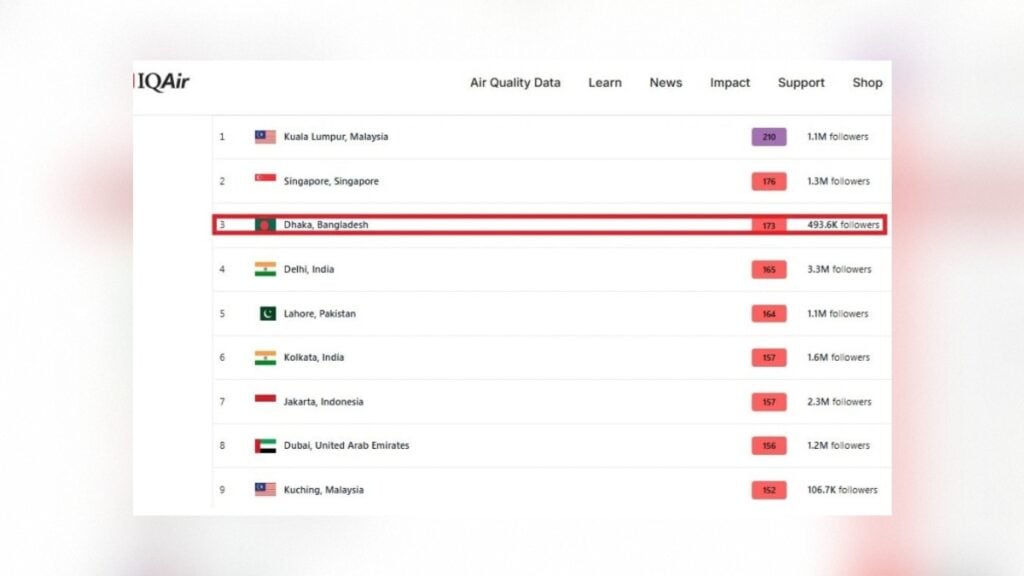
Dhaka has ranked third among the world’s most polluted cities, with its air quality reaching an unhealthy level amid persistent dust, fumes and harmful particulate matter. The Bangladeshi capital recorded an Air Quality Index (AQI) score of 173 on Wednesday (7 October), according to data from Swiss-based air quality monitoring organisation IQAir.
An AQI reading of 173 falls within the ‘unhealthy’ category, indicating that polluted air may pose health risks to the general population. People who spend extended periods outdoors may be exposed to higher levels of pollutants, while vulnerable groups can face greater health concerns.
According to IQAir’s global ranking, Kuala Lumpur in Malaysia was the most polluted city on the day, recording an AQI score of 210. The reading placed the Malaysian capital in the ‘very unhealthy’ category. Singapore ranked second with a score of 176.
Dhaka followed in third place with a score of 173. Delhi in India ranked fourth at 165, while Lahore in Pakistan was fifth with a score of 164.
The AQI scale is used to indicate the level of air pollution and the potential impact on health. Under IQAir’s classification, a score of zero to 50 represents ‘good’ air quality. Readings between 51 and 100 are considered ‘moderate’ or satisfactory, while 101 to 150 is categorised as ‘unhealthy for sensitive groups’.
Air with a score between 151 and 200 is classified as ‘unhealthy’. A reading from 201 to 300 is considered ‘very unhealthy’, while a score above 300 falls into the ‘hazardous’ category.
Bangladesh’s AQI assessment takes several major pollutants into account. These include particulate matter such as PM10 and PM2.5, nitrogen dioxide (NO₂), carbon monoxide (CO), sulphur dioxide (SO₂) and ozone (O₃). Fine particulate matter, particularly PM2.5, is a major concern because its small size allows it to penetrate deep into the respiratory system.
Dhaka’s air pollution is linked to several sources. A report published in March 2019 by the Department of Environment and the World Bank identified brick kilns, vehicle emissions and dust from construction sites as three major sources of pollution in the capital.
These sources continue to create challenges for a densely populated city where traffic, construction and other urban activities are part of everyday life. Dust from roads and construction sites can add to particulate pollution, while vehicle emissions contribute various pollutants to the urban atmosphere.
The health implications of prolonged exposure to polluted air are significant. According to the World Health Organisation (WHO), air pollution is associated with a higher risk of stroke, heart disease, chronic obstructive pulmonary disease, lung cancer and acute respiratory infections. The organisation estimates that air pollution contributes to around seven million deaths worldwide each year.
Dhaka’s latest ranking therefore highlights an ongoing public health and environmental challenge. Improving air quality will require sustained efforts to reduce pollution at its sources, including better management of construction dust, tighter control of vehicle emissions and effective measures to address pollution from brick kilns.
For residents, the deteriorating air also underlines the importance of paying attention to daily air-quality conditions, particularly for children, older people and those with existing respiratory or cardiovascular problems. The latest AQI reading serves as another indication that cleaner urban air remains a pressing priority for Dhaka.