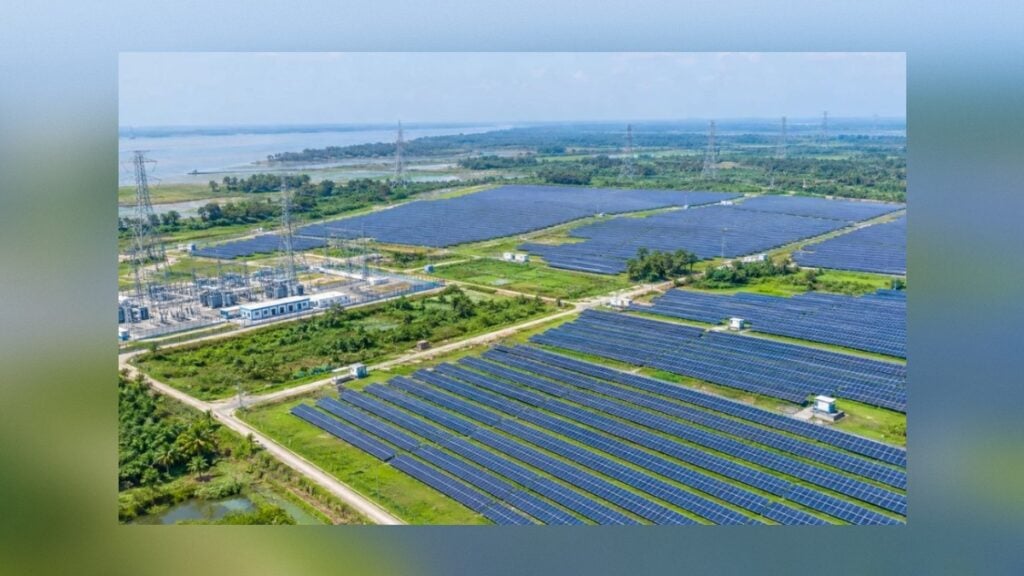
The government is taking a major step towards expanding renewable energy generation with a proposed 442-megawatt solar power plant in Rampal, Bagerhat, aimed at diversifying the country’s energy mix and reducing carbon emissions.
The project, titled the ‘Rampal 442MW Solar Power Plant Construction Project’, is scheduled to be placed before the Executive Committee of the National Economic Council (ECNEC) for approval at its meeting on Wednesday. The meeting is expected to be chaired by ECNEC Chairman and Prime Minister Tarique Rahman.
The estimated cost of the project is Tk 2,498.08 crore. The Power Division has proposed the project, while the Bangladesh Power Development Board (BPDB) will be responsible for implementation.
Of the total cost, Tk 374.71 crore will come from BPDB’s own funds, while Tk 2,123.37 crore will be financed through the Power Sector Development Fund.
Md Zahurul Islam, BPDB member for generation, said the proposed solar plant would have a panel capacity of 442MW. Electricity generated by the solar panels will be converted into alternating current through inverters before being supplied to the national grid.
He described the initiative as a significant step towards expanding renewable energy generation capacity in Bangladesh and increasing the use of cleaner sources in the power sector.
Existing land and transmission infrastructure to be used
The proposed solar power plant will be built on 918.50 acres in Rampal’s Block-B. The land has already been acquired by BPDB, meaning no fresh land acquisition will be required for the project.
This is expected to help contain costs and facilitate faster implementation.
BPDB acquired a total of 1,834 acres in Rampal in 2012 for the development of coal-fired power generation facilities. The land was divided into two sections: 915.50 acres in Block-A and 918.50 acres in Block-B.
The Maitree Super Thermal Power Plant, operated by Bangladesh-India Friendship Power Company (Pvt) Ltd, was built in Block-A. Block-B remains under BPDB’s control.
According to project documents, land development and boundary wall construction in Block-B have already been completed.
Another advantage is that the proposed solar plant will use the existing transmission infrastructure associated with the nearby Rampal coal-fired power plant. Electricity generated by the solar facility will be transmitted to the national grid through the existing transmission line.
Project documents say this arrangement should allow the solar plant to be implemented relatively quickly and at a lower cost, as the need for extensive new transmission infrastructure will be reduced.
Major investment in solar equipment
The proposed facility will use solar photovoltaic modules with a minimum capacity of 640 watt-peak. The project will also include grid-tied inverters with a combined capacity of 360MW, a pooling substation and a three-kilometre double-circuit 230kV transmission line.
Three 230kV bays, including one spare bay, will also be installed as part of the project.
The largest portion of the project cost—Tk 1,238.61 crore, or roughly half of the total—will be spent on solar photovoltaic modules and mounting structures.
Another Tk 732.25 crore has been allocated for electrical equipment, including inverters, transformers and the Supervisory Control and Data Acquisition (SCADA) system.
The Planning Commission has assessed the project as financially and economically viable.
Low-cost financing proposed
According to a senior Planning Commission official, the loan from the Power Sector Development Fund will carry an annual interest rate of 2 per cent. The repayment period will be 16 years, including a one-year grace period.
The Planning Commission has recommended implementing the project between September 2026 and March 2029.
The project had already been included in the Annual Development Programme (ADP) for the 2026-27 financial year as an unauthorised ‘green-page’ project.
Following recommendations from the Project Evaluation Committee and a subsequent decision to shorten the implementation period, the estimated cost has been reduced by Tk 4.32 crore from the original proposal submitted by the Power Division.
The Infrastructure Investment Facilitation Company (IIFC) conducted a feasibility assessment of the project and found it acceptable, according to the project summary.
Boost to renewable energy targets
The Planning Commission believes the project will increase electricity generation from renewable sources and contribute to the government’s target of obtaining 20 per cent of the country’s total energy mix from renewable sources by 2030.
Once completed, the project is expected to add 442MW of new generation capacity to the national grid.
Bangladesh currently has 28,827MW of on-grid electricity generation capacity, of which 797MW comes from solar power. The addition of the Rampal project would therefore represent a significant increase in the country’s grid-connected solar generation capacity.
The Planning Commission has also highlighted the project’s potential contribution to energy security. Greater reliance on solar power would diversify the sources used for electricity generation, while reducing dependence on conventional fuels and helping to lower carbon emissions.
The project is also aligned with the ‘Five-Year Strategic Framework for Reform and Development’ and Sustainable Development Goal 7, which calls for access to affordable, reliable, sustainable and modern energy for all.
Employment opportunities during and after construction
The project is expected to create employment both during construction and once the plant becomes operational.
Around 25 people will be employed at the project office during implementation, while approximately 200 temporary workers are expected to find employment through contractors.
Once the plant is operational, 261 people will be required for its operation and maintenance. Of these, 51 positions are expected to be permanent, while 203 people will be engaged through outsourcing, according to the project documents.
For Bangladesh, where the expansion of renewable energy has become increasingly important as the country seeks to diversify its energy sources, the proposed Rampal plant represents a sizeable addition to solar generation capacity.
If approved by ECNEC, the project will move forward on land that is already available and will make use of existing transmission infrastructure. These factors are expected to reduce both implementation complications and additional infrastructure costs while adding a substantial volume of renewable electricity to the national grid.