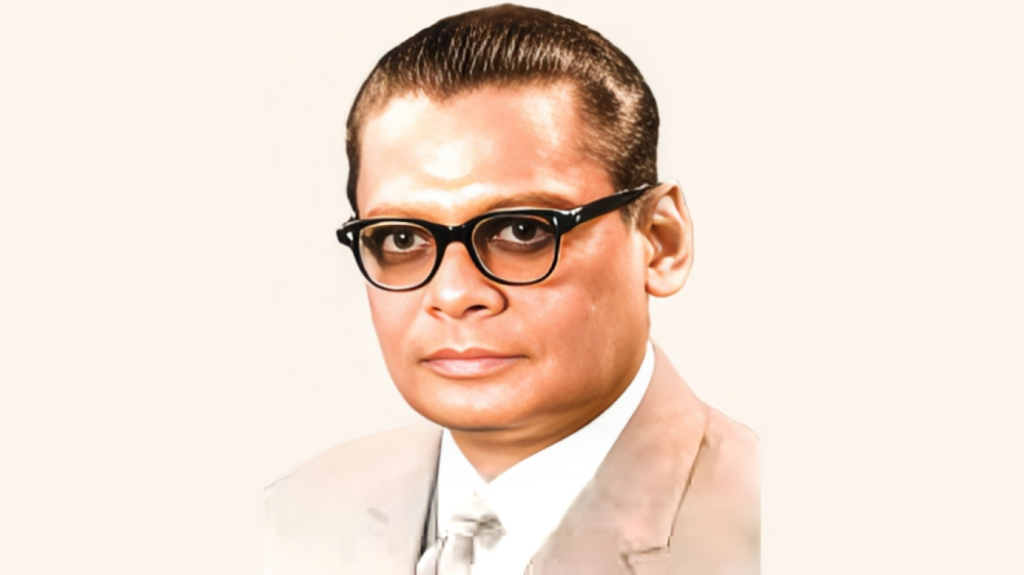
Justice Abu Sayeed Chowdhury was a multifaceted figure in the history of Bangladesh—an organiser of the Liberation War, the second President of independent Bangladesh, former President of the United Nations Human Rights Commission, and a former Vice-Chancellor of the University of Dhaka. His life was a beacon of justice, principle, and human dignity.
Early Life and Family Background
| Attribute | Details |
| Date of Birth | 31 January 1921 |
| Place of Birth | Nagbari, Tangail, Greater Mymensingh |
| Family Lineage | Influential zamindar family |
| Father | Abdul Hamid Chowdhury, Speaker, East Pakistan Provincial Assembly |
| Son | Abul Hasan Chowdhury Kaiser – former State Minister for Foreign Affairs under the Awami League government |
Academic and Professional Excellence
Justice Chowdhury was an exceptionally bright student. He completed his undergraduate degree at Presidency College, Kolkata, and went on to earn postgraduate and law degrees from the University of Calcutta. He later qualified as a Barrister-at-Law from Lincoln’s Inn, UK.
- Legal Career Milestones:
- Began practising at Calcutta High Court in 1947.
- Moved to Dhaka post-partition and joined Dhaka High Court in 1948.
- Became Advocate General of East Pakistan in 1960.
- Appointed as a High Court Judge in 1961.
- Served on the Constitutional Commission of Pakistan and chaired the Bangla Development Board.
Role in Academia and the Liberation War
- Appointed Vice-Chancellor of the University of Dhaka in 1969.
- In 1971, while in Geneva, he resigned in protest against the Pakistan army’s genocide.
- Moved to London to mobilise international opinion in support of the Bangladesh Liberation War.
National Political Roles
| Year | Position |
| 1972 | Took oath as Second President of Bangladesh on 12 January |
| 1973 | Re-elected President on 10 April |
| Dec 1973 | Resigned as President; appointed Special Envoy for Foreign Affairs |
| 1975 | Joined Sheikh Mujibur Rahman’s Cabinet as Minister of Ports and Shipping |
International Contributions and Recognition
Justice Chowdhury brought international honour to Bangladesh:
- Elected President of the United Nations Human Rights Commission in 1985.
- Awarded the title ‘Deshikottama’ by Visva-Bharati University.
- Received an Honorary Doctor of Laws (LL.D) degree from the University of Calcutta.
Legacy and Passing
Justice Abu Sayeed Chowdhury passed away on 2 August 1987 in London.
He remains an enduring light in Bangladesh’s history—a man whose contributions to law, education, diplomacy, and human rights are indelible. His life stands as a testament to what commitment to justice and patriotism can achieve.
Tributes to this towering figure of our nation.