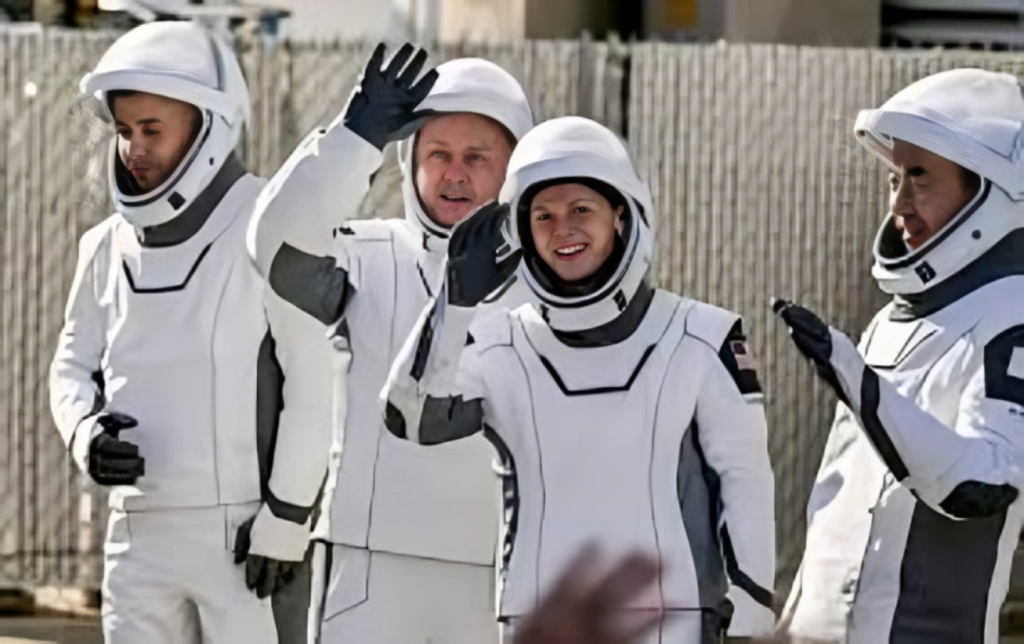
An international team of four astronauts aboard a SpaceX Crew Dragon capsule successfully docked with the orbiting International Space Station (ISS) on Saturday.
Docking Details
| Event | Details |
| Docking Time | 2:27 am Eastern Time (06:27 GMT) |
| Location | Over the southeast Pacific Ocean |
| Spacecraft | SpaceX Crew Dragon capsule launched atop Falcon 9 rocket |
| Launch Site | Kennedy Space Center, Florida |
| Mission Type | 11th crew rotation under NASA’s Commercial Crew Program |
SpaceX confirmed the docking on social media, sharing a video capturing the moment the spacecraft made contact with the ISS.
Crew Members and Mission Duration
| Astronauts/Cosmonauts | Nationality |
| Zena Cardman | United States |
| Mike Fincke | United States |
| Kimiya Yui | Japan |
| Oleg Platonov | Russia (Roscosmos) |
The crew will join the ISS for a six-month mission.
Arrival Exchange
Shortly after docking, the current ISS crew welcomed the newcomers:
“We have cold drinks, hot food, and us waiting — see you soon,”
to which Mike Fincke responded:
“Hello Space Station — Crew 11 is here and we are super excited to join.”
Mission Objectives
During their stay, the Crew-11 astronauts will conduct simulations of lunar landing scenarios relevant to the US-led Artemis programme, specifically near the Moon’s South Pole.
- They will use handheld controllers and multiple display screens to assess how gravity shifts impact astronauts’ ability to pilot spacecraft, including future lunar landers.
ISS Overview and Research Focus
- Continuously inhabited since 2000, the ISS serves as a vital testbed for research supporting deeper space exploration, including planned missions to Mars.
- Among the Crew-11’s cargo are Armenian pomegranate seeds, which will be compared to a control batch kept on Earth to study the effects of microgravity on crop growth.
Future of the ISS
The ISS is scheduled for decommissioning after 2030. Its orbit will then be gradually lowered until it re-enters Earth’s atmosphere, breaking up over Point Nemo — a remote region in the Pacific Ocean known as a spacecraft graveyard.