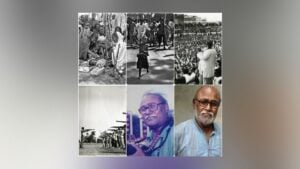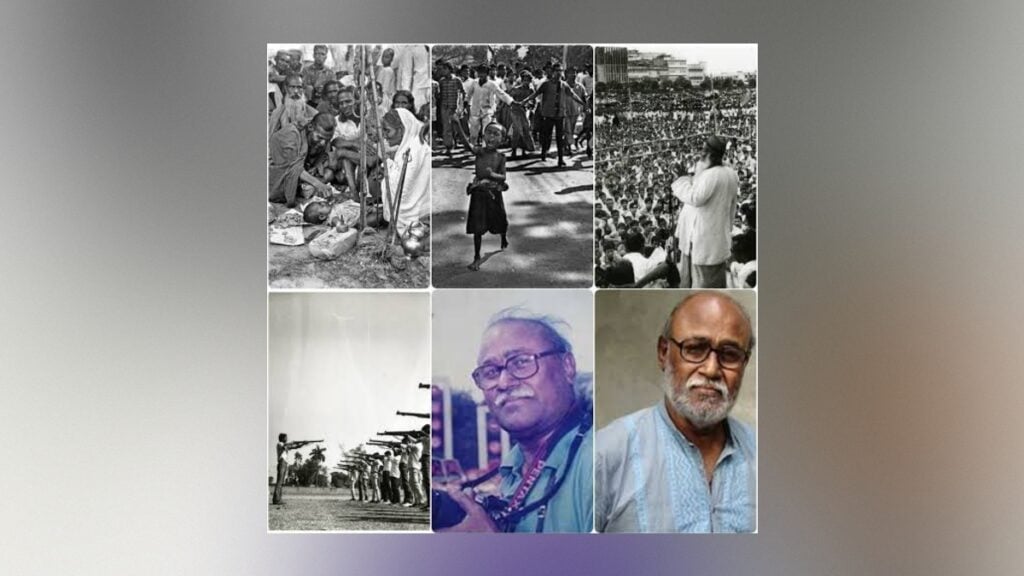
Rashid Talukder, one of Bangladesh’s most distinguished photojournalists, devoted his life to preserving such moments. Through his lens, he documented the Bengali struggle for political rights, the mass uprising of 1969, the Liberation War of 1971 and numerous defining episodes in the history of independent Bangladesh.
He did more than take photographs. He brought history to life through images that continue to tell the story of a nation’s struggle, sorrow, courage and freedom.
Born on 24 October 1939 in the 24 Parganas district of West Bengal, India, Talukder was affectionately known as Kanchan. Colleagues called him ‘Rashid Bhai’, a reflection of the warmth and familiarity he inspired among those who worked with him. During his youth in Rajshahi, he was also known as ‘Prince Rashid’.
His father, Abdul Karim Talukder, worked as a station master for the railway, while his mother, Rahima Khatun, was a homemaker. The family’s ancestral home was in South Ramjanpur village in Kalkini, Madaripur, in what was then East Bengal.
His father’s profession meant that Talukder was born in West Bengal and spent parts of his childhood and adolescence in different places as the family moved. These experiences exposed him to a variety of communities, people and ways of life, broadening his understanding of society and human experience.
Although he attended several educational institutions during his early years, photography eventually became the defining pursuit of his life.
In 1959, he began his professional career as a photo technician at the Press Information Department (PID), earning a monthly salary of just Tk 80. It was a modest beginning for a man who would later establish himself as one of the most important figures in Bangladesh’s photographic journalism.
His career took a significant turn in 1962 when he joined the daily Sangbad as a photojournalist. His first assignment was given to him by Shahidullah Kaiser, the renowned journalist and novelist.
Photojournalism in those days demanded considerable patience, technical knowledge and physical effort. Digital cameras, instant image transmission and modern photographic equipment were not available. Photographers had to work carefully, often under difficult conditions, to capture and process images that could communicate the significance of an event.
Talukder nevertheless developed a reputation for his determination, keen observation and willingness to work close to the heart of unfolding events.
In 1975, he joined the daily Ittefaq, where he worked alongside prominent journalists and editors, including Rahat Khan. He spent nearly three decades at the newspaper before retiring in 2007.
Retirement from professional journalism, however, did little to diminish the importance of his photographic legacy. His work continued to serve as a visual record of the events that shaped Bangladesh.
The 1969 mass uprising: A camera at the heart of a nation’s awakening
One of the defining characteristics of Talukder’s photography was his ability to capture the human reality behind political events. Rather than remaining a distant observer, he sought out the emotions, struggles and experiences of the people involved.
During the turbulent days of the 1969 mass uprising, his camera became a fearless witness to the movement for political rights and self-determination. He documented students and ordinary citizens taking to the streets, young protesters leading demonstrations, confrontations with the police and the atmosphere of resistance that swept across the country.
These were not simply photographs of crowds. They captured a society demanding change and a people increasingly determined to challenge authoritarian rule.
The death of student leader Asaduzzaman, widely known as Shaheed Asad, became a turning point in the Bengali struggle for political freedom. On 20 January 1969, Asad was shot dead by police during the uprising.
Talukder witnessed the events surrounding the killing and captured images that became part of the historical record of the movement. The bloodstained shirt associated with Asad’s death, along with the grief and anger of protesters, came to symbolise the sacrifices made in the struggle against authoritarianism.
Asad’s bloodied shirt was more than an item of clothing. It became an emblem of resistance and the Bengali people’s aspiration for freedom.
The episode also left a lasting mark on Bengali literature. Poet Shamsur Rahman immortalised the memory in his celebrated poem Asader Shirt, drawing on the symbolic power of the garment and the political significance of the young leader’s death.
Photography and poetry thus preserved the same historical moment through different forms of artistic expression. Talukder’s images conveyed the visual reality of protest, while Rahman’s words transformed its emotional force into literature.
Together, they helped ensure that the sacrifice associated with the uprising would remain part of the nation’s collective consciousness.
The photograph linked to the creation of ‘Tokai’
Among the memorable images associated with the 1969 uprising was a photograph of a street child at the forefront of a procession. The image has since been linked in public memory to the popular cartoon character Tokai, created by artist Rafiqun Nabi, widely known as Ranabi.
Tokai became an influential figure in Bangladeshi cartoon art, representing the lives of street children and exposing the inequalities, poverty and social contradictions that shape their existence. Through the character, Ranabi frequently highlighted the hypocrisy of the powerful and the everyday struggles of those living on society’s margins.
The association between Talukder’s photograph and the character illustrates how a moment captured by a photojournalist can inspire wider cultural reflection.
A photograph taken during a political demonstration may initially serve as a record of a particular event. With time, however, it can acquire meanings that extend far beyond its original setting, influencing art, literature and public understanding.
Talukder’s work demonstrated how the experiences of ordinary people could become central to the way a nation understands itself.
The Liberation War: Photography and patriotism
When the Liberation War began in 1971, Talukder’s role extended beyond that of a professional photojournalist. His deep sympathy for the struggle of the Bengali people brought him close to those fighting for independence.
Accounts of his life describe how he maintained contact with freedom fighters and assisted them in various ways during the war. His camera remained a constant companion, enabling him to document the courage, hardship and sacrifice that accompanied the birth of Bangladesh.
The Liberation War was not simply a military confrontation. It was a struggle for national independence, political rights and the right of a people to determine their own future.
Talukder’s photographs helped preserve the human dimension of that struggle. They recorded moments of resistance, the suffering of ordinary people, the determination of those seeking freedom and the emotional cost of a conflict that transformed the region.
His work also reflected an important responsibility of historical photography: to preserve evidence of events for generations who did not experience them first-hand.
Independence is won through sacrifice, but the memory of that sacrifice must also be protected. By documenting the events surrounding the struggle for freedom, Talukder contributed to the preservation of Bangladesh’s national history.
His photographs offered a visual account of a society enduring extraordinary hardship while continuing to fight for its future.
The killing fields of 1971: Images of a nation’s grief
Bangladesh achieved victory on 16 December 1971. Yet the celebration of independence was inseparable from the suffering, loss and devastation left by the war.
Among the darkest chapters of the conflict was the systematic killing of Bengali intellectuals. In the final days before victory, prominent academics, journalists, doctors and other intellectuals were abducted and murdered, in an attempt to deprive the emerging nation of some of its brightest minds.
After independence, the discovery of the bodies of intellectuals at the Rayerbazar killing field in Dhaka exposed the horrific scale of the atrocities.
Talukder’s photographs of the aftermath became enduring reminders of the brutality that accompanied the country’s birth. Images of the victims, the grief of bereaved families and the devastation left behind conveyed the immense human cost of the war.
These photographs were more than news images. They served as visual testimony to crimes committed against humanity and preserved evidence of a tragedy that might otherwise have been difficult for future generations to comprehend.
The contrast was particularly painful. Bangladesh had won its freedom, but the victory came at an immense cost. Families had lost loved ones, communities had been shattered and the country had suffered the destruction of lives and livelihoods.
The images from Rayerbazar continue to evoke that contradiction: the joy of independence alongside the profound sorrow of those who never lived to see it.
Some photographs astonish viewers. Others inspire admiration or happiness. Still others leave people speechless.
Talukder’s images of the killing fields belong to the last category. They confront viewers with the cruelty of the war and remind them of the human lives behind the historical record.
Capturing the figures who shaped Bangladesh’s history
Over the course of his career, Talukder photographed many of the prominent figures who influenced the political, social and cultural development of Bangladesh and the wider world.
His subjects included Bangabandhu Sheikh Mujibur Rahman, Maulana Abdul Hamid Khan Bhashani, Ziaur Rahman and Mother Teresa, among other well-known personalities.
His photographs of Sheikh Mujibur Rahman, particularly those associated with the historic 7 March 1971 speech, hold a special place in the visual record of Bangladesh’s independence movement.
Delivered at the Racecourse Ground in Dhaka, now known as Suhrawardy Udyan, the speech articulated the aspirations and determination of a people approaching a decisive moment in their struggle for self-determination. It remains one of the most significant speeches in the history of Bangladesh.
Photographs from that period preserve the atmosphere of the time and offer later generations a glimpse of the mass political mobilisation that preceded the Liberation War.
Talukder’s contribution was not limited to portraits of celebrated individuals. He documented events that altered the course of history, providing visual evidence of political movements, public gatherings and the changing relationship between the people and those in power.
His photographs allow contemporary viewers to look back at the faces, streets and crowds of a different era. They help explain not only what happened, but also how those events were experienced by the people who lived through them.
In this sense, his work forms an important bridge between historical events and the generations who encounter them through photographs.
The man behind the camera
Talukder began his photographic journey using an Isolate camera. Over time, he worked with different models, including Rolleicord, Rolleiflex and Nikon cameras.
The equipment available to him changed throughout his career, but the qualities that distinguished his work remained consistent: sharp observation, a willingness to be present where events unfolded and an ability to recognise the historical significance of a fleeting moment.
Photojournalism requires more than technical proficiency. A photographer must anticipate events, understand the environment and identify the details that communicate the wider significance of a story.
Talukder possessed these qualities in abundance. He understood that a photograph taken in the present could become an invaluable historical document in the future.
His work also challenges the idea that history exists only in official records, political speeches or the pages of textbooks.
History can be found in the expressions of ordinary people, the faces in a protest march, a bloodstained garment, the anguish of a bereaved family or a photograph that captures a decisive moment before it disappears.
Through his camera, Talukder brought these experiences into public view.
His photographs remind us that the lives of ordinary people are not peripheral to history. They are often at its very centre.
Recognition, awards and a lasting legacy
Throughout his long career, Talukder received various awards and honours in recognition of his contribution to photography and journalism. Yet the significance of his work cannot be measured by awards alone.
His greatest achievement was the preservation of moments that helped define Bangladesh’s national identity. By recording the struggles, sacrifices and turning points of the country’s history, he left behind a visual archive of enduring importance.
Talukder died at Square Hospital in Dhaka on 25 October 2011, aged 72.
His death marked the end of a remarkable life in photojournalism, but the images he created continue to speak to audiences long after his passing.
Whenever Bangladesh remembers the 1969 mass uprising, the sacrifice of Shaheed Asad, the Liberation War or the killing of intellectuals in 1971, Talukder’s photographs remain part of that remembrance.
Their importance lies not only in what they show, but also in what they preserve: the emotions, courage, suffering and determination of people who lived through defining moments in the nation’s history.
For historians, journalists, researchers and younger photographers, his career offers a lasting example of professional commitment and the importance of documenting events with care and courage.
His legacy also underscores the responsibility of the press in times of political upheaval. A photograph can challenge attempts to erase painful memories, bring overlooked experiences into public view and preserve evidence that might otherwise be lost.
Talukder’s work demonstrates how journalism can contribute to a society’s understanding of its own past.
A fearless witness to a nation’s journey
Rashid Talukder was more than a photographer who happened to be present at important historical events. He was a dedicated observer who recognised the significance of what he witnessed and understood the value of preserving it.
His camera became an instrument of memory. His photographs became a language through which history could speak to future generations.
The images he left behind capture the many dimensions of Bangladesh’s journey: the determination of people demanding their rights, the anguish of families caught in conflict, the courage of those fighting for independence and the grief of a nation confronted with immense loss.
They also remind us that the past is not simply a collection of dates and events. It is made up of individual lives, human emotions and moments that reveal the character of a society.
Some people make history through their actions. Others ensure that history is not forgotten.
Rashid Talukder belonged to the latter group. Through his dedication to photojournalism, he helped preserve the story of a people whose struggle for dignity, justice and independence transformed their future.
As Bangladesh reflects on his life and work, his contribution deserves profound respect. The photographs he captured will continue to bear witness to the nation’s struggles, sacrifices and triumphs, passing the memory of those defining moments from one generation to the next.
His camera may have fallen silent, but the history it recorded remains alive.