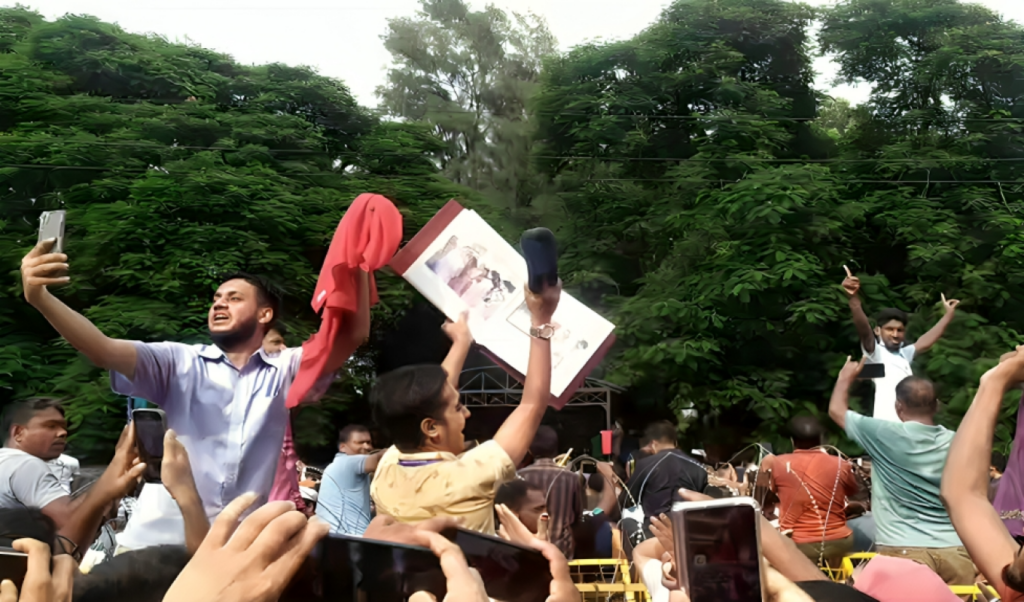
“Our children took to the streets dreaming of a just, democratic, and sovereign Bangladesh. But we are not getting that,” laments Sanjida Khan Deepti, a 36-year-old mother whose 17-year-old son, Anas, was killed by police gunfire on 5 August 2024. Deepti alleges that necessary reforms and justice have not been carried out, and she questions the worth of her son’s ultimate sacrifice:
“Then what is the meaning of my son’s sacrifice?”
Broken Dreams After the Fall of Power
Although a year has passed since the fall of the Awami League government, the unity and aspirations that defined the uprising have turned into disillusionment and confusion, according to Cynthia, a final-year Criminology student at the University of Dhaka and one of the victims of the July uprising. She suffered ten stitches to her head during the movement.
Referring to the increasing struggle for power among political parties, she comments:
“They are selling out the revolution.”
Transitional Government Under Pressure
While the transitional government claims to be working towards drafting a new constitution, it now finds itself under political pressure. Former allies in the fight against Sheikh Hasina are now embroiled in internal conflict, clashing over the route to future power.
Today, Tuesday, Professor Muhammad Yunus, the Chief Advisor, is scheduled to deliver the ‘July Declaration’, which is expected to outline a roadmap and necessary reforms. However, public expectations remain low.
Fractured Opposition and Divergent Agendas
The major political forces are now charting separate paths:
| Political Entity | Current Position |
| BNP | Demanding quick elections |
| National Citizens’ Party (NCP) | Seeking structural reforms before elections |
| Jamaat-e-Islami | Supporting reform-first approach |
To address this fragmentation, the Yunus-led administration formed a National Consensus Commission on 12 February 2025. Its goal is to collate reform proposals from various stakeholders and produce a draft political framework that the next government would be obliged to implement.
However, internal disputes persist within the commission, particularly over:
- Introducing a bicameral legislature
- Ensuring proportional representation
- Reducing the Prime Minister’s authority in appointing heads of constitutional bodies
Analysts Warn of Instability
Political analyst Rezaul Karim Rony warns that instability may escalate if the political forces fail to reach consensus.
On the other hand, Mobashar Hasan, a researcher at Western Sydney University, Australia, believes a political deadlock is unlikely:
“There will be some democratic progress, but no fundamental change.”
He also notes that while the Awami League, which once enjoyed mass support, is now banned, this ban could weaken the credibility of electoral democracy.
Rise in State Violence and Human Rights Abuses
With expanded authority to arrest, detain, or use lethal force, military patrols now dominate the streets.
According to human rights group Odhikar, between April and June this year:
| Incident Type | Count |
| Deaths in Political Violence | 72 |
| Injuries in Political Violence | 1,677 |
| Extrajudicial Killings (alleged) | 8 |
Crime rates, including abductions, rape, and robberies, have also risen.
The Bangladesh Police report that from January to May 2025, the murder rate surged by 25%, reaching 1,587 cases.
Police Paralysed by Political Void
Md. Ejazul Islam, Executive Director of the Human Rights Support Society, states that politically motivated killings have sharply increased.
He notes that the police are demoralised, contributing to their failure in restoring law and order.
“During the Awami League era, operations were often coordinated with local political leaders. That structure has collapsed. Now, everyone is scrambling for power.”
Source: Al Jazeera