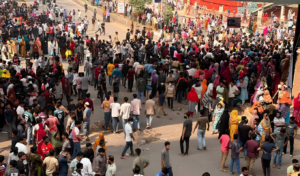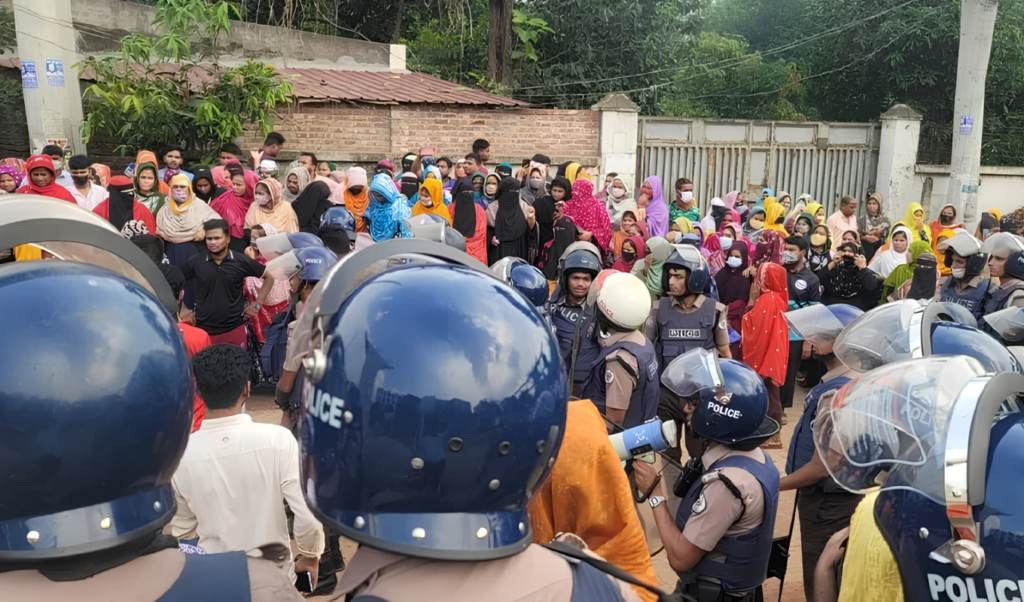
Widespread labour unrest has swept through Bangladesh’s garment manufacturing hubs as workers take to the streets demanding a minimum monthly wage of BDT 30,000. The escalating demonstrations have forced factory management to declare temporary holidays and suspend operations across key industrial belts, leaving over 700,000 workers off the production floor. Demonstrators blocked major highways in several districts, severely disrupting vehicular movement and prompting heightened security measures to protect key economic infrastructure.
According to figures released by the Bangladesh Garment Manufacturers and Exporters Association (BGMEA), 318 out of 2,134 garment factories operating across five primary industrial zones have ceased operations due to the ongoing turmoil. Consequently, 702,255 workers have walked out or been sent home. The remaining 1,816 units continue to operate under close observation.
In the Dhaka Metropolitan Police (DMP) zone, 68 of the 320 factories located in the Mirpur belt have shut down, affecting 51,625 workers. The Gazipur and Mymensingh regions experienced the most severe disruption, where 225 of the 836 factories suspended operations, sending 525,360 workers away from their workstations. In the Savar, Ashulia, and Jirani industrial hubs, 25 out of 441 factories suspended work, leaving 125,270 workers disengaged.
The unrest stems primarily from soaring inflation and the rising cost of living, which workers contend has rendered their current pay scales insufficient to cover basic household necessities. In Ashulia, protesting workers emphasised that spiralling commodity prices have created immense financial strain. In addition to wage demands, some male workers raised concerns regarding recruitment practices, claiming they face systemic discrimination due to a perceived preference for hiring female labourers in ready-made garment units.
To prevent violence and safeguard industrial property, law enforcement agencies have deployed significant reinforcements. Officers from the Industrial Police, including Additional Superintendent Mahbubul Haq Sojib and Ashulia Zone Superintendent Mominul Islam, confirmed that factory owners opted for voluntary closures as a precautionary measure. Police units remain stationed across volatile hotspots to restore order and manage traffic flow.
In response to the deteriorating situation, the government has deployed troops from the Border Guard Bangladesh (BGB) across critical points in Gazipur. BGB personnel are patrolling key industrial stretches including Chandra, Palli Bidyut, Safipur, Konabari, Mouchak, Naojor, and the Bhogra Bypass. Operating under the supervision of five executive magistrates appointed by the Gazipur District Administration, the paramilitary deployment will remain active until 7 November to maintain law and order across these vital commercial corridors.