Clashes broke out on Wednesday morning in the Fatullah area of Narayanganj district as ready-made garment (RMG) workers took to the streets for a third consecutive day, demanding a minimum monthly wage of 30,000 taka.
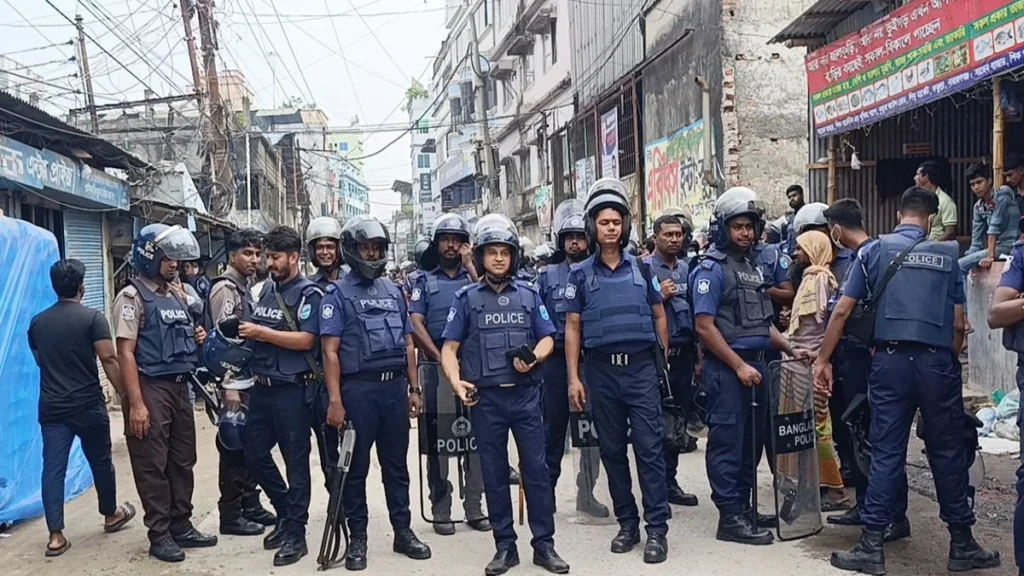
The confrontation began around 10:00 am in the Katherpool neighborhood when employees from several local apparel factories assembled with the intention of marching towards the main Dhaka-Narayanganj Link Road. Law enforcement personnel deployed at the scene intervened to block their progress, triggering a series of altercations that lasted for nearly two hours.
As tensions escalated, a section of the demonstrating workers threw brickbats at the police force. Officers responded by firing tear gas canisters, rubber bullets, and sound grenades to disperse the crowd. Intermittent skirmishes continued until roughly 11:45 am, transforming the industrial strip into a brief battleground.
Local shopkeepers reported that the initial friction arose when local political figures associated with the Bangladesh Nationalist Party (BNP) engaged in a heated argument with the gathering workers prior to the arrival of law enforcement. Workers from Metro Knitting, one of the affected factories, alleged that political activists physically assaulted peaceful demonstrators, escalating the situation.
Disagreements remain regarding the catalyst for the violent turn of events. Demonstrators accused the police of unprovoked aggression, claiming that tear gas was deployed to suppress a legitimate economic protest. Conversely, police officials maintained that officers acted strictly to restore order after repeated attempts at mediation failed over the preceding 48 hours.
Tarek Al Mehedi, Additional Superintendent of Police for Narayanganj District, stated that joint forces comprising police, Border Guard Bangladesh (BGB), and Special Ansar Battalion (SRB) personnel had been stationed in Fatullah from early morning to prevent disruption. According to the senior officer, authorities urged the demonstrators to disperse and await the formal recommendations of the newly formed Minimum Wage Board for the sector.
“When workers attempted to force their way onto the Dhaka-Narayanganj Link Road, officers were compelled to use tear gas and sound grenades to prevent a complete blockade of vital transport corridors,” Al Mehedi explained. He confirmed that police had detained four individuals in connection with the unrest, whilst traffic flow along the primary link road was eventually restored to normal. No factories had officially declared a shutdown at the time of reporting.
The unrest highlights ongoing pay disputes within Bangladesh’s multi-billion-pound ready-made garment sector—the nation’s primary export earner. Inflationary pressures and rising living costs have driven workforce demands across key manufacturing hubs, including Narayanganj, Gazipur, and Ashulia, where persistent road blockades earlier in the week had already caused severe commercial disruption.