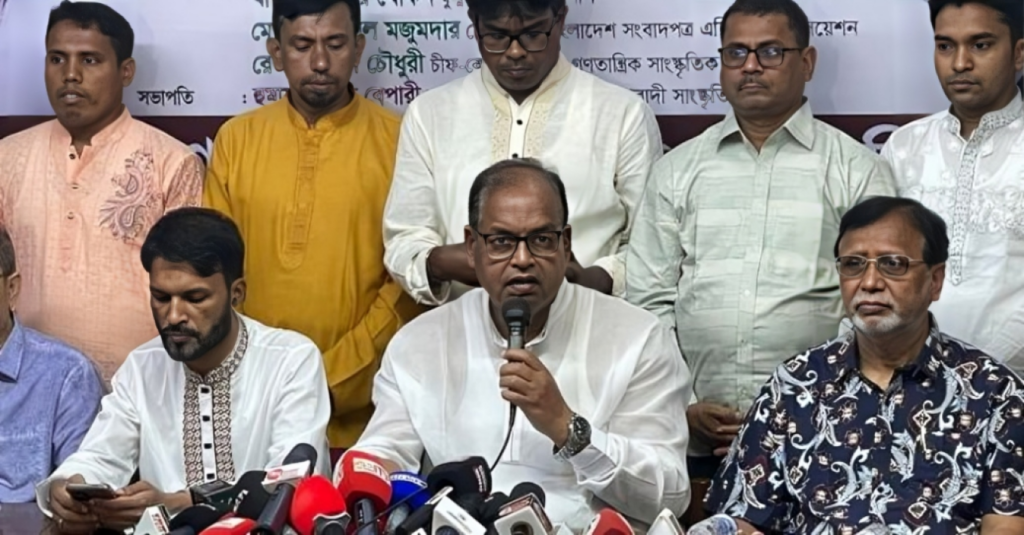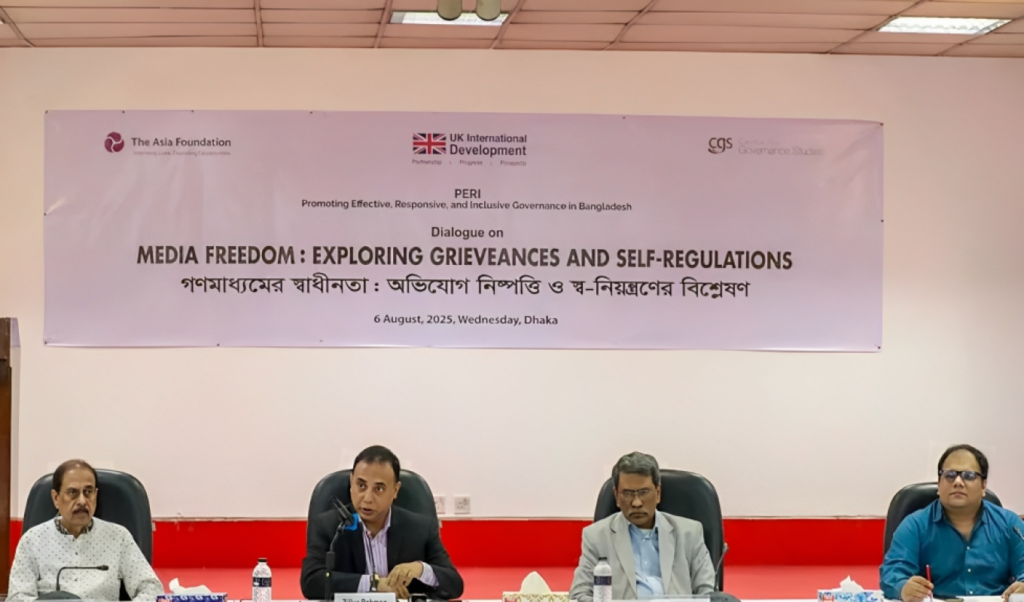
At a dialogue titled “Media Freedom: Analysis of Complaint Resolution and Self-Regulation”, held at the SIRDAP auditorium in Dhaka, prominent journalists, academics, and researchers voiced deep concern over the growing pressure and threats facing Bangladesh’s media.
The event, organised by the Centre for Governance Studies (CGS) on Wednesday morning (6 August), shed light on the shifting media landscape following the July uprising, where speakers observed that the press is now subject to novel forms of pressure and control.
Highlights from the Dialogue:
| Speaker | Designation | Statements |
| Matiur Rahman Chowdhury | Editor, Daily Manabzamin | “I am frightened and concerned. Journalists are constantly on the run. Many have been attacked, some have left the country, others lost their jobs. Now, journalism is said to be free — but only when in favour; if critical, it invites mob violence.” |
| “In commissions, though there is room for dissent through a ‘note of dissent’, this is not being properly reflected. That’s disheartening.” | ||
| Professor Ali Riaz | Vice-President, National Consensus Commission | “Mob journalism has become a major threat. Beyond the government, owners, and editors, a new force has emerged attempting to control the media.” |
| Professor S.M. Shamim Reza | Dept. of Mass Communication & Journalism, University of Dhaka | “Ongoing constitutional discussions lack focus on press freedom. Under the guise of self-regulation, journalists might be deprived of legal safeguards — this raises valid concerns.” |
| “There’s no commitment to resolving the pressure and injustices faced by journalists. The system must not remain that way.” | ||
| Asif Bin Ali | PhD Researcher, Georgia State University | “What we have now is ‘ad hoc freedom’. If someone is close to the government, they enjoy liberty. Even if someone made a mistake in the past, they are denied the chance to practice journalism now.” |
| “A recent example is Janakantha, which has reportedly been taken over. The forces behind this were active under the previous regime under different names and are now re-emerging.” | ||
| “In Bangladesh, media ownership is intertwined with business interests. Institutions like the Bashundhara Group use the media industry to legitimise their land-grabbing ventures. Without the rule of law, media freedom is impossible.” |
The dialogue underscored that the idea of “press freedom” in Bangladesh is increasingly conditional — one that grants liberties only to those in alignment with power structures while punishing dissent through institutional and mob-driven means.
Participants stressed the need for a media ecosystem based on genuine autonomy, legal protection, and a commitment to justice and fairness — rather than selective freedom dictated by political proximity or influence.