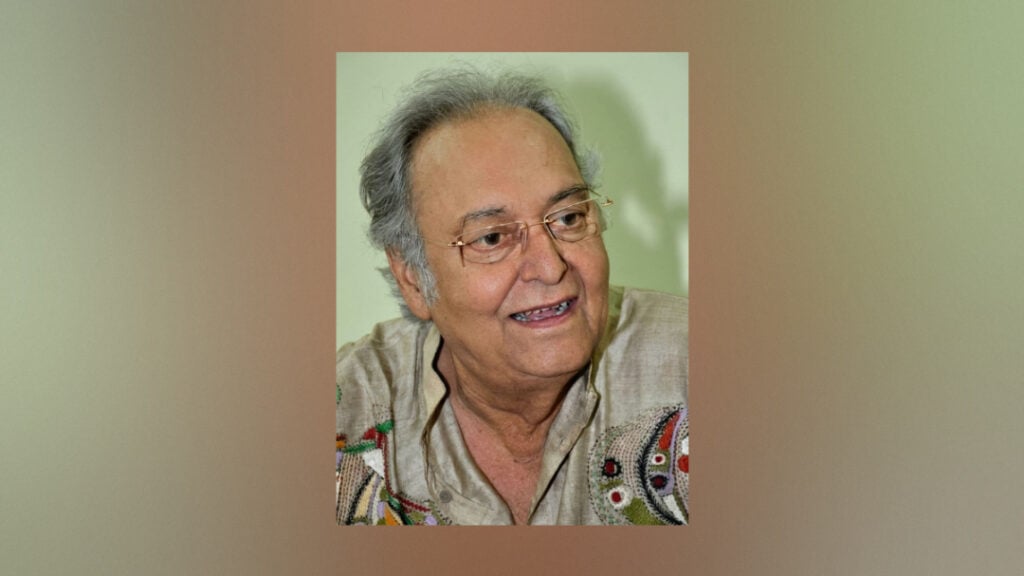
An era may have come to an end, but the story of an extraordinary artist lives on. The legacy of Soumitra Chatterjee, one of the most celebrated actors in Indian cinema, remains deeply embedded in the hearts of Bengalis across generations. His contribution to the world of art and culture extended far beyond the silver screen. He was an actor, poet, recitation artist, playwright, theatre director and literary editor whose creative journey reflected the intellect, emotions, values and cultural identity of Bengal.
Born on 19 January 1935 in Krishnanagar, Nadia district, West Bengal, Soumitra Chatterjee developed a deep interest in literature and the performing arts from an early age. He studied Bengali literature at City College in Kolkata, which was affiliated with the University of Calcutta. Literature remained an integral part of his life, even as acting became his principal profession. He wrote poetry, practised recitation, worked in theatre and spent many years editing the literary magazine Ekkhon. His interests and achievements across different artistic disciplines reflected his remarkable intellectual curiosity and commitment to Bengali culture.
Chatterjee made his film debut in 1959 with Apur Sansar, directed by legendary filmmaker Satyajit Ray. His portrayal of Apu introduced audiences to an actor whose natural performance and emotional depth would eventually make him one of the defining figures of Bengali cinema. The character became inseparable from his identity, earning him a special place in the hearts of film lovers.
His professional association with Satyajit Ray developed into one of the most memorable creative partnerships in Indian cinematic history. Chatterjee appeared in 14 of Ray’s 34 feature films, bringing a distinctive combination of intelligence, sensitivity and understated expression to each role. Their collaboration produced several acclaimed works that continue to be celebrated by audiences and critics around the world.
Among the notable films he made with Ray were Devi, Teen Kanya, Abhijan, Charulata, Kapurush, Aranyer Din Ratri, Ashani Sanket, Sonar Kella, Joi Baba Felunath, Hirak Rajar Deshe, Ghare Baire, Ganashatru and Shakha Proshakha. Each performance demonstrated his ability to understand the psychological complexity of a character and communicate it with remarkable restraint.
His portrayal of the fictional detective Feluda in Sonar Kella and Joi Baba Felunath remains particularly memorable. Created by Satyajit Ray, Feluda is one of the most popular detective characters in Bengali literature. Chatterjee brought the character to life with a combination of sharp intelligence, confidence, curiosity and effortless charm. His interpretation established an enduring screen image of Feluda that continues to influence how generations of Bengali audiences imagine the iconic detective.
However, Chatterjee’s artistic identity was never confined to his association with a single filmmaker. He worked with many distinguished directors, including Mrinal Sen, Tapan Sinha, Ajoy Kar and Tarun Majumdar. His filmography featured an extraordinary range of characters and genres, demonstrating his ability to adapt to different directorial styles and storytelling approaches.
His notable films included Apur Sansar, Atal Jaler Ahwan, Khudito Pashan, Devi, Swaralipi, Samapti, Teen Kanya, Agun, Benarasi, Abhijan, Saat Pake Bandha, Shesh Prahar, Charulata, Baksa Badal, Kapurush, Kanch Kata Hire, Ashani Sanket, Pronoy Pasha, Sonar Kella, Hirak Rajar Deshe, Joi Baba Felunath, Belashuru and Praktan.
Over a career spanning nearly six decades, he acted in more than 200 films. His performances covered an impressive spectrum of human experiences. He played romantic protagonists, sensitive lovers, ordinary middle-class men, intellectually curious investigators, socially conscious individuals and people struggling with the complexities of everyday life. Regardless of the character, he brought a sense of authenticity that made his performances convincing.
One of his greatest strengths was his natural acting style. He did not depend on exaggerated gestures or dramatic expressions to communicate emotion. Instead, he relied on the subtlety of dialogue delivery, facial expressions, body language and the power of silence. Even a brief exchange or a fleeting expression could reveal the inner world of a character. This ability to convey complex emotions without unnecessary theatricality distinguished him from many of his contemporaries.
His contribution to the performing arts was not limited to cinema. Theatre remained an important part of his creative life, and he was actively involved in acting, playwriting and direction. He also appeared in television serials and worked in the traditional Bengali theatre form known as jatra. His commitment to the stage continued throughout his life. His performance in William Shakespeare’s King Lear received considerable appreciation from audiences and critics, further demonstrating his versatility as an actor.
Chatterjee’s artistic achievements earned him numerous prestigious awards and honours in India and abroad. In 2004, the Government of India conferred the Padma Bhushan on him in recognition of his contribution to the arts. In 2006, he received the National Film Award for Best Actor for his performance in Podokkhep. In 2012, he was honoured with the Dadasaheb Phalke Award, India’s highest recognition in the field of cinema.
His international recognition continued in 2017, when France awarded him the Legion of Honour, one of its most distinguished civilian honours. In the same year, he received the Banga Bibhushan from the Government of West Bengal. These awards reflected the lasting influence of his work and the respect he commanded beyond the boundaries of Bengali cinema.
Yet, for Chatterjee, artistic recognition was never merely a matter of awards and accolades. His dedication to his craft, commitment to cultural values and relationship with audiences remained central to his life. He was known for his independent views, straightforward manner and willingness to express his opinions on social, political and cultural issues. He did not hesitate to speak about matters he considered important, maintaining his own convictions throughout his life.
Remembering Soumitra Chatterjee means remembering much more than an accomplished actor. It means recalling a particular tradition of Bengali intellectual and cultural life, in which literature, cinema, theatre and social awareness existed in close association. Through his performances, he encouraged audiences to appreciate the complexities of human relationships, question social realities and look at ordinary life from different perspectives.
His Apu represented the hopes, uncertainties and emotional struggles of ordinary people. As Amal in Charulata, he captured the delicate nuances of affection, attraction and emotional restraint. As Feluda, he embodied the intelligence, courage and inquisitive spirit of the Bengali imagination. In later films such as Belashuru and Praktan, he explored the complexities of relationships, ageing, separation and the passage of time with remarkable maturity.
These performances ensured that his artistic appeal extended beyond the generation that first watched him on screen. Younger audiences, too, discovered his work and recognised the timeless quality of his acting. His characters continued to speak to people because they were rooted in recognisable human emotions rather than the changing fashions of cinema.
On 15 November 2020, Soumitra Chatterjee died in Kolkata at the age of 85. His death marked the end of an extraordinary personal journey and left a profound void in the cultural life of Bengal. The news brought grief to admirers, fellow artists and generations of film lovers who had grown up watching his performances.
Five years after his death, his influence remains undiminished. His dialogue continues to resonate, his characters retain their emotional power, and his films remain an essential part of Bengali cinema’s cultural heritage. Whenever Apu appears on screen, audiences are reminded of the remarkable artist who gave the character an enduring human identity. Whenever Feluda returns to solve a mystery, Chatterjee’s unmistakable presence comes alive in the imagination of viewers.
For countless admirers, his performances also bring back memories of other beloved characters and stories from Bengali cinema. The emotional worlds he created through films such as Charulata, Sonar Kella, Joi Baba Felunath, Belashuru and Praktan continue to connect audiences with different stages of life, love and human experience.
An artist’s physical presence may disappear, but genuine artistic achievements are not confined by time. They survive through creative works, collective memories and the affection of successive generations. Soumitra Chatterjee belongs to that rare group of artists whose contributions continue to shape the cultural identity of their community long after their death.
His legacy is not simply a collection of films, awards or memorable characters. It is also a reflection of a rich cultural tradition that values intellectual depth, artistic integrity and sensitivity towards human life.
Soumitra Chatterjee may have left the world on 15 November 2020, but the world he created through his art remains alive. He will always be remembered as the actor who gave Bengali cinema an unforgettable Apu, brought Feluda to life on screen and left an extraordinary mark on the history of Indian cinema.
He is gone, but his art remains. In the hearts of Bengalis, Soumitra Chatterjee will forever be their eternal Apu.
A humble tribute to the legendary artist and his enduring legacy.