Labour unrest over demands for a minimum monthly wage of Tk 30,000 and other workplace-related issues has forced another 29 garment factories in Gazipur to suspend operations, adding to growing uncertainty across Bangladesh’s key industrial areas.
Of the 29 factories, 13 issued closure notices on Saturday night, while the remaining 16 announced their closure on Sunday morning. The latest shutdowns have further disrupted production in Gazipur, where workers have been staging demonstrations over wages and other demands in recent days.
Gazipur Industrial Police Superintendent Amjad Hossain said workers attempted to stage protests in several areas on Sunday (15 November), but members of the law enforcement agencies dispersed them.
He said workers at 13 factories had been informed on Saturday night that their workplaces would remain closed from Sunday. Another 16 factories subsequently announced closures on Sunday morning.
Many workers arrived at their workplaces as usual, only to find closure notices displayed at factory entrances. Unable to enter, they had to return home. Some waited for extended periods, hoping that operations might resume, but received no confirmation about when the factories would reopen.
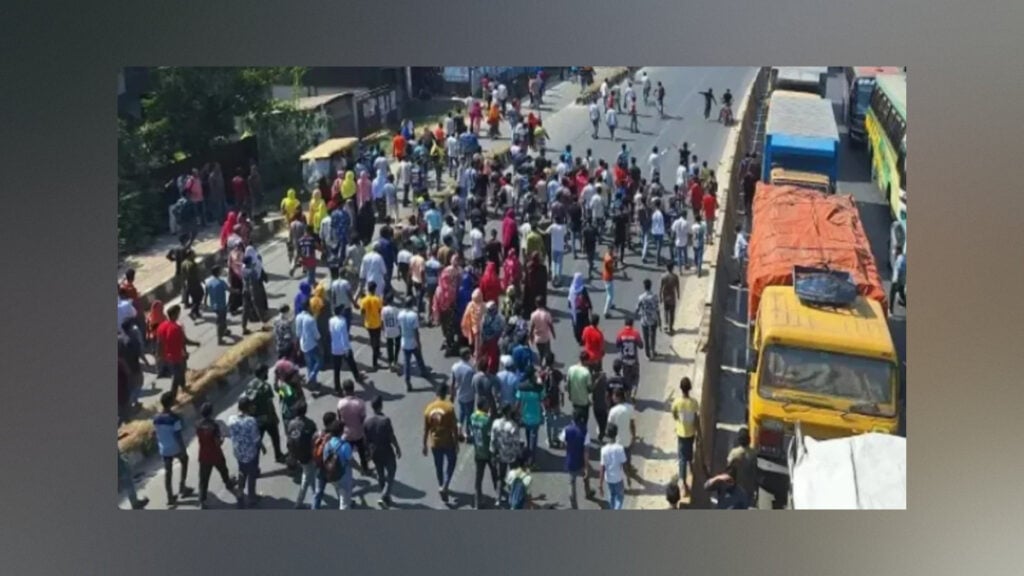
The latest developments come amid several days of protests across Gazipur and other industrial areas over demands for a minimum monthly wage of Tk 30,000. Demonstrations, road blockades and incidents of vandalism have been reported in different locations, raising concerns about workers’ safety, industrial security and the continuity of garment production.
Police, industrial police, the Special Reserve Battalion (SRB), Ansar and Border Guard Bangladesh (BGB) personnel have been deployed in affected areas to maintain order and prevent further escalation.
Against this backdrop, two major garment industry associations, the Bangladesh Garment Manufacturers and Exporters Association (BGMEA) and the Bangladesh Knitwear Manufacturers and Exporters Association (BKMEA), held a press conference in Dhaka on Saturday. They said factory owners would be compelled to suspend operations if labour unrest occurred and workers failed to report for duty.
BGMEA President Mahmud Hasan Babu said factories in the affected areas could not continue operating without adequate industrial security and a conducive production environment.
He said a decision had been taken to close factories whose production activities had been disrupted by the ongoing unrest indefinitely from 15 November, in accordance with Section 13(1) of the Bangladesh Labour Act.
Section 13(1) of the Act allows an employer to close an affected branch or department, or the entire establishment, either partially or completely, if an illegal strike takes place in any branch or department. Workers participating in such a strike are not entitled to wages for the period of closure under the provision.
The current wave of unrest began towards the end of last month, when garment workers took to the streets demanding a minimum monthly wage of Tk 30,000. The protests gradually spread across several industrial hubs, including Mirpur in Dhaka, Gazipur, Savar, Ashulia and Narayanganj.
What initially began as demonstrations over wages eventually turned violent in some areas, with clashes and vandalism reported. One worker was killed during the unrest, adding to tensions between workers, factory owners and the authorities.
On Saturday, garment workers blocked the Dhaka-Tangail highway in Kaliakair upazila of Gazipur, demanding action on their grievances. The blockade disrupted traffic and added to concerns over the deteriorating situation in the industrial belt.
The situation has also affected factories in neighbouring Ashulia. On the same day, factory owners announced the closure of 40 garment factories in the area, while another seven were given a one-day holiday. The latest shutdowns in Gazipur have added to the number of factories affected by the continuing labour unrest.
Meanwhile, the government has initiated a formal process to review garment workers’ minimum wages. A minimum wage board was formed on 1 November to consider the issue and facilitate discussions between workers’ representatives and employers.
At the board’s second meeting, held last Monday, the workers’ representative proposed setting the minimum monthly wage at Tk 32,000, which is higher than the Tk 30,000 demanded during the protests.
The board’s third meeting is scheduled for Monday, where discussions on the proposed wage structure are expected to continue.
With factory closures spreading across major garment-producing areas, the situation has become increasingly challenging for both workers and manufacturers. Workers are pressing for wages that they believe would better reflect their living costs, while factory owners are concerned about production disruptions and industrial security. The outcome of the minimum wage board’s discussions may prove crucial in determining whether tensions ease or further disruptions affect the country’s garment industry.