Test cricket has long been defined by patience, technical discipline, and the gruelling art of surviving at the crease. For generations, batters in the five-day format prioritised occupation of the crease over boundary-hitting, and clearing the ropes was often frowned upon by traditionalist pundits as an unnecessary risk. Yet the modern game has steadily dismantled that orthodoxy. Over the past two decades, a fearless breed of stroke-makers has proved that calculated aggression can thrive—and even dictate terms—in red-ball cricket.
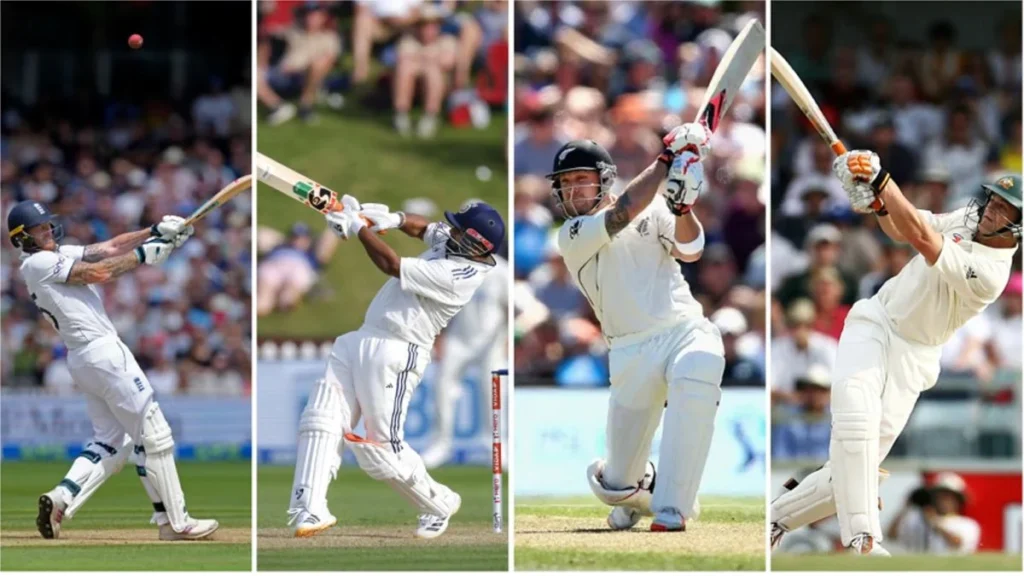
Across nearly 150 years of Test history, only four batters have managed to reach the milestone of 100 or more sixes. At the summit of this exclusive list sits England captain Ben Stokes, who has set the benchmark with 138 maximums. Immediately behind him now stands India’s dynamic wicketkeeper-batter, Rishabh Pant.
On Sunday in Wellington, Pant produced a scintillating innings of 128 against New Zealand during the first Test, peppering the boundary with six towering sixes. That blistering knock propelled the left-hander past former New Zealand skipper Brendon McCullum into second place on the all-time Test six-hitting chart. McCullum, who finished his career with 107 sixes across 101 matches, had held the second spot since his retirement before Stokes overtook him.
With only Stokes ahead of him, Pant is firmly on course to rewrite the record books. Remarkably, the Indian star has reached 108 sixes in just 53 Test matches—less than half the appearances Stokes required to amass his tally. Pant’s strike frequency stands out starkly against his peers; he clears the boundary once every 47.93 deliveries, a rate among specialists matched in speed only by New Zealand’s lower-order hitter Tim Southee. Given that Pant still has a substantial portion of his international career ahead of him, Stokes’s long-standing crown appears far from secure.
The broader top-ten list reflects a fascinating mix of modern power-hitters, aggressive wicketkeepers, and enduring all-rounders. Australia’s Adam Gilchrist, who revolutionised the role of the wicketkeeper-batter at the turn of the century, rounds out the 100-six club with an exact century of maximums. Just shy of triple figures sit Southee and West Indies opener Chris Gayle on 98 apiece, followed closely by South African great Jacques Kallis, whose 97 sixes came over a monumental 166-Test career.
Here is the complete breakdown of the top ten batters with the most sixes in Test cricket:
| Player | Matches | Runs | Fours | Sixes | Balls per Six |
| Ben Stokes | 122 | 7,273 | 833 | 138 | 90.05 |
| Rishabh Pant | 53 | 3,853 | 406 | 108 | 47.93 |
| Brendon McCullum | 101 | 6,453 | 776 | 107 | 93.39 |
| Adam Gilchrist | 96 | 5,570 | 677 | 100 | 67.96 |
| Tim Southee | 107 | 2,245 | 215 | 98 | 27.70 |
| Chris Gayle | 103 | 7,214 | 1,046 | 98 | 122.14 |
| Jacques Kallis | 166 | 13,289 | 1,488 | 97 | 297.97 |
| Virender Sehwag | 104 | 8,586 | 1,233 | 91 | 114.74 |
| Angelo Mathews | 119 | 8,214 | 835 | 90 | 188.56 |
| Rohit Sharma | 67 | 4,301 | 473 | 88 | 85.66 |
India features prominently in the upper echelons of this table, boasting three representatives in Pant, Virender Sehwag, and Rohit Sharma. As red-ball scoring rates continue to climb worldwide, Pant’s pursuit of Stokes promises to remain one of the most compelling statistical storylines in Test cricket.