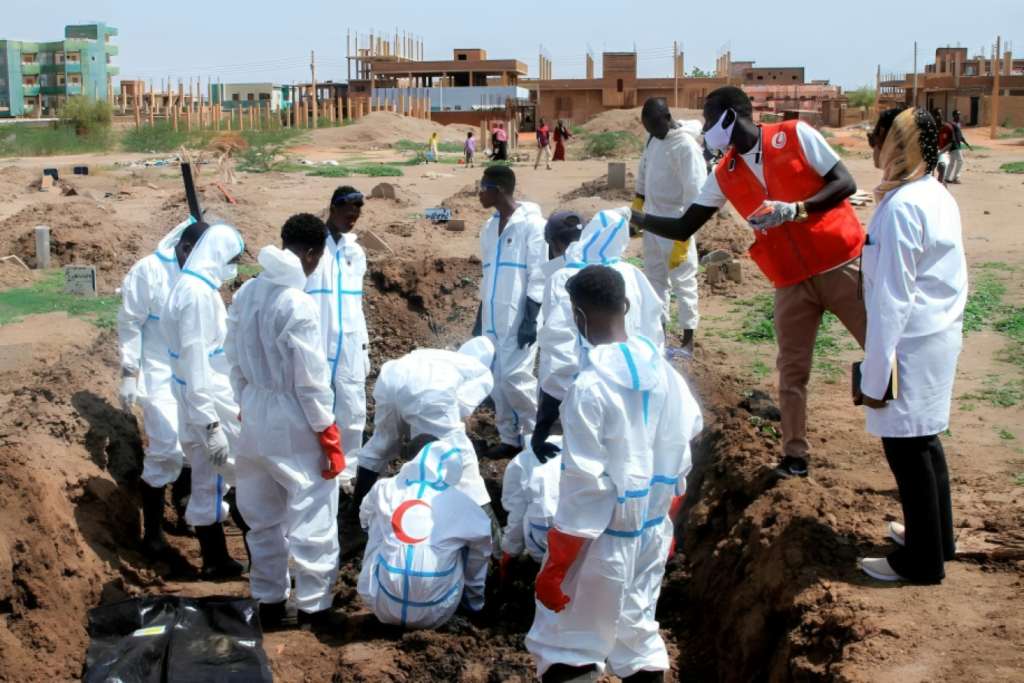
In Sudan’s war-torn capital Khartoum, Red Crescent volunteers have begun the grim task of exhuming the dead from makeshift burial plots created during the conflict, enabling families to provide proper funerals.
Teams of workers, clad in dust-streaked white hazmat suits, comb vacant lots, locating the sites where survivors say they buried their loved ones.
Mechanical diggers peel back layers of earth under the supervision of Hisham Zein al-Abdeen, head of the city’s forensic medicine department.
“We’re finding graves everywhere — in front of homes, inside schools and mosques,” he told AFP.
“Every day we discover new ones.”
Context of the Burials
In the southern Al-Azhari neighbourhood, families buried their loved ones wherever possible during fighting between the regular army and the paramilitary Rapid Support Forces (RSF).
| Event | Date | Description |
| Outbreak of war in Khartoum | April 2023 | RSF swiftly occupied entire districts; residents fled bombardments and street fighting |
| Recapture by army and allies | March 2024 | Khartoum retaken in a fierce offensive |
| Exhumation and proper burial efforts | August 2025 | Families can now bury loved ones with dignity after frontlines moved |
Personal Stories
“My daughter was only 12,” said Jawaher Adam, standing beside a shallow makeshift grave, tears streaming.
“I had only sent her out to buy shoes when she died. We couldn’t take her to the cemetery. We buried her in the neighbourhood.”
Months later, Adam witnessed her daughter’s reburial, this time conducted with dignity. Each body is disinfected, wrapped, and labelled by Red Crescent volunteers before being transported to Al-Andalus cemetery, 10 kilometres away.
“It’s painful,” said Adam, “but to honour the dead is to give them a proper burial.”
The Scale of the Tragedy
Many of the war’s deadliest battlegrounds were densely populated residential areas, often without access to hospitals, making it almost impossible to establish an accurate death toll.
- Estimates:
- Former US envoy Tom Perriello suggested up to 150,000 people killed in the first year of conflict.
- In Khartoum alone, over 61,000 people died in the first 14 months — a 50% increase on the pre-war death rate, according to the London School of Hygiene and Tropical Medicine.
- Of these, 26,000 deaths were directly attributed to violence.
Makeshift Graves and Reburial Efforts
At first glance, the vacant lot in Al-Azhari appears littered with debris — wood, bricks, an old signpost. Closer inspection reveals straight lines marking makeshift graves.
| Data | Figure |
| Graves exhumed in one Al-Azhari lot | 317 |
| Bodies reburied across Khartoum so far | 2,000 |
| Estimated total in makeshift graves citywide | 10,000 |
| Missing persons reported in Sudan last year | 8,000 (ICRC calls this “tip of the iceberg”) |
Grieving mothers observe silently, hands clasped tightly. They are among the few who know where their loved ones are buried; many families have no such knowledge. Authorities label unclaimed bodies and record their details for future reference.
Reclaiming the Land
“Originally, this site was designated as a school,” said Youssef Mohamed al-Amin, executive director of Jebel Awliya district.
“We’re moving the bodies so it can serve its original purpose.”
The exhumations allow the community some degree of closure and free the vacant lots for their intended uses.
Post-War Return and Challenges
The United Nations estimates that up to two million people may return to Khartoum state by the end of the year, depending on whether security and basic services are restored.
- Pre-war population: 9 million (Greater Khartoum, UNDP)
- Displaced by conflict: 3.5 million
Much of the capital still lacks power, running water, and functioning hospitals or schools, leaving returning residents to confront significant post-war challenges.