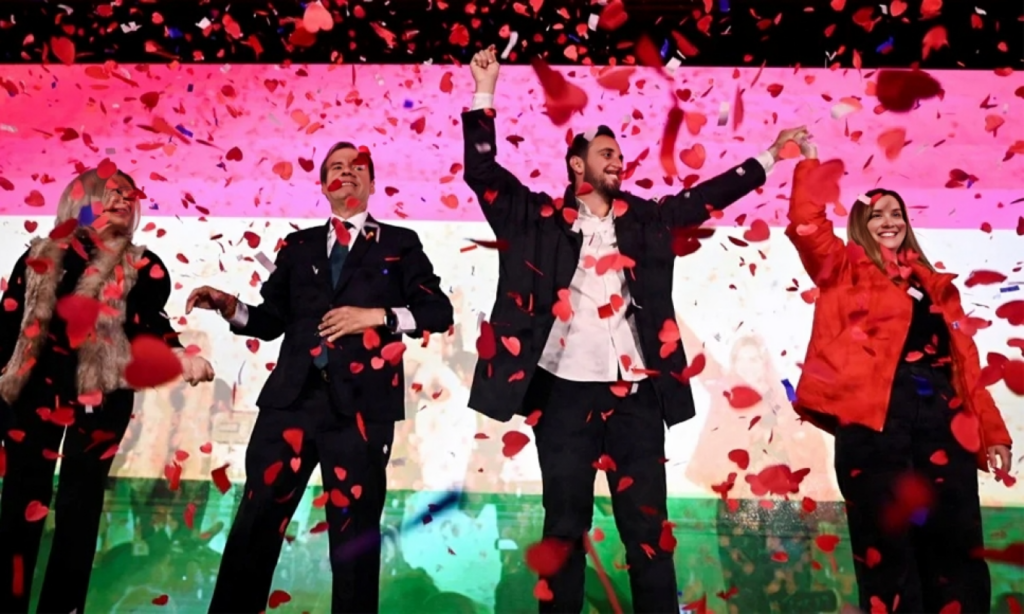
Early projections indicate that two right-wing candidates are poised to advance to a presidential run-off in Bolivia, signalling the possible end of two decades of leftist rule.
According to projections based on partial results by Ipsos and Captura pollsters, center-right Senator Rodrigo Paz emerged as the surprise frontrunner with over 31 percent of the vote. He was followed by former right-wing president Jorge “Tuto” Quiroga, who secured around 27 percent.
Millionaire businessman Samuel Doria Medina, previously tipped as a frontrunner, came in third with 19.5–20.2 percent, well ahead of the main leftist contender, Senate President Andronico Rodriguez.
| Candidate | Political Alignment | Projected Vote Share |
| Rodrigo Paz | Center-right | 31%+ |
| Jorge “Tuto” Quiroga | Right-wing | 27% |
| Samuel Doria Medina | Right-wing | 19.5–20.2% |
| Andronico Rodriguez | Leftist | Below 19% |
The election was dominated by Bolivia’s worst economic crisis in a generation, prompting voters to abandon the ruling socialists in large numbers. Annual inflation hit nearly 25 percent in July, while the country faces critical shortages of fuel and US dollars, the currency in which most Bolivians store their savings.
This vote marks the possible end of 20 years of socialist governance, which began in 2005 when Evo Morales, an Indigenous coca farmer, was elected president on a radical anti-capitalist platform.
“The left has done us a lot of harm. I want change for the country,”
— Miriam Escobar, 60-year-old pensioner, La Paz
Both main right-wing candidates have pledged to revamp Bolivia’s state-led economic model and reshape international alliances.
“This is a day that will mark the history of Bolivia,”
— Jorge “Tuto” Quiroga, after voting in La Paz
Quiroga has promised to cut public spending, encourage foreign investment, and strengthen ties with the United States, which were downgraded during Morales’ administration, ending with Morales’ resignation in 2019 following mass protests over alleged election rigging.
Meanwhile, Rodrigo Paz campaigned on a populist platform, promising to fight corruption, reduce taxes, and deliver “capitalism for all”.
“Quiroga is a dinosaur. I support Paz, who offers real solutions,”
— Agustin Quispe, 51-year-old miner
Many voters have drawn comparisons to the shock therapy implemented by Argentine President Javier Milei, seeking stability and economic recovery.
“What people are looking for now, beyond a shift from left to right, is a return to stability,”
— Daniela Osorio Michel, Bolivian political scientist, German Institute for Global and Area Studies
Quiroga, pursuing his fourth presidential campaign, emphasised his experience in government and multilateral organisations as qualifications to steer Bolivia away from bankruptcy. He previously served as vice-president under ex-dictator Hugo Banzer and briefly as president in 2001 when Banzer stepped down to battle cancer.
Although Evo Morales was barred from a fourth term, his influence remains significant. Morales encouraged rural Indigenous supporters to spoil ballots in protest and threatened mass demonstrations if the right returns to power.
Under Morales, Bolivia experienced over a decade of strong growth and Indigenous upliftment, nationalising the gas sector and using revenues for social programmes that halved extreme poverty.
However, underinvestment in exploration has caused gas revenues to plummet, from $6.1 billion in 2013 to $1.6 billion last year. Meanwhile, lithium reserves remain untapped, and the government is running critically low on foreign exchange needed to import fuel, wheat, and other essential commodities.
| Economic Indicators | Data |
| Annual Inflation | ~25% (July) |
| Gas Revenue | $6.1B (2013) → $1.6B (2024) |
| Shortages | Fuel, US dollars, wheat |
| Lithium Reserves | Untapped |
The unfolding political shift in Bolivia signals major change both economically and politically, as voters weigh right-wing reform against two decades of socialist governance.