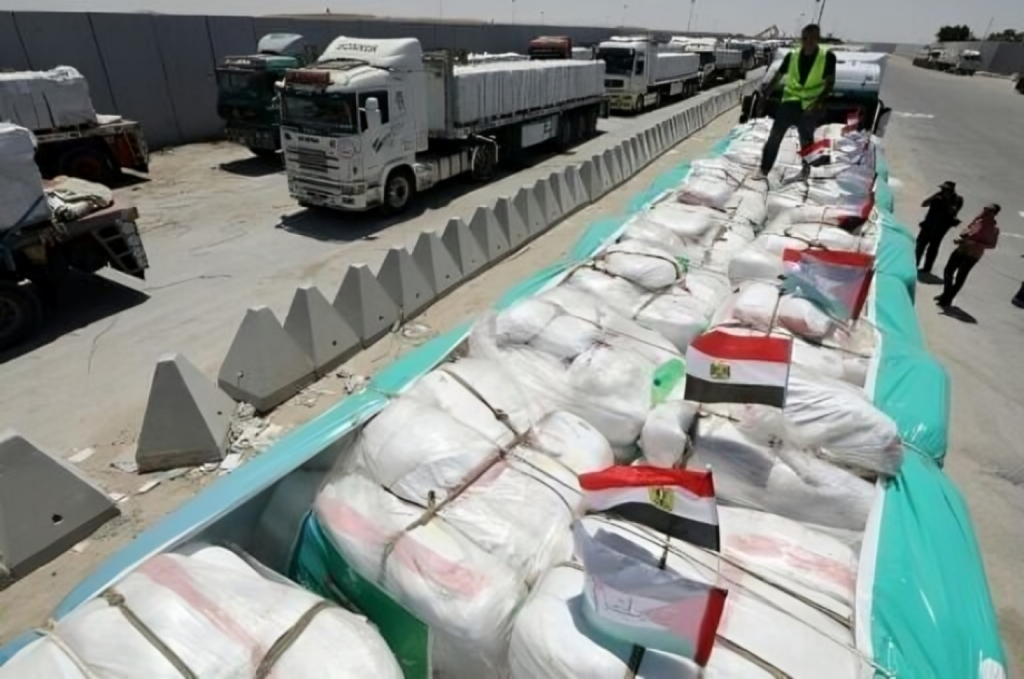
At the Rafah crossing into the Gaza Strip, hundreds of aid trucks have remained stationary in the Egyptian desert for days, with only a few permitted by Israel to enter and alleviate the worsening humanitarian crisis across the border.
After nearly two years of conflict, UN-backed experts have warned of a looming famine in the Palestinian territory, alongside severe shortages of clean water and essential medicines. However, aid organisations report that the delivery of life-saving supplies continues at an agonisingly slow pace.
Several UN officials, truck drivers, and an Egyptian Red Crescent volunteer told AFP that Israel has repeatedly denied entry to critical medical equipment, shelters, and parts for water infrastructure. The reasons given often include “dual-use” concerns — meaning items could potentially be used for military purposes — or minor packaging flaws.
“Some materials, just because they are metallic, are not allowed to enter,” said Amande Bazerolle, head of emergency response in Gaza at the French medical charity MSF.
Aid workers described instances where even basic supplies were delayed over minor details. A truck carrying intensive care gurneys sat baking in the sun on the Egyptian side because one pallet was made of plastic instead of wood, despite severe shortages in Gaza. Other shipments were rejected due to slightly misaligned pallets or improperly wrapped cling film.
Amal Emam, chief of the Egyptian Red Crescent, emphasised that even pre-approved shipments could still be turned back at the border.
“You can have a UN approval number on the side of a pallet, approved by all sides, including COGAT, and yet it gets to the border and is turned back, just like that.”
COGAT, the Israeli Ministry of Defence agency responsible for civil affairs in the Palestinian territories, oversees these approvals. Emam described compliance with the restrictions as prohibitively costly: “I have never in my life as a humanitarian seen these kinds of obstacles being put to every bit of aid, down to the last inch of gauze.”
Simple medicines such as ibuprofen can take up to a week to cross into Gaza. The World Health Organisation (WHO) often has to improvise, using regular trucks for temperature-sensitive medicines like insulin when refrigerated containers are denied entry.
In a tent warehouse, dozens of oxygen tanks, wheelchairs, portable toilets, and generators sit abandoned, months after being rejected.
“It’s like they’re rejecting anything that can give some semblance of humanity,” a UN staffer told AFP, requesting anonymity.
Olga Cherevko, spokesperson for the UN humanitarian agency OCHA, noted that the prohibited list of items is extensive. Truck drivers reported waiting for days as other vehicles carrying identical supplies were either waved through or rejected without explanation.
Egyptian driver Mahmoud El-Sheikh said he had been waiting for 13 days in extreme heat with a truck full of flour: “Yesterday, 300 trucks were sent back. Only 35 were allowed in. It’s all at their discretion.”
Another driver, Hussein Gomaa, said that up to 150 trucks lined up each night, yet in the morning, only a select number were inspected and permitted to cross.
According to a WHO official, at most 50 trucks enter Gaza daily, while Egyptian Foreign Minister Badr Abdelatty stated that 130–150 trucks cross each day, sometimes reaching 200 — roughly one-third of what is needed.
“This is engineered hunger,” Abdelatty said on Monday, adding that more than 5,000 trucks were waiting at the border.
Last week, COGAT denied blocking aid. In a statement on X, the agency said Israel facilitates humanitarian assistance while accusing Hamas of exploiting supplies to strengthen its military capabilities. It claimed that 380 trucks entered Gaza last Wednesday.
MSF warned that delays are costing lives. Vital medical tools such as scalpels and external fixators used to treat broken limbs cannot enter.
“People are at risk of losing limbs because we don’t have basic tools,” said Bazerolle.
She added that supplies are depleting faster than expected:”We order for three or five months and then in two months it’s gone.”
| Figures | Details |
| Trucks awaiting entry | Over 5,000 |
| Trucks crossing daily | 130–150 (Egyptian estimate), 50 (WHO estimate) |
| Items delayed | Medical equipment, shelters, water infrastructure parts, oxygen tanks, wheelchairs, portable toilets, generators |
| Organisations affected | MSF, WHO, Egyptian Red Crescent, UN OCHA |
| Consequence | Growing humanitarian crisis, risk of limb loss, potential famine |