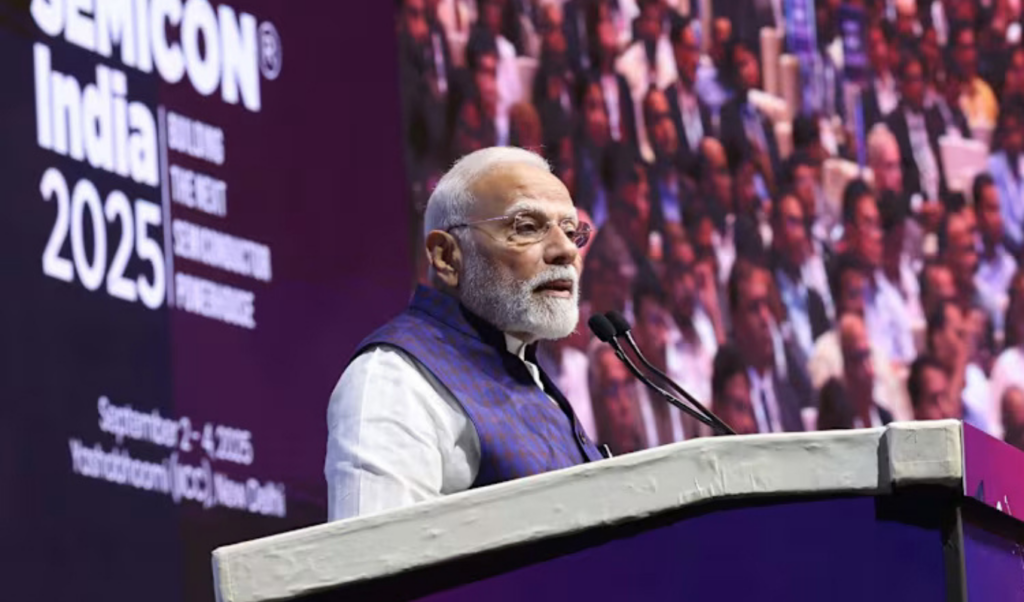
India is set to begin commercial semiconductor production by the end of 2025, Prime Minister Narendra Modi announced on Tuesday, positioning the nation as a future “global hub” for chip innovation.
Prime Minister Modi made the remarks while inaugurating the annual Semicon India conference in New Delhi. He confirmed that test chips from Micron and Tata are already being produced.
“Commercial chip production will begin this year,” Modi said.
“This reflects how rapidly India is advancing in the semiconductor sector.”
India’s semiconductor industry has seen remarkable expansion:
| Year | Market Size (USD) | Notes |
| 2023 | 38 billion | Baseline market valuation |
| 2024–2025 | 45–50 billion | Projected growth |
| 2030 | 100–110 billion | Government target |
Currently, 10 semiconductor projects are underway in India, totalling $18 billion in investments. This includes two new 3-nanometre design facilities in Noida and Bengaluru — among the most advanced globally.
“Our journey began late, but nothing can stop us now,” Modi remarked.
India highlights three key advantages in the semiconductor sector:
| Area | Details |
| Component Production | Manufacturing essential semiconductor equipment components |
| Critical Materials | Supply of chemicals, minerals, and other essential raw materials |
| Services | Research & development, AI, big data, cloud computing |
Additionally, the country claims a human capital edge, with 20 percent of the global talent in semiconductor design originating from India.
The announcement follows Japan’s pledge to invest 10 trillion yen ($68 billion) in India, focusing on semiconductors and AI, made during Modi’s recent visit to Tokyo.
India, the world’s fifth-largest and fastest-growing major economy, has been impacted by US tariffs of 50 percent under President Donald Trump, making the development of domestic chip production a strategic growth priority.
With global chip demand surging but supply chains concentrated in a few regions, India aims to create a complete semiconductor ecosystem spanning design, manufacturing, and packaging. The goal is to become self-reliant and globally competitive.
“Today’s India inspires confidence in the world,” Modi said in a government briefing note.
“When the chips are down, you can bet on India.”