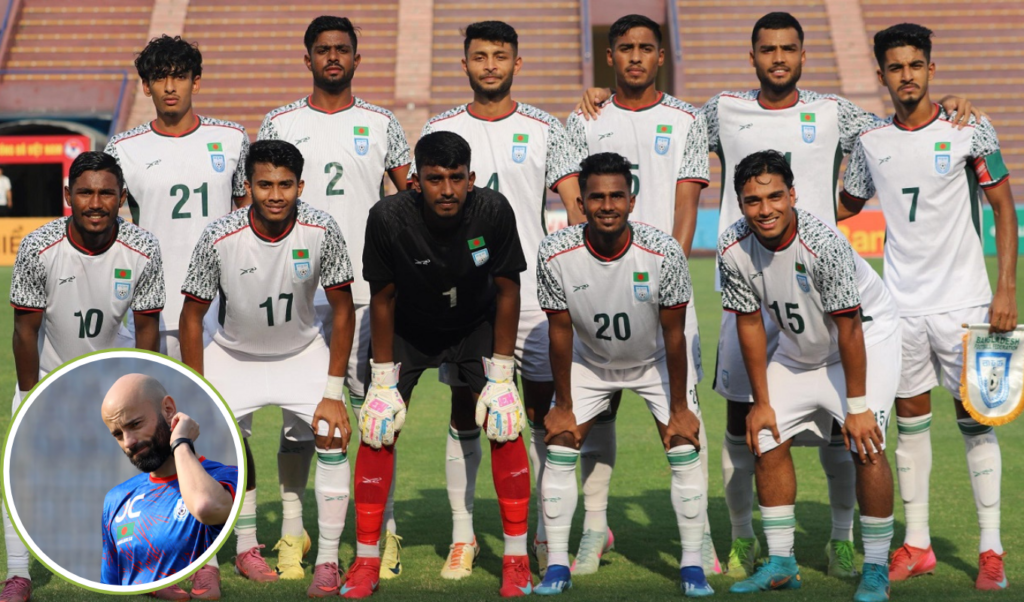
The Bangladesh U-23 football team has exited the AFC U-23 Championship qualifiers with a game still remaining. This early elimination has raised eyebrows as the Bangladesh Football Federation (BFF) had ensured unprecedented preparations for the tournament in Vietnam.
Players trained for two weeks in Bahrain, played two friendly matches, and altogether enjoyed a full month of training – something no U-23 squad had experienced before. Moreover, the quality of the current squad, led by captain Morsalin and forward Zayan, was believed to be stronger than in previous campaigns. Yet, despite such potential and preparation, the team suffered a humiliating failure, sparking widespread debate and criticism.
Preparations vs. Results
| Category | Details |
| Training Duration | 1 month (including 2 weeks in Bahrain) |
| Friendly Matches | 2 in Bahrain |
| Squad Strength | Rated higher than previous U-23 sides |
| Match Outcomes | Lost both fixtures, eliminated before last group game |
| Goals Scored | None (only Morsalin’s long-range attempt came close) |
Five BFF executive members attended both group matches in Vietnam. They were deeply dissatisfied with both the results and performances. Many will present their observations in the upcoming National Team Committee meeting.
- Golam Gaus (Former National Player, BFF Executive Member):
Criticised poor substitutions:“A coach can change a game through one smart substitution. Ours were wrong. Even captain Morsalin, a vital attacking force, was taken off at a crucial moment. Those decisions directly affected the results.” - Zahid Hasan Emily (Former National Captain):
Held both coaching staff and senior players responsible:“The federation did everything—camps, matches in Bahrain. Yet there was no coordination or tactical imprint. The coaching staff must take responsibility. Senior players, too, failed to deliver. Across two games, we hardly created chances apart from Morsalin’s long-range effort.”
Following two straight defeats, acting head coach Hasan Al Mamun remarked at the post-match press conference that the tournament should be seen as a “learning opportunity” for players. This angered federation officials, who argued that U-23 is essentially an extension of the senior national team and not a developmental stage like U-14 or U-19. They viewed Mamun’s words as an attempt to deflect blame.
- Official Head Coach: Saiful Bari Titu (for AFC Pro Licence requirement).
- De facto Head Coach: Javier Cabrera (Spanish head coach of the senior national team).
- On the Ground: Hasan Al Mamun (assistant coach, executing Cabrera’s directives).
During friendlies in Bahrain and matches in Vietnam, Mamun managed the dugout, but reports suggest Cabrera made key decisions on formations and substitutions remotely.
- Emily’s View: “Everyone knows Mamun was only following Cabrera’s orders. Cabrera’s competence and judgement had already been questioned. Expecting more from his assistant is unrealistic.”
He contrasted this with Mohammedan SC, where Alfaz, an assistant coach under Sean Lane, thrived because Lane himself was a capable coach. In contrast, Cabrera’s questionable leadership meant his assistant could hardly inspire confidence.
A team insider revealed that Cabrera issued instructions from Spain, Dhaka, and even Nepal, micromanaging the squad. This long-distance interference led to confusion and disrupted proper implementation, ultimately contributing to the team’s downfall.
Meanwhile, Mamun, a former national captain and once a star footballer, began his coaching career as assistant to Shafiqul Islam Manik at Sheikh Jamal Dhanmondi. Despite his loyalty to Cabrera, his lack of experience as a head coach made the U-23 assignment especially challenging. The results reflected this struggle, yet the federation failed to critically evaluate these factors beforehand.
Former national footballer and coach Zulfiker Mahmud Mintu pointed out that the issue is not merely with individuals but with the football system itself: “Our system is flawed. Without structural change, success in international football is impossible. We need educated coaches, not just certificate holders. Only then will we produce intelligent, self-reliant players. A shift in both club and federation culture is essential for sustainable results.”