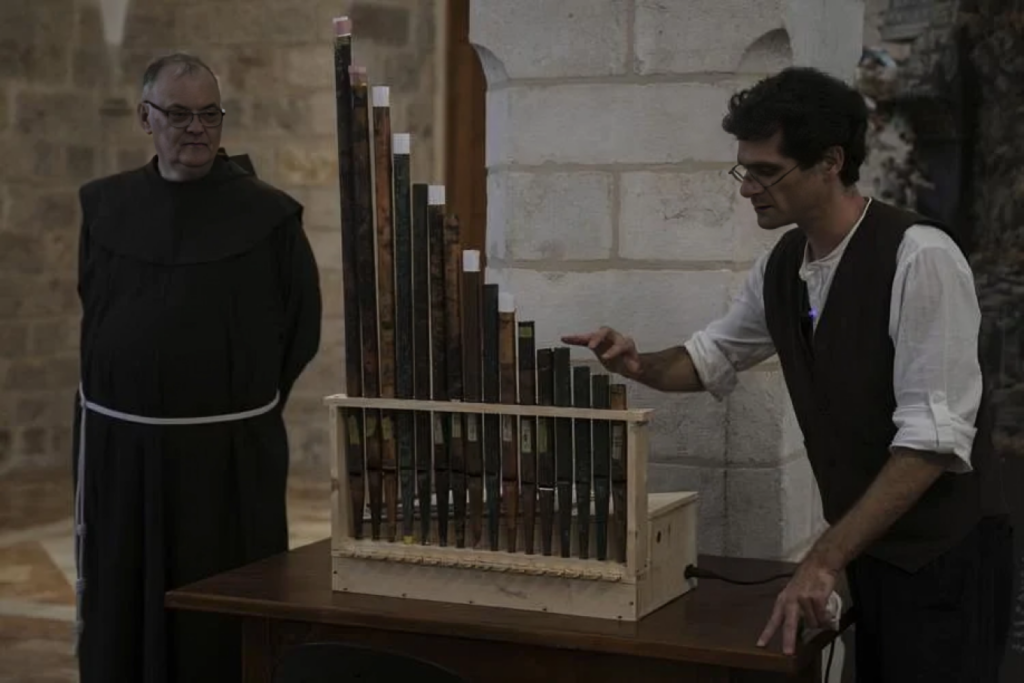
A medieval organ, buried for centuries near the Church of the Nativity in Bethlehem, has once again filled a Jerusalem monastery with its ancient melodies. This 11th-century instrument, discovered in the occupied West Bank, offers an unprecedented auditory window into the past.
“This is a window into the past… we have the opportunity for the first time in modern history to listen to a medieval sound which is a thousand years old,” explained David Catalunya, a Spanish researcher who has dedicated over five years to restoring the instrument.
“And it’s not a recreation or hypothetical reconstruction; it’s the original sound — the same vibration the Crusaders heard at the Nativity Church,” he told AFP.
The organ, dating nearly as far back as the invention of the instrument itself, was initially discovered in 1906 at the biblical birthplace of Jesus Christ.
Currently housed in the Monastery of Saint Saviour in Jerusalem’s Old City, the instrument will eventually be displayed in a museum run by the Franciscan Custody of the Holy Land.
Catalunya demonstrates the organ by pulling small tabs, producing a formidable ringing from the modest wooden structure he affectionately calls a “miracle”.
“This is like finding a living dinosaur — something we knew existed but only through fossils, with very limited evidence,” noted Alvaro Torrente, a musicologist involved in the restoration. “This is not a fossil; this is the real object and the real sound.”
The organ’s unearthing was, according to Father Eugenio Alliata, a Franciscan archaeologist, “almost by chance”. During the construction of a pilgrim hostel, 222 copper pipes and a bell carillon were uncovered near the Nativity Church.
Catalunya emphasised that the instrument had been buried with utmost care, allowing researchers to painstakingly reconstruct it.
Koos van de Linde, one of the world’s leading organ specialists and a consultant on the project, reflected: “The hope the Crusaders who buried these pieces had — that one day they would resound again — was not in vain. It was an immense honour to witness and participate in their resurrection.”
The organ is remarkable not only for its complexity — 18 pipes producing a single note — but also for its exceptional preservation and antiquity.
| Feature | Details |
| Age | 11th century |
| Origin | France |
| Transport | Brought to Bethlehem by Crusaders in the 12th century |
| Components | 222 copper pipes, bell carillon |
| Notes | 18 pipes produce a single note |
| Preservation | Extremely well-maintained, original materials intact |
While the oldest organs previously studied by historians date from the 15th century, this instrument predates them by several centuries.
“The Christians of Europe brought to the Church of the Nativity the most avant-garde musical instrument used at the time in liturgy: the organ, designed to become the emblem of sacred music,” said Torrente.
Torrente hopes the rediscovery will spark wider interest in the “Bethlehem organ”, which has yet to reveal all its tunes. For music historians and enthusiasts, it represents both a rare technical marvel and a sonic link to the musical world of the Crusaders.