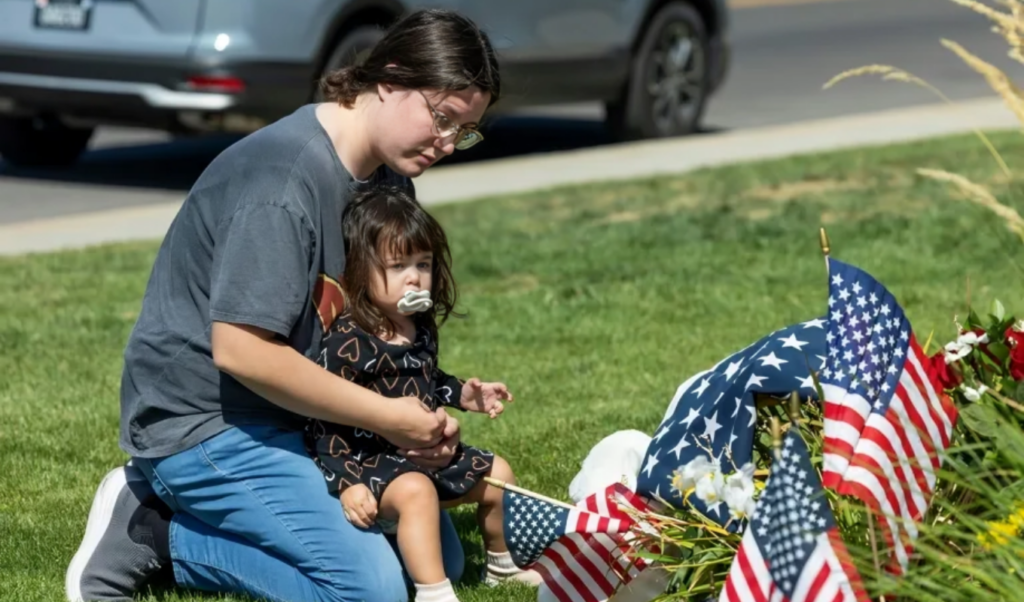
University students have been left reeling after the murder of conservative activist Charlie Kirk, describing the loss as akin to losing a family member.
For accounting student Dave Sanchez, witnessing the shooting at Utah Valley University on Wednesday felt deeply personal.
“It still makes me sick to my stomach,” Sanchez said on Thursday, returning to campus to mourn.
“We watch him all the time and so it really does feel like one of your own family members, your own brother’s been killed.”
The 26-year-old, whose father emigrated from Peru, had been drawn to Kirk’s social media content, admiring his “dedication to faith, family and freedom.” Sanchez added: “He did change the political climate on campuses, leading young people to look at conservatism in a different way.”
Wearing a red “Make America Great Again” cap, Sanchez noted that he had supported Donald Trump in both the 2020 and 2024 elections.
At 31, Charlie Kirk had become a prominent figure on the American right, hosting a conservative talk show and running the youth organisation Turning Point USA, which operates on over 800 campuses nationwide.
Kirk toured universities engaging in debates with students, aiming to counter what he called “left-wing indoctrination in academia.”
However, his Christian nationalist views and staunch advocacy for traditional family values drew criticism and accusations of homophobia and racism. A remark on a 2024 podcast — “If I see a Black pilot, I’m gonna be like ‘Boy, I hope he is qualified'”— provoked significant controversy.
Even in Utah, a predominantly conservative, Trump-supporting state, some students called Kirk’s rhetoric dangerous.
More than a day after the shooting, the perpetrator remained unidentified, while Utah’s Republican governor described the attack as a “political assassination.”
Carson Caines, a 23-year-old computer science student, described Kirk as “a martyr of free speech” and “a huge spokesman for our generation.”
Despite feeling anger over Kirk’s killing, Caines emphasised the importance of rejecting violence: “I think, like a lot of people, my first initial reaction was like, wanting to do something physical about it. But I refuse to feed this cycle of violence.”
He plans to join Turning Point USA, the organisation that mobilised youth activists to the January 6, 2021 rally that escalated into the US Capitol riot.
Another student, who only gave his first name Alexander, expressed concern that Kirk’s death would intensify political polarization in the US: “I hear a lot of people saying he was an extremist. But in the right-wing community, he’s one of the more moderate voices out there. Killing him is only going to make it worse and increase the divide between Americans.”
Alexander, 23, who supports gun rights and opposes abortion, explained that conservatives often feel silenced: “In the past decade, I think anyone who leans conservative has had to censor their beliefs, even basic ones like being pro-family or pro-Second Amendment, in order to avoid public backlash. Cancel culture has gone crazy. This killing is a cultural artifact, I think, of everything that happened during the last decade or so.”
The responses from students reflect a broader national debate over freedom of speech, political extremism, and cultural division. While some mourn Kirk as a symbol of conservative youth activism, others warn that his rhetoric and the violence surrounding his death underscore growing tensions in American society.
The tragedy at Utah Valley University has left both students and the nation grappling with questions of safety, political discourse, and the limits of ideological expression.