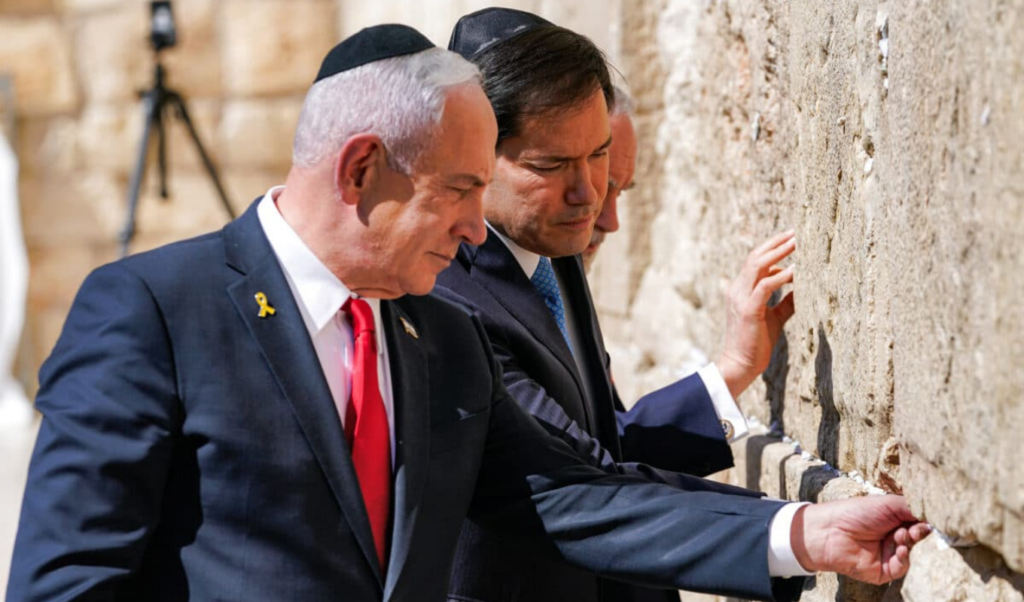
US Secretary of State Marco Rubio is meeting Israeli Prime Minister Benjamin Netanyahu on Monday to discuss the aftermath of an Israeli strike in Qatar—an action opposed by Washington—and its implications for efforts to establish a ceasefire in Gaza.
Background of the Qatar Strike
- The visit comes one week before a French-led United Nations summit aimed at recognising a Palestinian state—a proposal strongly opposed by Netanyahu’s right-wing government.
- Last week, Israel conducted an attack in Qatar, targeting Hamas leaders who were meeting to discuss a new US ceasefire proposal for Gaza. The strike surprised the Trump administration, as Qatar hosts the region’s largest US air base.
Rubio commented on departure: “Obviously we’re not happy about it. The president was not happy about it. Now we need to move forward and figure out what comes next.”
Rubio intends to discuss with Netanyahu:
| Topic | Details |
| Gaza military plans | Israeli military operations to seize Gaza City, the largest urban centre in the territory. |
| West Bank annexation | Potential plans to annex parts of the West Bank to prevent a Palestinian state. |
| Hostage situation | Resolution following the October 7, 2023 attacks, ensuring hostages are released and Hamas neutralised. |
| Impact of Qatar strike | How last week’s strike affects ongoing ceasefire and Gaza operations. |
Rubio stated that Trump wants the Gaza conflict to be “finished with”, implying both hostage release and ensuring Hamas no longer poses a threat.
US Position and Diplomatic Context
- The US has not joined European powers in pressing Israel to end its offensive, despite fears that the campaign will exacerbate the humanitarian crisis in Gaza.
- Rubio met Netanyahu on Sunday at the Western Wall, the holiest site where Jews are permitted to pray.
Rubio, a devout Catholic, later stated that his visit demonstrates his belief that Jerusalem is the “eternal capital” of Israel.
- Prior to Trump’s presidency, US leaders avoided such explicit endorsements of Israeli sovereignty over contested Jerusalem, which is also sacred to Muslims and Christians.
- Trump relocated the US embassy to Jerusalem and has repeatedly expressed strong support for Israel, even when it undertakes actions opposed by his administration, such as the strikes in Qatar.
Netanyahu, speaking after joining Rubio on a tour of excavated sites beneath the Western Wall, said: “Israel’s alliance with the United States has never been stronger.”
Rubio is also expected to attend the inauguration of a pilgrim’s tunnel leading to the holy area. While he described it as: “One of the most important archaeological sites in the world,”
Palestinian and peace groups argue that the event legitimises Israeli claims to East Jerusalem, which Israel annexed after the 1967 war.
This visit highlights rising US–Israel diplomatic coordination, ongoing tensions over Gaza and West Bank policy, and sensitivity surrounding contested religious sites in Jerusalem.