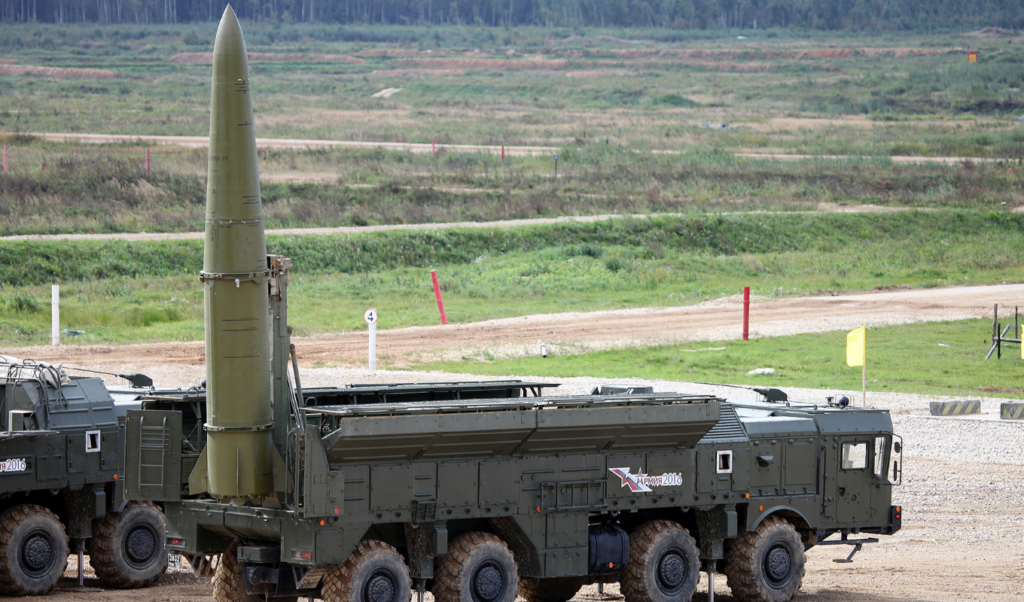
During joint military drills with Belarus, Russia has once more showcased its Iskander missile system, releasing video footage of the weapon deployed in the Kaliningrad region near the Baltic Sea. The Russian Defence Ministry published the clip on Monday (15 September), saying the exercise included an electronic launch rehearsal of the system as part of the manoeuvres.
The Iskander is one of Russia’s most modern short-range ballistic-missile systems and is capable of carrying either nuclear or conventional warheads. Known to NATO by the codename SS-26, the missile has a reported range of at least 500 kilometres, allowing it to strike targets at substantial distance. That range — and the system’s ability to deliver a powerful strike quickly — has prompted concern among countries in eastern Europe and within the European Union.
Deployment history and combat use
- In December 2022, Russia deployed Iskander systems to Belarus, at a time when the Russia-Ukraine war had passed its ten-month mark.
- During the conflict in Ukraine, Iskander-M tactical missiles have been used by Russian forces. Moscow has claimed that an Iskander destroyed a US-supplied Patriot air-defence system in Ukraine — a claim that has been reported but remains disputed in international media and by some analysts.
- The recent Kaliningrad footage underlines Russia’s continued practice of showing off and testing its more advanced conventional and strategic capabilities during multinational drills.
The Iskander system’s combination of speed, mobility, precision and dual-capability warheads (conventional and nuclear) makes it a particularly sensitive asset in regional security calculations. With a strike radius of around 500 km (roughly 300 miles), Iskander positions launched from Kaliningrad or Belarus can potentially reach deep into neighbouring territories — a fact that has raised alarm among NATO members and EU states in Europe’s east.
Iskander at a glance
| Feature | Detail |
| NATO designation | SS-26 |
| Warhead types | Conventional or nuclear |
| Reported range | At least 500 km (≈300 miles) |
| Notable deployments | Belarus (Dec 2022); Kaliningrad demonstrations (September 2025) |
| Combat use | Reported use in the Russia–Ukraine war (Iskander-M) |
| Concerns | Threat to security of eastern EU countries; ability to strike air-defence assets and critical infrastructure |
Kaliningrad, a Russian exclave sandwiched between NATO members, and Belarus — a close Russian ally — provide launch positions that significantly extend the geographic reach of Russian missile capabilities in northern and eastern Europe. Public demonstrations such as the recent video serve multiple purposes for Moscow: testing the system, signalling capability to adversaries, reassuring domestic and allied audiences, and potentially deterring actions by NATO or regional states.
While state claims about battlefield effects (for example, the destruction of advanced air-defence systems) are often contested, the visible deployment and rehearsal of electronic launches and other launch procedures make clear that Russia continues to maintain and exercise its tactical missile forces actively. That continued activity — combined with the Iskander’s dual-use lethality — keeps the weapon system high on the list of regional security concerns.