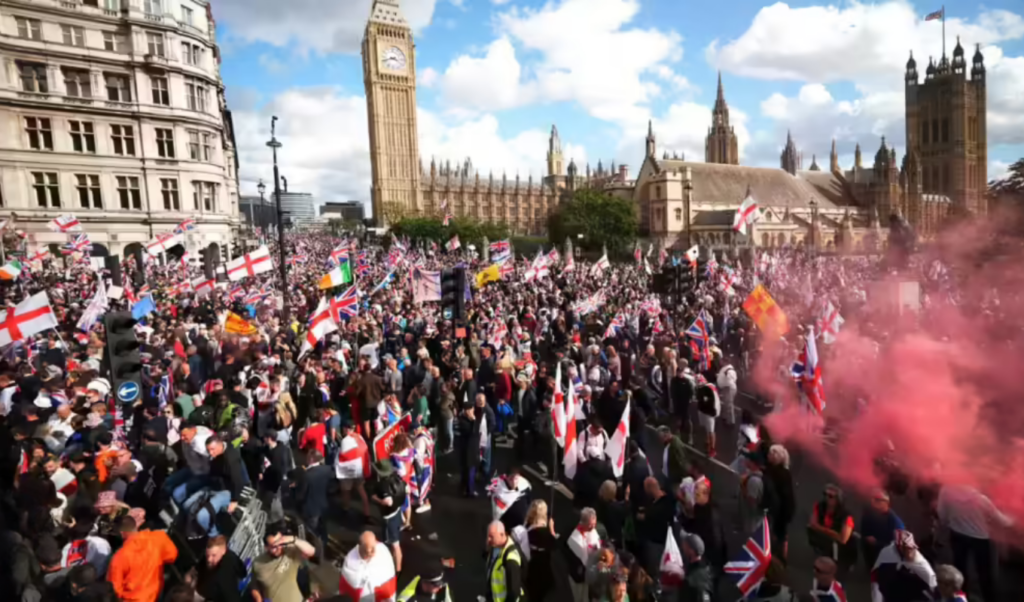
A weekend march in London organised by far-right activist Tommy Robinson attracted up to 150,000 protestors, prompting soul-searching across Britain over the mainstreaming of fringe political movements.
The large turnout on Saturday surprised many observers and has raised questions about the potential impact on British politics and society in the years ahead.
Despite his criminal history and controversial reputation, Robinson was able to mobilise enormous numbers.
“We were looking at something that was kind of a perfect storm,” said Matthew Feldman, visiting professor at Liverpool Hope University and expert on far-right extremism.
Several factors contributed to the rally’s scale:
- Public anger over migrants crossing the Channel in small boats.
- Controversy around housing asylum seekers in hotels.
- Heated debates over free speech.
- Economic stagnation and societal frustrations.
Trevor Phillips, former head of the Commission for Racial Equality, summarised the appeal: “The angry protests outside asylum hotels are now metastasising into a simpler, broader message: stop immigration, defend free speech, revive Christianity. It is a compelling trinity for a country that feels angry and unmoored.”
Feldman noted, however, that Robinson’s reach on X (formerly Twitter), where Elon Musk addressed the rally via video link, was the key factor behind the unprecedented mobilisation.
The march included Robinson’s core supporters from his earlier days as a football hooligan, along with working-class and rural middle-class attendees.
Sporadic violence broke out during the day. Figures from the global far-right also addressed the crowd:
- French politician Eric Zemmour spoke about the “great replacement” of European populations by migrants from the south and Muslim cultures.
- Elon Musk warned of “massive uncontrolled migration” destroying Britain, adding that “violence is coming” and “you either fight back or you die.”
The UK government condemned Musk’s comments as “dangerous and inflammatory.”
Experts see the rally as evidence of the emboldening of far-right politics:
- Aaron Winter, Lancaster University, described the event as a “worrying sign of mainstreaming.”
- The number of individuals imprisoned for far-right terrorism in Britain has risen from 42 in 2020 to 75 today, according to official statistics.
Feldman noted that Robinson, backed by Musk’s platform, now has tools unavailable a decade ago, amplifying his influence.
The Reform UK party, led by Brexit figurehead Nigel Farage, has capitalised on public anger over immigration and polls suggest it could gain substantial influence in the next election, although no vote is expected for four years.
“The far right has momentum. Reform UK is getting closer to 40 percent in polls, and no one is able to stop it,” said Georgios Samaras, King’s College London.
However, Farage distances himself from Robinson, dismissing him as an extremist, while Musk has criticised Farage for not taking a hardline stance, suggesting governing could be challenging.
Winter noted that the mainstreaming of far-right views has already affected policy: both major parties are “chasing that vote” and adopting tougher immigration rhetoric.
Labour MP Clive Lewis stressed that categorising all attendees as “racists or fascists” would be a mistake, urging progressives to offer a “story of renewal” to draw support away from far-right figures.
Feldman emphasised the importance of maintaining clear boundaries between mainstream politics and extremism:
“At the height of World War II, George Orwell said, ‘not all of us can have a direct influence on the war, but our duty at home is to keep our little corner clean.’”
He added that communities at risk of radicalisation should be supported, standing up for British values of tolerance and multiculturalism.
“The floodwaters are rising, but let’s not go weak at the knees,” Feldman said.
Key Takeaways:
| Aspect | Details |
| Rally | London, led by Tommy Robinson, up to 150,000 participants |
| Motivating factors | Migration anger, asylum housing, free speech debates, economic stagnation |
| Speakers | Eric Zemmour, Elon Musk |
| Support base | Hardcore far-right supporters, working-class, rural middle-class |
| Political impact | Momentum for Reform UK; mainstream parties adopting tougher immigration stance |
| Security issues | Sporadic violence; rise in far-right terrorism prisoners |
The rally underscores the growing visibility and influence of far-right movements in the UK, prompting debates on political, social, and security implications.