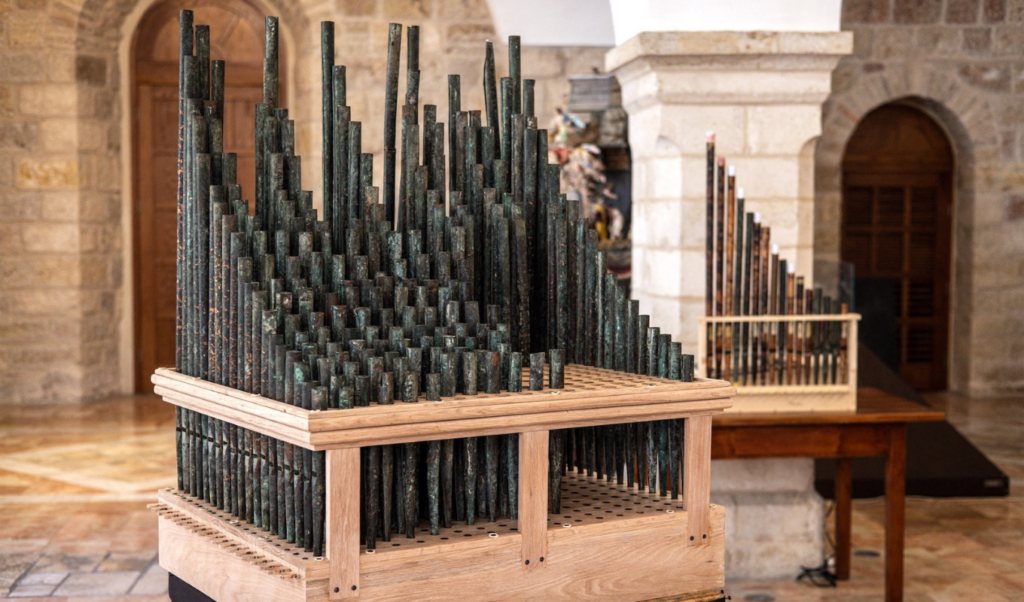
The long-forgotten pipes of a medieval organ, hidden beneath the earth for centuries and unearthed near the Church of the Nativity in Bethlehem, are once again producing music – this time within the sacred walls of a Jerusalem monastery.
David Catalunya, a Spanish scholar who dedicated over five years to reviving the instrument, described the project as a rare glimpse into the medieval soundscape.
“This is a window into the past… we have the opportunity for the first time in modern history to listen to a medieval sound that is a thousand years old,” Catalunya explained.
“And it’s not through a recreation or hypothetical reconstruction, but the original sound itself – the very vibrations the Crusaders once heard at the Nativity Church.”
Dating back almost to the earliest years of organ-making, the pipes were first discovered in 1906 during an excavation at the Biblical birthplace of Jesus Christ.
Catalunya now plays the instrument by pulling small tabs, producing powerful, resonant tones from the modest wooden framework. He calls the organ nothing short of a “miracle.”
Currently housed at the Monastery of Saint Saviour in Jerusalem’s Old City, the restored organ will soon be exhibited at the museum of the Franciscan Custody of the Holy Land.
Alvaro Torrente, a musicologist who worked alongside Catalunya, likened the discovery to a living relic: “It’s like finding a living dinosaur. We knew these instruments existed, but only through fragments – fossils, if you will. This, however, is the real object with the real sound.”
The rediscovery of the organ pipes was, as Franciscan archaeologist Father Eugenio Alliata recounted, “almost by chance.”
In 1906, during the construction of a pilgrim hostel near Bethlehem’s Church of the Nativity, workers unearthed:
| Item Discovered | Quantity | Notes |
| Copper Pipes | 222 | Carefully buried, allowing preservation |
| Bell Carillon | 1 | Found alongside the pipes |
The organ components appeared to have been deliberately buried with great care, enabling researchers to meticulously reconstruct the instrument centuries later.
Koos van de Linde, a world-renowned organ specialist who also contributed to the project, emphasised the emotional weight of the moment: “The hope the Crusaders had when they buried these pieces – that one day they would resound again – was not in vain. It was an immense honour to witness and participate in their resurrection.”
What makes the instrument remarkable is not only its complexity – with 18 pipes required to produce a single note – but also its age and remarkable preservation.
- Built in the 11th century in France
- Transported to Bethlehem by Crusaders in the 12th century
- Oldest surviving organ ever reconstructed (predating most historical organs, which date from the 15th century)
According to Catalunya, the organ is in an “incredible state of preservation.”
Torrente highlighted the significance of the find: “The Christians of Europe brought to the Church of the Nativity in Bethlehem the most avant-garde musical instrument of its time – the organ – which was designed to become the emblem of sacred music.”
The team of researchers hope that the so-called “Bethlehem Organ” will inspire greater scholarly and public interest in medieval music.
Torrente believes the instrument still holds many secrets: “This organ has not yet sung all its tunes.”
Would you like me to also create a timeline graphic/table tracing the organ’s journey from its 11th-century French origins to its 21st-century revival in Jerusalem? That could further enrich the piece.