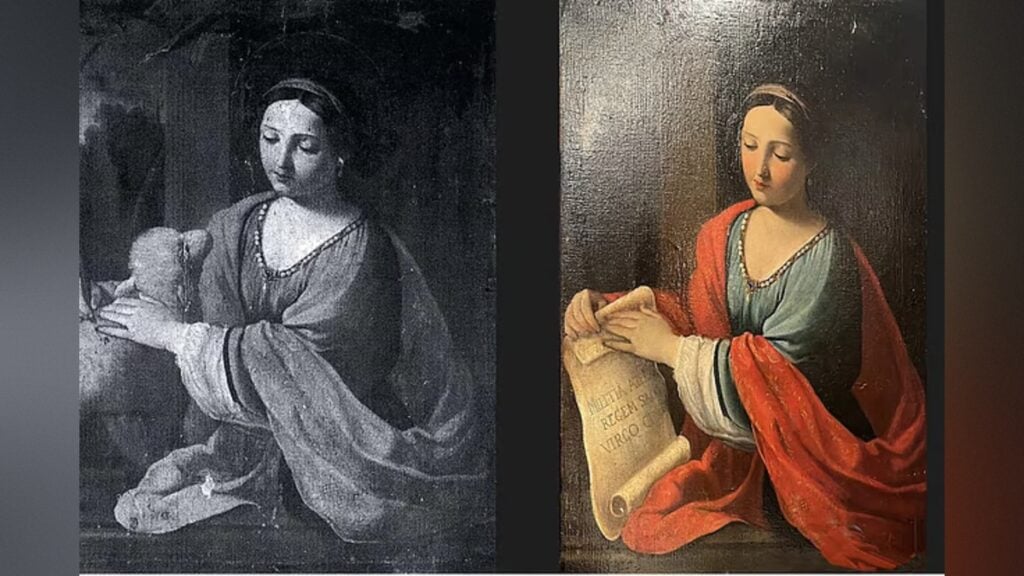
One notable success involved a 17th-century painting of Saint Agnes, which was stolen from a church in Popoli, Italy, in 2004. The artwork was eventually recovered after an artificial intelligence system flagged a suspicious image taken at an archaeological and antiquities exhibition in Parma in 2024.
The image appeared to show a young woman holding an old letter. At first glance, it seemed to be an ordinary portrait. However, an AI-assisted analysis identified similarities with the missing religious painting, suggesting that the original composition had been altered to disguise its identity. Changes to the central figure and other visual elements had transformed the appearance of the artwork, making it more difficult to recognise as a stolen religious image.
The technological analysis provided investigators with a crucial lead, helping them identify and recover the painting. The case illustrates how digital tools can support art-crime investigations, particularly when stolen objects have been modified or presented under a different identity.
Lieutenant Colonel Salvatore Rapicavoli of Italy’s Carabinieri unit responsible for protecting cultural heritage said the AI-powered SWOADS algorithm had been producing significant results since its introduction in November 2023.
According to Rapicavoli, the system has helped recover 303 paintings and sculptures, alongside more than 165,000 coins and ancient documents. The estimated value of the recovered items exceeds €200 million.
The system works by examining distinctive characteristics in images and comparing them against information held in digital databases. These characteristics may include colour proportions, patterns, compositional details and other features associated with an artwork’s original appearance. Even when a painting has been altered, some underlying details may remain sufficiently distinctive to help establish a match.
Such capabilities are particularly valuable in the investigation of cultural property theft. Stolen paintings and artefacts can pass through private collections, dealers and international markets, sometimes without their original provenance being disclosed. Investigators may have to compare thousands of images and historical records to establish whether an object is connected to a reported theft. Automated analysis can narrow the search and help experts concentrate on the most promising leads.
However, AI is not a substitute for professional judgement or conventional police work. Karina Popovici, co-founder of the art-recognition company Art Recognition, and Timothy Carpenter, a former head of the FBI’s Art Crime Team, have highlighted the limitations of relying solely on automated analysis. The technology can identify possible matches, but investigators must verify the findings, establish the object’s provenance, gather admissible evidence and take appropriate legal action.
The reliability of the results also depends on the quality of the available data. Incomplete or inaccurate records can complicate identification, while artificially generated images and copies of original artworks may create additional difficulties. Distinguishing an authentic historical object from a reproduction often requires specialist examination alongside digital analysis.
Italy’s initiative forms part of a broader international effort to protect cultural heritage through technology and information-sharing. Countries including France, Germany and Türkiye have been developing or using digital tools to help identify stolen cultural objects. Interpol’s ID-Art application also supports efforts to identify and document missing artworks and other cultural property, allowing users to consult information on objects reported stolen.
International cooperation is particularly important because stolen artefacts can cross national borders, making investigations more complex. Shared records and improved identification systems can help authorities compare information across jurisdictions and recognise objects that might otherwise remain undiscovered.
Paintings, sculptures, coins and religious artefacts are more than valuable possessions. They preserve evidence of artistic traditions, religious practices and historical periods. Once stolen, they can disappear from public view for decades, depriving communities of an important part of their cultural heritage.
The recovery of Saint Agnes demonstrates how AI can help reconnect historical objects with their past. Although the technology cannot independently establish guilt or replace the work of investigators and art historians, it offers law-enforcement agencies a powerful additional tool. As digital databases improve and international cooperation expands, AI-assisted identification could play an increasingly important role in recovering stolen treasures and protecting cultural heritage for future generations.