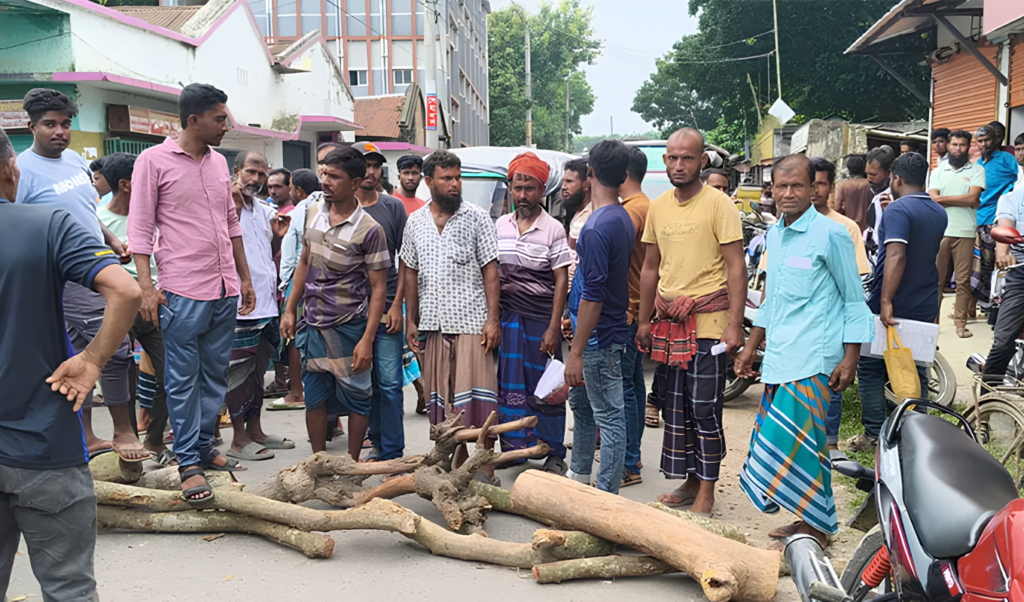
Frustrated by an abrupt refusal of chemical fertilizer distribution, hundreds of local farmers staged a road blockade in Jhenaidah’s Shailkupa upazila on Saturday morning, halting traffic along a major regional highway.
The demonstration erupted at Garaganj Bazar, a prominent commercial hub in the upazila. Local growers gathered outside ‘Shuva Enterprise’—an authorised fertilizer dealership situated in the old market area of Garaganj—to purchase essential crop nutrients for the ongoing planting season. However, tensions flared when representatives of the dealership unexpectedly informed the waiting farmers that no fertilizer would be issued to them.
The abrupt refusal sparked immediate outrage among the farming community, many of whom had travelled long distances and queued for hours. In protest against the dealer’s refusal, the growers gathered on the Garaganj-Shailkupa regional highway, placing large tree trunks and wooden logs across the road to cut off vehicular movement.
The blockade quickly brought traffic to a complete standstill for nearly an hour. Long queues of passenger buses, commercial trucks, and local three-wheelers formed on both sides of the highway, causing significant disruption to commuters and regional transport operators.
Upon receiving news of the blockade, upazila agricultural officers rushed to Garaganj Bazar to intervene. The officials engaged directly with the protesting farmers, listened to their grievances, and directed the dealership to immediately resume fertilizer distribution under official supervision.
Normalcy returned to the highway once the dealership opened its doors and began issuing fertilizer bags to the waiting farmers. Satisfied with the immediate administrative intervention, the demonstrators cleared the tree trunks from the tarmac, allowing traffic to resume.
Addressing the incident, local agricultural officials acknowledged that a miscommunication in the dealer’s distribution process had created an unwanted situation. Authorities assured the public that measures had been put in place to streamline distribution, ensuring local farmers receive their allocated quotas without further hindrance during the critical cultivation cycle.