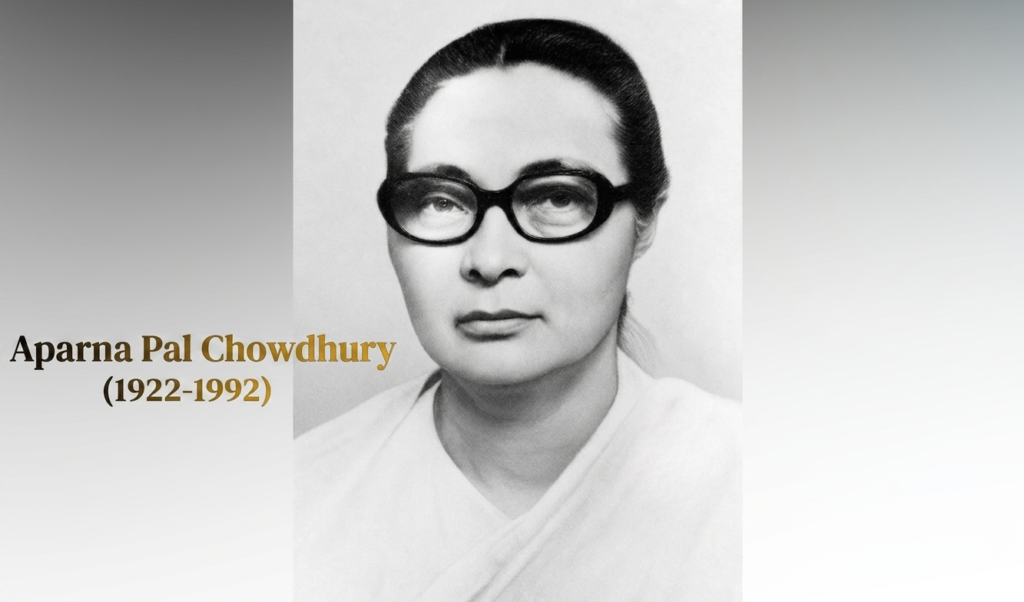
The history of South Asian anti-colonial resistance and social justice is shaped by individuals whose personal sacrifices laid the foundation for modern civil liberties. Among the most remarkable of these revolutionaries was Aparna Pal Chowdhury, a formidable leader who dedicated her life to the rights of working peasants, the emancipation of women, and the creation of an egalitarian society. Across the turbulent landscape of the anti-British independence movement, communist politics, and the historic Nankar peasant rebellion, her fortitude and ideological clarity established her as an enduring symbol of resistance.
Born in Sylhet in 1922, Aparna Pal Chowdhury displayed an early commitment to political consciousness. During her student years, she immersed herself in radical politics, taking a prominent role in the nationalist student demonstrations of 1940. Serving as the secretary of the student division, she organised young activists while establishing women’s committees (Mahila Samiti) across both urban centres and rural villages. Her ability to rally women at the grassroots level provided a crucial organizational framework for gender equality within the broader anti-imperialist movement.
Her political engagement deepened in 1942 when she formally joined the Communist Party of India (CPI). It was through her involvement with agrarian labour that she emerged as a principal architect of the Nankar Rebellion in the greater Sylhet region. Under the oppressive Nankar custom, feudal landlords (zamindars and mirashdars) granted small patches of land to peasants in exchange for mandatory, uncompensated physical labor and domestic service. This archaic practice trapped generations of rural families in bonded servility without wage rights. The region of Saneshwar in Beanibazar became the nucleus of the peasant resistance, with Aparna standing at the forefront of the effort to abolish feudal servitude and secure land ownership for tillers.
The confrontation reached a tragic turning point on 18 August 1949, when state police and landlord militias launched a brutal crackdown on the movement. During the violent raid, six striking peasants were shot dead. Aparna, who was pregnant at the time, was subjected to severe police violence. The physical assault resulted in an immediate miscarriage and inflicted permanent physical disability upon her. Following her arrest, she endured nearly five years of harsh imprisonment across facilities in Sylhet, Rajshahi, and Dhaka.
Upon her release in 1954 due to critical health conditions, Aparna relocated to West Bengal. Following the 1964 split within the Communist Party of India, she and her husband, Surath Pal Chowdhury, joined the Communist Party of India (Marxist). Despite her ongoing physical ailments, she remained steadfast in progressive politics, teaching, and championing women’s rights until her death. Her autobiographical work, Nari Andolan: Smritikatha (Women’s Movement: Reminiscences), remains a vital historical document detailing the intersection of gender activism and class struggles in Bengal.
When Aparna Pal Chowdhury passed away on 6 August 1992, she left behind a legacy defined by courage and sacrifice. Decades after her passing, her lifelong campaign against exploitation continues to serve as an inspiring precedent for movements advocating human dignity and fundamental rights.