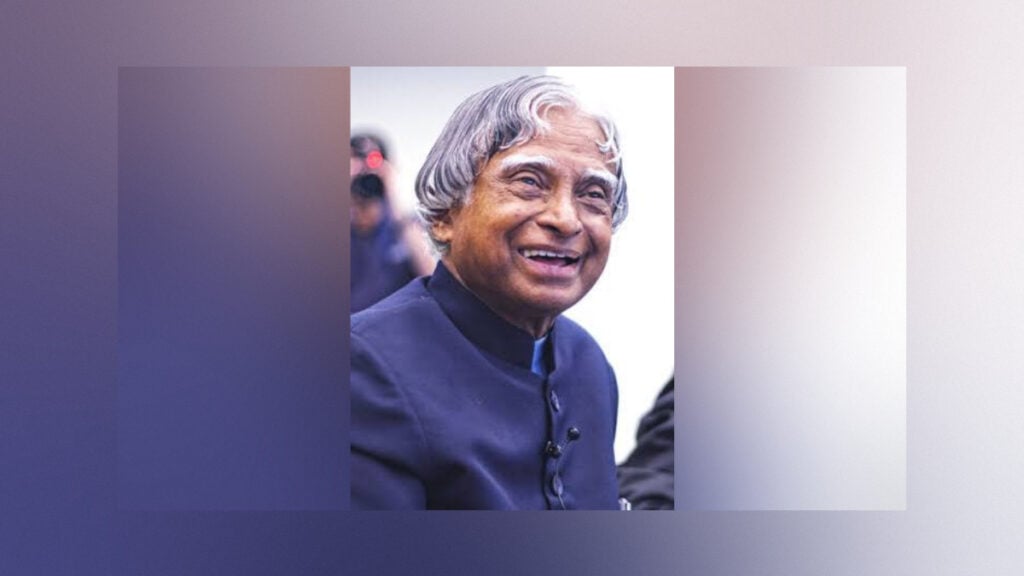
Some people leave an enduring mark on history through their intellect, integrity, dedication and vision. Their achievements extend beyond professional success, inspiring generations to overcome adversity, pursue knowledge and work for the greater good. Dr APJ Abdul Kalam, India’s celebrated aerospace scientist and 11th President, was one such figure. Known as the ‘Missile Man of India’, he combined scientific excellence with a lifelong commitment to education, humility and the aspirations of young people.
Born on 15 October 1931 in Rameswaram, Tamil Nadu, Kalam grew up in a modest Tamil Muslim family. His full name was Avul Pakir Jainulabdeen Abdul Kalam. His father, Jainulabdeen, owned a boat and earned a living by arranging transport for pilgrims. His mother, Ashiamma, was a compassionate and religious woman who helped nurture the values that would shape his character.
Kalam’s childhood was marked by financial hardship. To support his family and contribute towards his educational expenses, he sold newspapers while still young. Despite these difficulties, he remained determined to study and build a better future. His early experiences helped shape his belief that a person’s circumstances at birth need not determine their ultimate achievements. Perseverance, self-discipline and a willingness to learn can create opportunities even when resources are limited.
After graduating in physics from St Joseph’s College in Tiruchirappalli, Kalam studied aeronautical engineering at the Madras Institute of Technology. His fascination with aircraft, flight and advanced technology guided him towards a career that would eventually place him at the forefront of India’s space and defence research.
He began his professional career at the Defence Research and Development Organisation (DRDO), where he worked on the development of a small hovercraft. In 1969, he joined the Indian Space Research Organisation (ISRO), becoming closely involved in the country’s efforts to develop indigenous space technology.
One of his most significant achievements came as project director of the Satellite Launch Vehicle-III (SLV-III), India’s first indigenous satellite launch vehicle to achieve a successful orbital launch. In July 1980, the vehicle placed the Rohini satellite into Earth’s orbit. The accomplishment represented a major milestone for India’s space programme, demonstrating the country’s growing ability to launch satellites using its own technology.
The achievement strengthened India’s ambitions in space research and helped establish a foundation for future advances in launch vehicles and satellite technology. Kalam’s contribution was not simply technical; he also became known for his ability to work with scientific teams towards demanding national objectives.
He later returned to defence research and became one of the leading figures in India’s guided missile development programmes. His work contributed to projects associated with the Agni and Prithvi missile systems, helping advance the country’s indigenous defence capabilities. These contributions earned him the widely recognised title ‘Missile Man of India’.
Kalam believed that scientific progress was closely linked to national security, technological independence and economic development. He regarded investment in research as essential for a country seeking to strengthen its capabilities and reduce dependence on imported technology.
He also played an important role in the Pokhran-II nuclear tests conducted by India in Rajasthan in May 1998. The tests marked a significant development in the country’s strategic and defence policy. His involvement in major space, missile and nuclear initiatives established him as one of India’s most prominent scientific figures.
Yet Kalam’s identity extended well beyond laboratories and defence establishments. He was a writer, educator and advocate of human development who believed that science should ultimately serve society. For him, technological progress had the potential to improve living standards, create opportunities and help address the challenges facing developing communities.
In 2002, Kalam was elected the 11th President of India with support from the governing Bharatiya Janata Party (BJP), the principal opposition Indian National Congress and several other political parties. He served from 2002 to 2007.
Despite occupying the country’s highest constitutional office, Kalam remained known for his simplicity and modest lifestyle. His approachable manner and willingness to engage with ordinary citizens helped distinguish him from conventional political figures. His particular affection for students earned him the enduring nickname ‘People’s President’.
Engaging with young people was among his most cherished activities. Kalam believed that a nation’s future depended on the knowledge, creativity, ethical values and capabilities of its younger generations. He encouraged students to think independently, ask questions, develop practical skills and pursue ambitious goals through persistent effort.
His vision for India was articulated in India 2020, co-authored with Y. S. Rajan. The book presented a roadmap for transforming India into a developed nation, with an emphasis on science, technology, education and economic progress. Kalam believed that the effective use of knowledge and innovation could help the country overcome developmental challenges and improve opportunities for its citizens.
His autobiography, Wings of Fire, recounts his journey from a modest childhood to becoming one of India’s most recognised scientists. The book offers an account of the determination, education and professional experiences that shaped his career. Other notable works include Ignited Minds and My Journey, through which he shared his ideas about personal growth, national development and the potential of young people.
His contributions to science and public life earned him some of India’s highest civilian honours. He received the Padma Bhushan in 1981, the Padma Vibhushan in 1990 and the Bharat Ratna, the country’s highest civilian award, in 1997. Universities and institutions also awarded him honorary doctorates in recognition of his achievements and influence.
Kalam did not withdraw from public life after completing his presidential term in 2007. Instead, he returned to teaching, research and writing, continuing to engage with students across India. He served as a professor at Anna University in Chennai and visited educational institutions to discuss science, innovation and the responsibilities of future generations.
He viewed teaching as much more than the transfer of information. Educators, he believed, had a responsibility to awaken curiosity, encourage independent thought and help students recognise their potential. He wanted young people to become active learners who could question established ideas, explore new possibilities and develop solutions to real-world problems.
At the centre of Kalam’s philosophy was the relationship between dreams and action. He encouraged young people to understand that meaningful dreams are not merely wishes but ambitions that inspire sustained effort. Achieving them requires discipline, courage, knowledge and the ability to learn from failure.
This message resonated with students from different backgrounds, particularly those who felt constrained by financial or social circumstances. Kalam’s own journey demonstrated how education and determination could help individuals move beyond the limitations of their beginnings.
His personal conduct reinforced the values he promoted. He was widely admired for his humility, straightforward manner and respect for others. Although he remained committed to his religious beliefs, he valued communal harmony, tolerance, education and shared human dignity. His life demonstrated how scientific thinking and humanitarian principles could complement one another.
On 27 July 2015, Kalam collapsed while delivering a lecture to students at the Indian Institute of Management Shillong in Meghalaya. He was taken to hospital, where he died at the age of 83.
His death was particularly poignant because he remained engaged in the work that had defined much of his life: teaching and inspiring young people. Even in his final hours, he was sharing knowledge and encouraging students to think about the future. His passing prompted widespread grief and tributes across India and beyond.
The country lost an accomplished scientist, a respected former President and a devoted educator. Yet his influence did not end with his death. His scientific contributions, books, speeches and confidence in the younger generation continue to shape discussions about education, innovation and national development.
Kalam’s life also challenges the assumption that success depends primarily on wealth, privilege or position. Rising from a financially modest background, he became an internationally recognised scientist and eventually occupied India’s highest constitutional office. Throughout that journey, he remained associated with the values of hard work, integrity and public service.
His legacy is particularly relevant to young people navigating a world shaped by rapid technological change and growing demands for scientific knowledge. Kalam’s example encourages them to pursue education, approach challenges with curiosity and use their abilities to benefit others. His vision of progress was not confined to technological achievement; it also involved building a society in which knowledge, compassion and opportunity could help people lead better lives.
As the world remembers APJ Abdul Kalam on his birth anniversary, 15 October, his life offers a reminder of the importance of investing in education, supporting scientific research and nurturing the ambitions of young people. His achievements demonstrate what sustained effort and a sense of purpose can accomplish, while his humility offers a lasting lesson about the responsibilities that accompany success.
Kalam is no longer with us, but the ideals he championed remain alive. His journey from a modest childhood in Rameswaram to the Presidency of India continues to inspire people to overcome limitations, pursue knowledge and contribute to society.
A humble tribute to Dr APJ Abdul Kalam — India’s ‘Missile Man’, visionary scientist, former President and lifelong teacher.