khaborwala online desk
Published: 14 Mar 2026, 05:26 pm
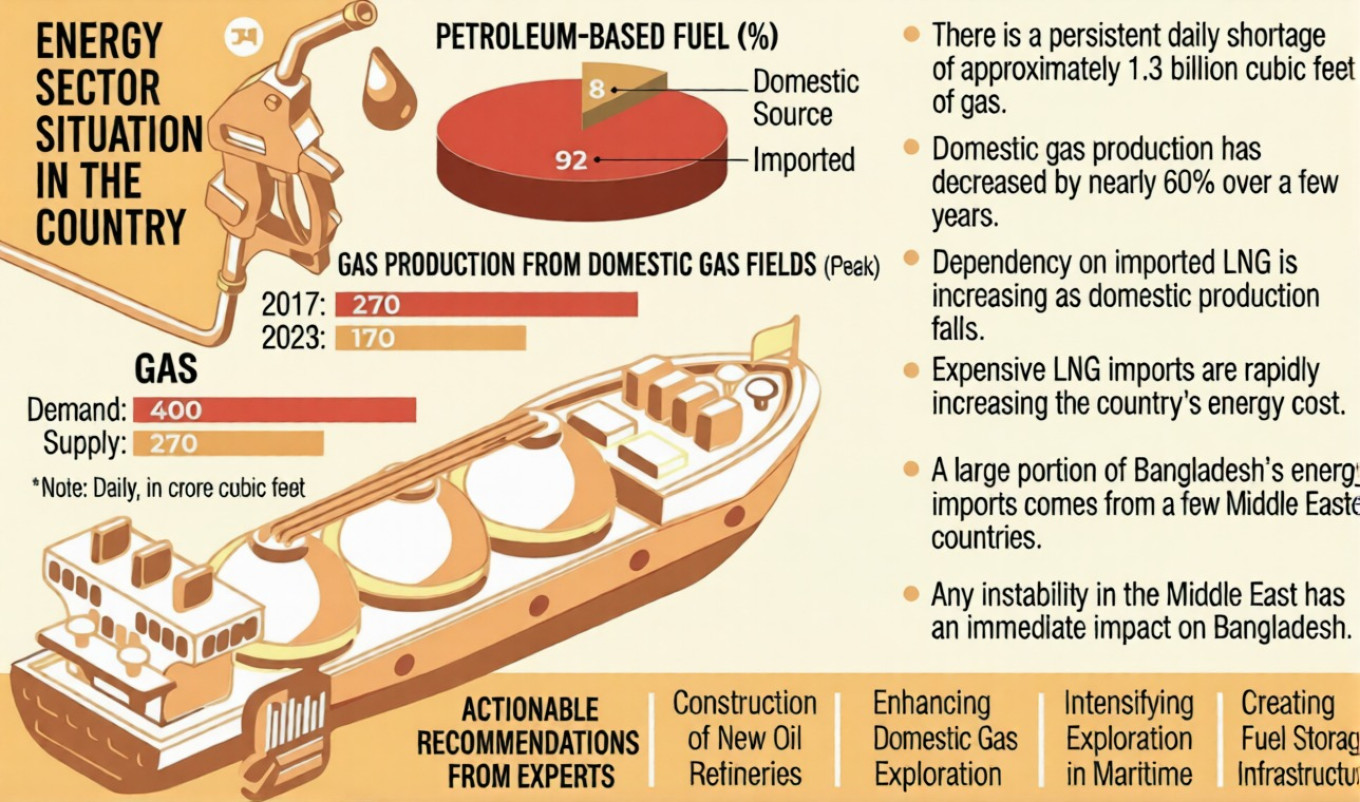
Over the past decade, Bangladesh’s energy sector has grown increasingly complex and vulnerable. Domestic demand for natural gas and petroleum products has risen sharply, yet local production has not kept pace. Declining gas output and the limited capacity of the country’s sole oil refinery have forced the country to rely increasingly on imports to maintain supplies for electricity generation, industry, transport, and agriculture. Experts warn that limited import sources and global market volatility place Bangladesh’s energy security at significant risk.
According to Petrobangla, the country’s daily gas demand currently stands at approximately 40 billion cubic feet (bcf). However, total domestic supply remains around 27 bcf, leaving a persistent daily shortfall of roughly 13 bcf. This deficit directly affects industrial operations, electricity generation, and household consumption. Many factories face production disruptions due to intermittent gas shortages, while residential areas experience low gas pressure and related inconveniences.
| Category | Daily Demand (bcf) | Domestic Production (bcf) | LNG Imports (bcf) | Shortfall (bcf) |
|---|---|---|---|---|
| Total | 40 | 17 | 8–10 | ~13 |
Domestic gas production peaked in 2017, with some days reaching 27 bcf. Since then, output has gradually declined, primarily due to ageing gas fields, slow discovery of new large fields, and extended stagnation in exploration activities during certain political administrations.
Bangladesh’s offshore territory holds significant untapped energy potential. Its maritime area is divided into 15 deepwater and 11 shallow-water blocks. While production began at the Sangu gas field in 1998, the field ceased operations after a few years, and no offshore fields have been integrated into the national grid since. Despite repeated international tenders, foreign investment has remained limited. Experts stress that without intensified offshore exploration, increasing domestic gas production will remain challenging.
To cover the supply gap, Bangladesh began importing liquefied natural gas (LNG) in 2018. Initial imports were modest, but volumes have grown rapidly. In the first year, 41 LNG cargoes were imported under long-term contracts with Qatar and Oman. By 2025, the country imported 56 cargoes via long-term contracts and 53 via spot market purchases, totalling 109 cargoes. Estimates suggest that by 2026, imports could reach 115 cargoes.
Each LNG cargo contains approximately 33.6 million MMBTU, which converts to roughly 3.24 bcf of gas—insufficient to meet a single day’s demand. Consequently, continuous LNG imports remain essential.
Rising LNG imports have significantly increased Bangladesh’s energy expenditure. Prices in the spot market have surged to $20–28 per MMBTU, compared with around $10 at the beginning of the year, placing additional financial pressure on the government.
Bangladesh Petroleum Corporation reports that around 92% of petroleum products are imported, with only 8% produced domestically. Local production mainly comes from condensate processed into petrol and octane. Diesel accounts for the largest share of consumption, comprising roughly 67% of total petroleum use.
| Sector Usage (FY 2023-24) | Share (%) |
|---|---|
| Transport | 56 |
| Power | 18 |
| Agriculture | 18 |
| Industry | 5 |
Domestic refining capacity is extremely limited. Chittagong’s Eastern Refinery has an annual capacity of 1.5 million tonnes, whereas national fuel demand ranges between 7–8 million tonnes, necessitating large-scale imports of refined products.
Most crude oil and LNG imports come from a narrow range of Middle Eastern countries—Saudi Arabia, UAE, Kuwait, Qatar, and Oman. Any geopolitical or military tension in this region could rapidly affect Bangladesh’s energy supply. Approximately 20% of the world’s oil is transported via the Strait of Hormuz, making the country vulnerable to global supply shocks.
Professor Shasul Alam, Energy Advisor at the Consumer Association of Bangladesh (CAB), observes:
“Without accelerating domestic exploration, expanding offshore activities, diversifying supply sources, investing in renewable energy, constructing new refineries, and enhancing storage infrastructure, Bangladesh’s energy security will remain precarious. Long-term planning is critical to avoid even greater challenges in the future.”
In summary, Bangladesh faces declining domestic energy production, rising import dependence, and growing vulnerability to international market fluctuations, posing serious challenges to economic growth and industrial stability.

> Transformer Blast Claims Man’s Life
> Kings Surge Ahead with Victory Over Fortis
> Missile and Drone Strike Hits US Embassy Baghdad
> Meta Infotech Secures ₹1.91 Crore Renewal Order
> At Least 12 Medical Staff Killed in Lebanon
> MetLife Bangladesh and GP Join Forces Nationwide
> Over 2,000 Queen Ants Seized in Kenya
> Fraudster Arrested with Foreign Counterfeit Currency in Nilphamari
> Global Currency Exchange Rates: Bangladesh Taka Updates
> Four Killed in US Military Plane Crash Iraq
> Hamza Returns: Boost for Bangladesh Ahead of Vietnam
> Five Bangladeshi Workers Die in Maldives Kitchen Fire

A man who sustained severe burn injuries in a transformer explosion at Mawna Chowrasta in Gazipur’s...

A thrilling five-goal encounter at Kings Arena saw a single hero emerge: Dorielton Gomez. The Brazil...
MetLife Bangladesh, one of the country’s leading life insurance providers, has recently signed a str...
The Capital Development Authority, RAJUK, has proposed a substantial increase in the minimum prices...

Mustafizur Rahman is set to become the first Bangladeshi to feature in England’s domestic franchise...
With nearly a week to go before the holy festival of Eid-ul-Fitr, thousands of Dhaka residents have...
The national meteorological authorities have forecast rain accompanied by thunderstorms in several p...

A luminous figure in the musical landscape of Bangladesh, freedom fighter and “sound warrior” of the...

The sporting community of Bangladesh is mourning the loss of Shamima Sattar Mimo, a celebrated forme...
Bangladesh’s Foreign Minister, Dr. Khalilur Rahman, has departed Dhaka on a diplomatic mission to th...

Following his appointment as Bangladesh’s one-day international captain, Mehedi Hasan Miraz has expe...
Bangladesh’s 13th National Parliament has come under intense criticism following the adoption of a c...


Availabe for iphone & ipads

Available in google play
 বাংলা
বাংলা