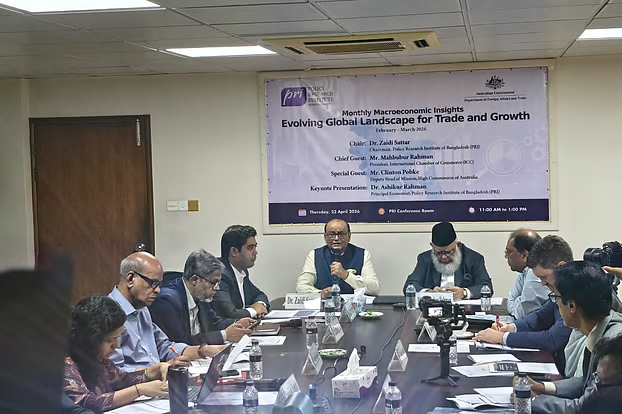
A senior economist from a leading Bangladeshi research institute has warned that recent government borrowing from the central bank could intensify inflationary pressures in the economy.
Speaking at a seminar held in Dhaka on the economic situation of February and March, Ashikur Rahman, Chief Economist of the Policy Research Institute (PRI), stated that the government had effectively “printed money” by borrowing heavily from Bangladesh Bank during March.
According to him, the government borrowed approximately 200 billion Bangladeshi taka (equivalent to 20,000 crore taka) from the central bank in a single month. He described this as “high-powered money,” which directly increases money supply in circulation and may contribute to rising inflation.
“During March alone, Bangladesh Bank extended around 20,000 crore taka in government borrowing. This is essentially base money creation, which can fuel inflationary pressure in the economy,” he said.
The seminar, held at PRI’s office in Banani, also featured discussions on broader macroeconomic challenges, including financial sector reforms, investment uncertainty, and energy market pressures. The session was attended by Mahbubur Rahman, President of the International Chamber of Commerce Bangladesh, as chief guest, while Zaidi Sattar, Chairman of PRI, presided over the event.
Concerns Over Financial Reform and IMF Relations
Presenting the keynote paper, Ashikur Rahman cautioned that any reversal of ongoing structural reforms in the financial sector could prove counterproductive. He stressed the importance of continuing banking sector restructuring and warned against policy backtracking.
He further noted that hesitation or delays in implementing reforms had created unnecessary uncertainty regarding the country’s engagement with international financial institutions, particularly the International Monetary Fund (IMF).
“A retreat from reforms would be self-defeating. The authorities should carefully review the bank resolution framework. Any uncertainty surrounding IMF-related commitments is avoidable and could be damaging,” he added.
Investment Climate and Energy Pressures
Speaking at the same event, Mahbubur Rahman highlighted growing hesitation among private sector investors. He noted that businesses are increasingly uncertain about the availability of essential utilities such as gas and electricity, which is affecting investment decisions.
Zaidi Sattar, in his remarks, pointed out that global energy markets remain under pressure, particularly due to geopolitical tensions affecting key supply routes such as the Strait of Hormuz. He stressed that energy price volatility has widespread implications for domestic inflation and economic stability.
He also emphasised the need for a democratically elected government to pursue comprehensive structural reforms to ensure long-term economic resilience.
Key Economic Concerns Raised
| Issue | Observation | Potential Impact |
|---|---|---|
| Central bank borrowing | ~20,000 crore taka in March | Expansion of money supply, inflation risk |
| Financial sector reforms | Risk of slowdown or reversal | Weakening of banking stability |
| IMF-related uncertainty | Policy hesitation noted | Reduced investor confidence |
| Energy price volatility | Global geopolitical pressure | Increased domestic inflation |
| Investment climate | Utility supply concerns | Slower private sector investment |
Overall, the seminar highlighted a convergence of monetary, structural, and external pressures facing Bangladesh’s economy, with experts urging continued reform momentum and cautious macroeconomic management.