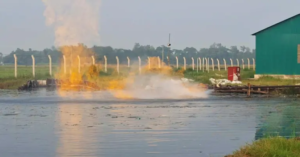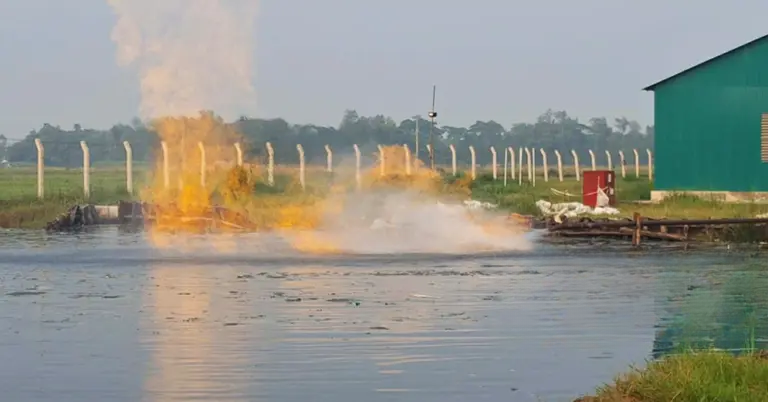
NOAKHALI — Engineers at the Bangladesh Petroleum Exploration and Production Company Limited (Bapex) have struck a significant natural gas reserve at the Sundalpur South-1 exploratory well in Companiganj upazila, Noakhali. Rig testing confirmed the presence of commercially viable hydrocarbon reserves across two distinct geological zones following an official flare-off test on Monday, 2 November.
Technical evaluations conducted by state engineers estimate the total recoverable reserves at the site to be 97.69 billion cubic feet (BCF). Based on current consumer tariff structures set by regulatory authorities, the monetary value of the gas stands at approximately 5,809 crore Bangladeshi Taka. The state-owned exploration entity projects a daily output of 15 million cubic feet (MMCFD) once the site is fully linked to the national gas transmission grid, with extraction operations planned to continue over an operational span of 20 years.
The drilling initiative was entirely self-funded through a joint financial allocation from the Government of Bangladesh and Bapex. Site selection and operational planning followed a comprehensive three-dimensional seismic survey commissioned by the Ministry of Power, Energy and Mineral Resources to identify high-potential subterranean structures across the coastal belt.
Engineers deployed the indigenous Bijoy-10 drilling rig to spud the exploratory well on 8 July. Drilling crews successfully penetrated target formations down to a total vertical depth of 3,289 metres before encountering the hydrocarbon-bearing reservoirs.
Speaking on the operational breakthrough, Project Director Mohammad Mozammel Haq confirmed the discovery, noting that field testing is proceeding to fully map the reservoir’s characteristics. Over the next fortnight, technical teams will conduct rigorous Drill Stem Testing (DST) and monitoring protocols to ascertain whether liquid hydrocarbons or condensate deposits are present alongside the primary natural gas reserves.
This discovery comes at a critical juncture for the domestic energy sector, which faces growing demand across industrial hubs, power stations, and commercial sectors. Domestic exploration projects like Sundalpur South-1 remain central to national efforts aimed at reducing reliance on expensive imported liquefied natural gas (LNG) and bolstering long-term energy security.