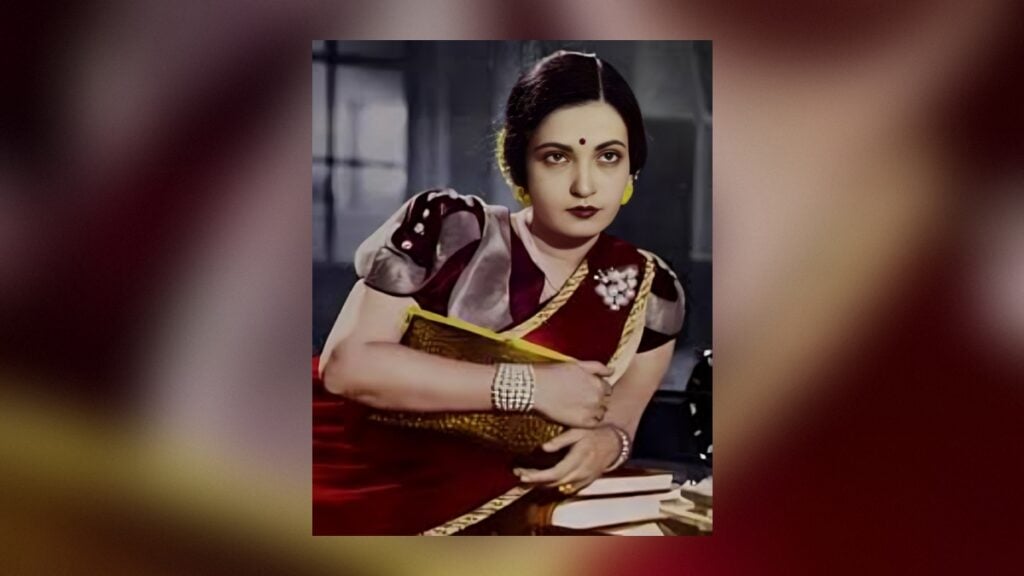
Ghazal found a language of its own in Begum Akhtar’s voice. Sorrow became gentle melancholy, love took the form of longing, and hurt seemed to fall silently between the folds of her music. Decades after her death, her voice continues to evoke an extraordinary sense of intimacy among listeners across the Indian subcontinent.
Begum Akhtar, widely remembered as the ‘Malika-e-Ghazal’ or Queen of Ghazal, was one of the defining figures of South Asian music. Through ghazal, dadra and thumri, she created a style that combined the discipline of classical music with an emotional directness that could reach listeners far beyond the traditional concert hall.
Born Akhtari Bai Faizabadi on 7 October 1914 in Faizabad, Uttar Pradesh, she showed an early fascination with music. Her first public performance came when she was only seven. She subsequently trained in Hindustani classical music under prominent musicians, including Ustad Ata Mohammad Khan of the Patiala tradition and Ustad Abdul Waheed Khan of the Kirana tradition.
Her journey to becoming one of the most celebrated singers of her generation was not an easy one. Years of rigorous musical training shaped the technical foundation of her singing, while her own experiences gave her performances an unmistakable emotional depth. In thumri and dadra, she brought together elements associated with the Purab and Punjab traditions, eventually developing a highly individual style.
Ghazal, however, became the art form with which her name would be most enduringly associated.
She had a remarkable ability to inhabit the poetry she sang. The verses of celebrated poets, including Mirza Ghalib, gained renewed emotional force through her interpretations. Themes of love, separation, waiting, loneliness and wounded pride were not simply performed; they appeared to be lived through her voice. That quality helped make her music accessible to both connoisseurs of classical traditions and ordinary listeners.
Begum Akhtar was also a performer on screen. During the 1930s and 1940s, she appeared in several films, including Mumtaz Begum, Nasib Ka Chakkar, Roti, Panna Dai and Dana Pani. Yet cinema ultimately remained secondary to her musical career. Singing was where her artistic identity found its strongest expression.
In 1944, she married Lucknow-based barrister Ishtiaq Ahmed Abbasi. Following her marriage, she withdrew from public singing for a period. Music, however, remained an inseparable part of her life. By around 1948–49, she had returned to broadcasting through All India Radio, allowing her voice once again to reach audiences across the region.
Her comeback marked a significant new phase in her career. Radio expanded the reach of her music beyond live gatherings, while recordings helped preserve performances that would later introduce her artistry to successive generations.
Her connection with Bengali listeners was particularly strong. Songs such as Koelia Gaan Thama Ebar and Jochhona Korechhe Ari gave her a special place in the cultural memory of Bengali-speaking audiences. For many listeners, therefore, Begum Akhtar was more than a celebrated ghazal singer from North India. Her music became part of a shared emotional and musical heritage.
Her achievements received recognition from the Indian state and leading cultural institutions. In 1968, she was awarded the Padma Shri. She received the Sangeet Natak Akademi Award in 1972, recognising her contribution to Indian music. After her death, she was awarded the Padma Bhushan posthumously in 1975.
But even a career of extraordinary distinction eventually reaches its final performance.
In October 1974, Begum Akhtar continued to perform despite declining health. During one of her final appearances, she reportedly became dissatisfied with her singing and pushed herself to sing at a higher intensity. Her condition deteriorated afterwards, and she was taken to hospital.
Accounts of her final performance differ in some details concerning the exact venue and date. However, it is widely recorded that she fell seriously ill following a performance in Ahmedabad in late October 1974 and died there on 30 October, aged 60.
Her death marked the end of a remarkable musical life, but it did not silence the voice that had defined an era.
Begum Akhtar’s enduring legacy rests not simply on the number of songs she recorded or the honours she received. Her importance lies in the emotional character she brought to ghazal and related forms. She demonstrated how poetry could be transformed through melody into something intensely personal, allowing a listener to recognise their own heartbreak, desire or solitude in another person’s voice.
That is perhaps why her music has remained so powerful.
Long after the gatherings where she once performed have disappeared, her recordings continue to find listeners. A quiet room, a late night and the opening notes of one of her songs can still create the impression of an old musical gathering returning for a moment.
The Queen of Ghazal is gone, but her voice remains.
The melancholy remains. The tenderness remains. The poetry remains.
And so does the extraordinary musical legacy of Begum Akhtar—an artist whose voice turned longing into art and gave generations of listeners a lasting language for the emotions that words alone could not express.