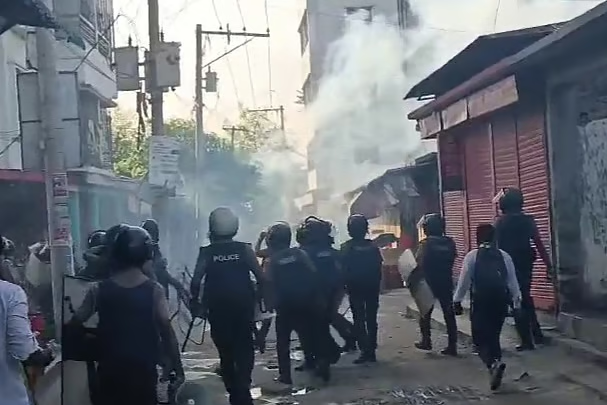
Volatile scenes erupted across Bangladesh’s key ready-made garment (RMG) hubs of Savar and Ashulia on Wednesday, as clashes broke out between law enforcement officers and garment workers demanding a substantial pay rise. The unrest forced factory owners to shutter more than 50 industrial units prematurely to prevent further damage and ensure personnel safety.
The morning began under tense circumstances. While the majority of workers reported to their respective factories at the scheduled start of the day, labor dissatisfaction quickly manifested. In several manufacturing units, employees refused to join their shifts, choosing instead to stage sit-ins inside the premises. As the protest gathered momentum, workers walked out onto the streets, attempting to block key transport arteries, notably the vital stretch connecting Abdullahpur to Baipail.
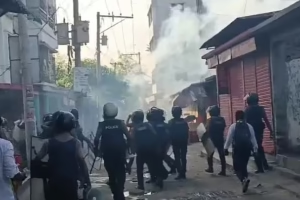
Tensions crested rapidly in the Jamgora, Nischintapur, Narasinghapur, and Jirabo areas of Ashulia. As demonstrators attempted to occupy the main roads, police stepped in to disperse the crowds. Demonstrators retaliated by hurling bricks and stones at law enforcement personnel and armored personnel carriers (APCs). To regain control of the escalating situation, police deployed tear gas shells and fired sound grenades, sending scatter waves through the industrial zone.
Simultaneously, similar confrontations flared up in the Hemayetpur precinct of Savar. Striking workers gathered in front of a factory belonging to the Standard MH Group in Bagbari. Despite repeated police orders to clear the thoroughfare, the crowd maintained their demonstration. The encounter turned hostile when protesters pelted police officers with projectiles, prompting law enforcement to deploy sound grenades and tear gas in response. Multiple rounds of chase and counter-chase ensued before the crowd was eventually broken up.
At the core of the protests lies a demand for a revised minimum monthly wage of 30,000 BDT for ready-made garment workers, alongside an immediate halt to worker layoffs across the sector. The apparel industry serves as the backbone of Bangladesh’s export economy, accounting for over 80 percent of total export earnings. However, rising inflation and elevated living costs have severely strained the purchasing power of factory workers, prompting widespread calls for financial relief and structural wage updates.
Senior police officials suggested that external agents may have escalated the friction. Mohammad Mominul Islam Bhuiyan, Superintendent of Police for Ashulia Industrial Police-1, confirmed that between 50 and 60 factories declared a holiday by 3:00 PM due to security concerns. Additionally, Md Jahangir Alam, Additional Superintendent of Police (Crime, Ops, and Traffic North) for Dhaka District, noted that while a official Minimum Wage Board has already been formed and initial discussions have taken place to address worker pay, external instigators appeared to leverage the situation to engineer disruption.
To restore order and protect industrial property, local authorities scaled up security arrangements. Saiful Islam, the Upazila Nirbahi Officer (UNO) of Savar, confirmed that 15 platoons of the Border Guard Bangladesh (BGB) have been deployed across Savar and Ashulia alongside district and industrial police forces, supervised by four executive magistrates patrolling the industrial zone.