DHAKA, Feb 22, 2025 (BSS) – Dhaka Chamber of Commerce and Industry (DCCI) President Taskeen Ahmed has emphasized the need to increase private sector credit flow to double digits, ensuring good governance and financial transparency to foster a business-friendly environment in Bangladesh.
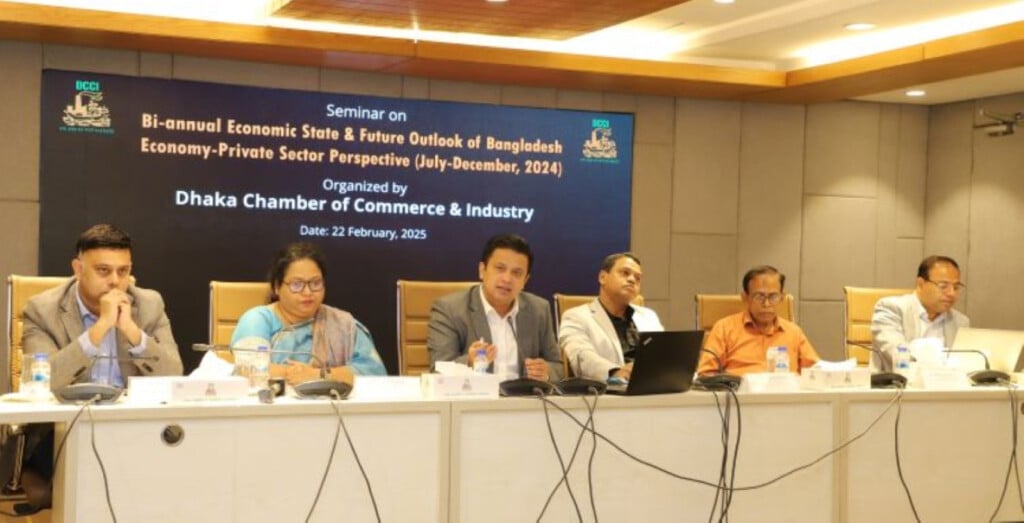
Speaking at a seminar titled “Bi-Annual Economic State and Future Outlook of Bangladesh Economy – Private Sector Perspective (July-December 2024),” organized by DCCI at its auditorium, Ahmed called for lower interest rates on loans, continued policy support to attract both local and foreign investment, and infrastructural development to sustain economic growth.
In his keynote address, Ahmed highlighted key economic factors, including global economic conditions, monetary policy, inflation, private investment, foreign direct investment (FDI), agriculture, industry, energy, logistics, and financial sector stability. He urged for stronger market monitoring to combat inflation, stricter law enforcement to dismantle price-manipulating syndicates, and increased VAT on luxury goods while reducing VAT on essential commodities.
Government and Economic Experts Weigh In
Md. Abdur Rahim Khan, Secretary (Routine Charge) of the Ministry of Commerce, who attended as the chief guest, stated that Bangladesh could reduce trade costs by 10-15% if the logistics policy and WTO trade facilitation agreements are fully implemented. He highlighted the government’s initiative to establish a Technology Centre in Gazipur to support the light engineering sector, a key industry for Bangladesh’s economic future.
Dr. M Masrur Reaz, Chairman of Policy Exchange of Bangladesh, noted that central bank interventions at the end of 2024 helped stabilize inflation. He predicted that if the country’s foreign exchange reserves reach $25-27 billion this fiscal year, industrial imports and supply chains would improve significantly. To address price manipulation, he urged strengthening the Bangladesh Competition Commission’s market oversight capabilities.
Dhaka University Professor Dr. Mohammad Abu Eusuf advised against a deficit-heavy national budget, warning that excessive bank borrowing by the government could negatively impact private sector credit availability. He emphasized the importance of aligning budgetary policy with monetary strategies to curb inflation and suggested raising the country’s low tax-to-GDP ratio to enhance revenue generation.
Dr. Mohammad Yunus, Research Director of BIDS, stressed the need for enhanced industry compliance and stronger public-private coordination to navigate the post-LDC transition successfully.
Central Bank and Policy Recommendations
Bangladesh Bank’s Executive Director (Research), Dr. Sayera Younus, acknowledged that inflation rose due to supply-side factors but assured that the central bank’s monetary policy measures, including increased policy rates, had stabilized the situation. She noted that the exchange rate had also been effectively managed and projected a promising economic outlook.
Meanwhile, Additional Secretary of ERD AHM Jahangir affirmed that Bangladesh is well-prepared for LDC graduation, but a final decision should be taken after thorough stakeholder consultation. He advocated for a well-structured Smooth Transition Strategy (STS) to ensure a seamless shift.
DCCI Vice-President Md. Salem Sulaiman and other board members were also present at the event, where 90 top officials from the government and financial sector participated in discussions on enhancing private sector credit flow and economic sustainability.