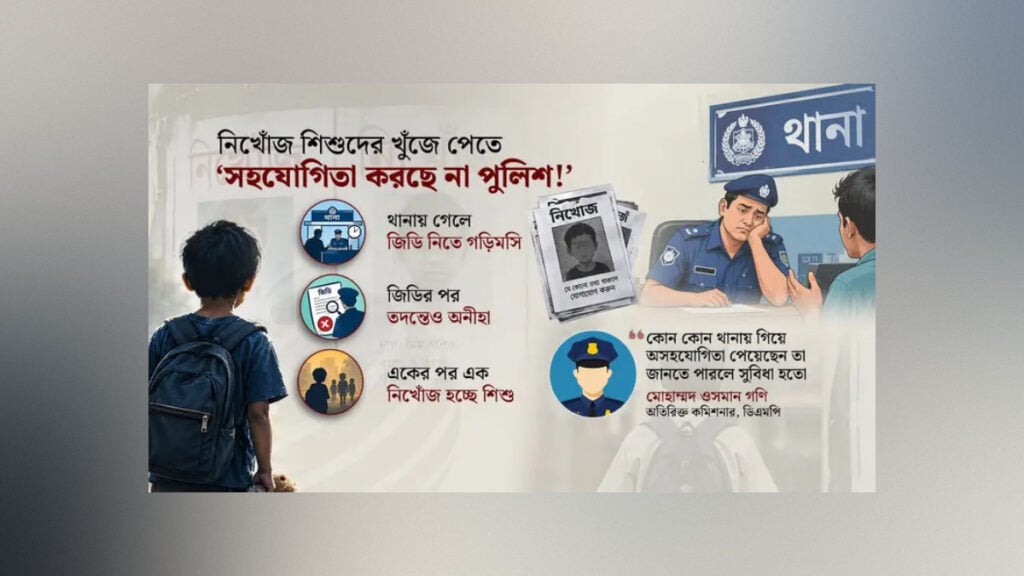
Families of missing children in Bangladesh have accused police of delaying general diary (GD) filings and showing little urgency in investigating cases, with some relatives claiming they were repeatedly sent away from police stations when they sought help.
The allegations came into sharper focus after four-year-old Saiba went missing in the Banani area of Dhaka on 30 August. Saiba had accompanied her mother, Bithi Akter, to the foot of the footbridge near Banani Sainik Club to buy shoes. Bithi said she left her daughter nearby while she concentrated on buying the shoes. When she returned about five minutes later, Saiba was gone.
The family immediately began searching for the child and went to Banani Police Station. Bithi alleged that officers initially told her to search for the child herself and declined to record her complaint. She said she returned to the station several times over the following two days but was unable to have a GD registered.
According to Saiba’s grandmother, Sharifa Begum, the child disappeared at about 5pm on 30 August, while the GD was finally recorded at around 4pm on 1 September — nearly two days later.
Sharifa also alleged that the investigating officer told her that finding the child was not solely the police’s responsibility and suggested that the family should search on its own and inform officers if they found any information. Seven days after Saiba disappeared, the family said they had still received no information about her whereabouts.
The allegations were raised publicly on 6 September at a press conference organised by social organisation Moon Alert at the Dhaka Reporters Unity. Relatives of at least two dozen missing children spoke at the event, with several breaking down in tears as they described their efforts to find their children.
The families claimed that reluctance to accept GDs was not limited to Saiba’s case. They alleged that, even when a GD was eventually registered following repeated requests or intervention, police often failed to maintain sufficient urgency in subsequent searches.
Police authorities, however, have rejected the suggestion that officers are not responsible for helping to recover missing children.
Mohammad Osman Gani, additional commissioner of the Dhaka Metropolitan Police responsible for crime and operations, said specific complaints would need to be identified and verified before action could be taken. He asked families to provide details of the police stations where they had allegedly faced obstruction.
AIG (Media) A H M Shahadat Hossain said police personnel had been instructed to treat cases involving missing children with seriousness and sensitivity. He said departmental action would be taken if a specific complaint established that officers had refused to accept a GD or failed to co-operate with a family.
He also pointed to the availability of online GD facilities, saying there should be no delay in accepting an online submission.
Police Headquarters figures cited in the report show the scale of the issue. Between January and July this year, 15,717 children were reported missing across the country. Of them, 13,679 had been recovered, while 2,038 remained missing — about 13 per cent of the total.
The figures also show a marked difference between age groups. Among children aged between zero and nine, 474 GDs relating to missing cases were recorded during the seven-month period. Some 406 children were recovered, while 68 remained missing. For those aged between 10 and 17, 15,243 GDs were recorded; 13,273 children were recovered and 1,970 remained untraced.
The police response has also been questioned in several other cases raised at the Moon Alert event.
Bilqis Begum, from Koyra in Khulna, said her daughter Samira disappeared from a local market on 26 August last year. According to her account, witnesses later said a 19-year-old man named Azmir had given the child sweets after placing her on a van. Police reportedly took Azmir to the station after local people raised questions, but Samira was never found.
Bilqis alleged that Azmir admitted knowing the child during questioning but was not arrested and was later released. She believes a more forceful investigation at the beginning of the case might have helped locate her daughter.
Another unresolved case concerns Mohammad Ibrahim, who disappeared from the Mirpur-11 area of Dhaka on 13 May. His father, Mohammad Jasim, a street food seller, alleged that Pallabi Police Station initially refused to record a GD. According to him, the GD was eventually accepted on 15 May. He said the family repeatedly approached police but received little meaningful assistance before the investigation was later handed over to the Detective Branch.
Jasim described the experience as particularly difficult because of his limited financial means and appealed for help in finding his son.
Former police officer Mohammad Nazrul Islam also attended the press conference seeking information about his son Tamim, who disappeared on 20 May last year. Nazrul said his son had been expected to attend school but was later found to have been absent. Despite searches across different parts of the country, he said the child remained missing.
Nazrul claimed that he had spent more than Tk 2.5 million searching for his son, exhausting his retirement savings in the process. He said that although he had himself served in the police, he did not receive the level of assistance he had expected.
The Moon Alert event was attended by representatives of 35 affected families, while more than two dozen relatives spoke about their experiences.
According to Moon Alert, the organisation has received 1,226 reports of missing children since beginning its activities. More than 800 children have reportedly been recovered with police assistance. The organisation has issued 171 alerts in connection with missing-child cases, following which 119 children were recovered.
Sadaat Rahman, chief coordinator of Moon Alert, called for a more effective system for responding to missing-child cases. He said the organisation wanted Bangladesh to adopt stronger practices for locating missing children and stressed that government agencies, law-enforcement authorities and other stakeholders needed to work together.
For families, the central concern remains the same: when a child disappears, every delay can add to their uncertainty. The allegations over delayed GDs and the subsequent pace of investigations have therefore placed renewed attention on how missing-child complaints are received, investigated and followed up by law-enforcement agencies.