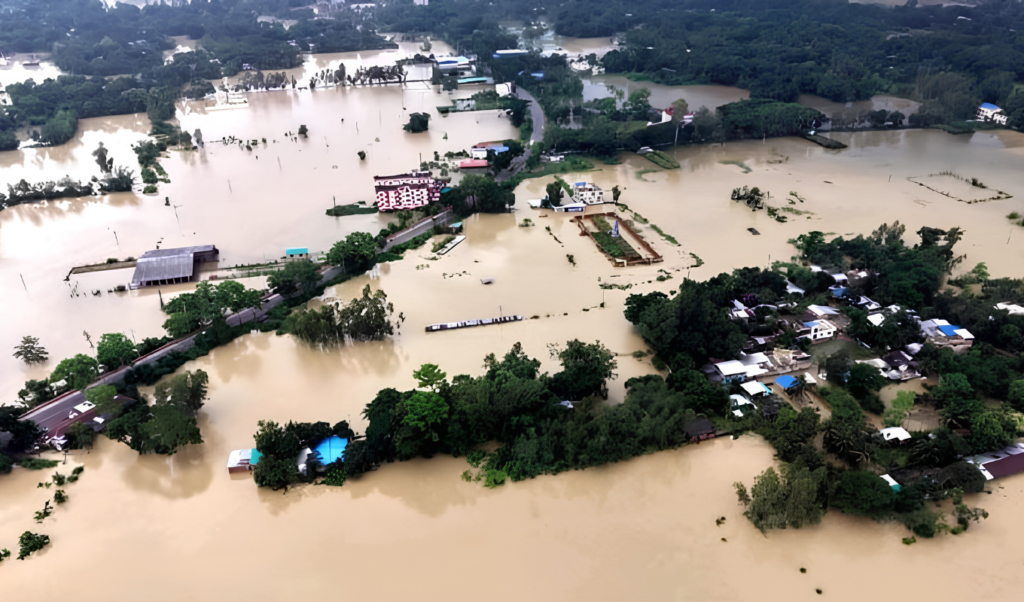
Relentless torrential rain and subsequent flooding have caused widespread devastation across the fisheries sector in Chittagong. Nearly 10,000 fish farms, enclosures, and ponds have been submerged under floodwaters, washing away vast quantities of stock. Local fish farmers, many of whom rely entirely on seasonal yields to repay agricultural loans, have been left financially ruined.
According to an official assessment report published on Saturday, 11 July 2026, by the Chittagong District Fisheries Department, the total financial damage has reached at least 91 crore taka. The destruction spans all 15 sub-districts (upazilas) of the region, with coastal and low-lying areas like Banshkhali, Satkania, and Lohagara bearing the brunt of the environmental disaster.
Regional Breakdown of Submerged Enclosures and Financial Losses
| Serial No. | Affected Upazila / Loss Category | Submerged Ponds & Enclosures | Financial Loss (BDT) |
| 1 | Banshkhali Upazila | Most severely flooded region | 41.50 Crore |
| 2 | Satkania Upazila | Over 3,000 (combined with Lohagara) | 11.00 Crore |
| 3 | Lohagara Upazila | Over 3,000 (combined with Satkania) | 8.50 Crore |
| 4 | Patiya Upazila | 1,435 Ponds and Waterbodies | Included in District Total |
| 5 | Anwara Upazila | 1,100 Ponds and Waterbodies | Included in District Total |
| 6 | Karnafuli Upazila | 557 Ponds and Waterbodies | 6.00 Crore |
| 7 | Chandanaish Upazila | 383 Ponds and Waterbodies | 6.00 Crore |
| 8 | Structural Damage | Flood Embankments and Nets | 86.50 Lakh |
| 9 | Fish Fingerling Loss | 60 Lakh Tonnes of Fry | 23.00 Crore |
| 10 | Adult Fish and Shrimp Loss | 3,123 Tonnes of Fish & 570 Tonnes of Shrimp | 65.00 Crore |
The comprehensive survey conducted by the District Fisheries Office reveals that the floodwaters have inundated a staggering 9,933 ponds, lakes, and traditional sanctuaries. In addition, 320 commercially developed specialised fish enclosures (ghers) were completely submerged. The total surface area of the deluged waterbodies covers approximately 4,111 hectares across the district.
Geographically, Banshkhali emerged as the worst-hit upazila, registering more than forty per cent of the total district-wide losses. Satkania and Lohagara collectively ranked as the second most devastated zone, where over three thousand aquaculture facilities went entirely underwater within days.
Salma Begum, the Chittagong District Fisheries Officer, stated that the downpour, which commenced on 5 July, spared none of the 15 upazilas in the district. She noted that the preliminary estimate of 91 crore taka reflects the immediate impact, and the authorities fear the long-term economic repercussions might be even more severe once the water recedes completely.
The physical loss of livestock is immense. The report highlights that 3,123 tonnes of mature finfish and 570 tonnes of shrimp—a lucrative export commodity—were washed out into open waters. The most devastating blow to future sustainability is the loss of 60 lakh tonnes of fish fingerlings and fry, valued at 23 crore taka. This loss effectively halts the production cycle for the upcoming months. Furthermore, structural damages to embankments, security nets, and farming infrastructure have added another 86.50 lakh taka to the total losses, leaving the local aquaculture industry facing an unprecedented crisis.