The District Commissioner of Dhaka, Farida Khanom, has emphasised the urgent need for coordinated efforts among government bodies, law enforcement agencies, local administration, elected representatives, the media, and the general public to effectively prevent human trafficking and migrant smuggling.
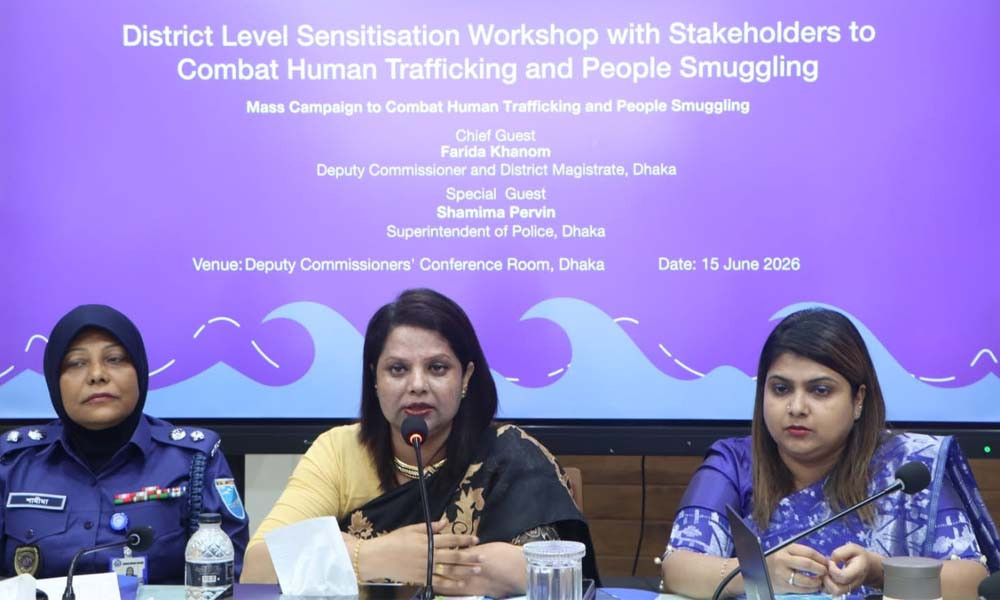
She made the remarks on Monday (15 June) while addressing the inaugural session of a district-level workshop titled “Prevention of Human Trafficking and Migrant Smuggling”, held at the conference room of the District Commissioner’s office.
Human trafficking as a rights violation
In her speech, Farida Khanom stated that human trafficking is not merely a criminal offence but represents a severe form of human rights violation. She underlined that it poses a significant threat to societal security, dignity, and core humanitarian values.
She further observed that many individuals, driven by aspirations for improved livelihoods abroad, fall prey to organised networks of traffickers and brokers. These groups often lure people into irregular and high-risk migration routes.
According to her remarks, irregular migration—particularly through maritime routes—has become increasingly concerning. Such journeys frequently result in fatalities, disappearances, or exploitation and abuse in destination countries.
Need for safe migration awareness
The District Commissioner stressed that while safe, orderly, and lawful migration is a fundamental right, irregular migration exposes individuals to severe risks. She highlighted the importance of disseminating accurate information and raising public awareness to prevent people from taking unsafe migration routes.
She also noted that preventing human trafficking cannot be achieved by any single institution alone. Instead, it requires a unified approach involving government and non-government organisations, educational institutions, religious leaders, and the media.
Special attention, she said, must be given to educating young people about safe migration practices and the deceptive tactics used by trafficking networks.
Policy framework and local implementation
Farida Khanom added that the government has already adopted various laws, policies, and action plans aimed at combating human trafficking and migrant smuggling. However, she emphasised that effective implementation at the local level requires stronger coordination, improved information sharing, and active community engagement.
She expressed hope that the discussions, experiences, and recommendations shared during the workshop would contribute meaningfully to developing practical and effective strategies for combating trafficking.
Police participation
The event also featured participation from senior law enforcement officials, including Dhaka Superintendent of Police Shamima Parveen, who attended as a special guest.
Key stakeholders and roles discussed
| Stakeholder | Role in prevention efforts |
|---|---|
| Government agencies | Policy formulation, legal enforcement, and coordination |
| Law enforcement agencies | Investigation, prevention, and action against trafficking networks |
| Local administration | Grassroots monitoring and awareness activities |
| Elected representatives | Community mobilisation and advocacy |
| Media | Public awareness and information dissemination |
| Educational institutions | Awareness-building among students and youth |
| Religious leaders | Ethical guidance and community influence |
| General public | Reporting suspicious activities and awareness participation |
The workshop underscored the importance of integrated and multi-sectoral collaboration to address human trafficking and migrant smuggling, with a particular focus on prevention, awareness, and coordinated local implementation.