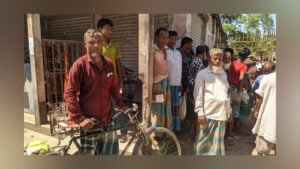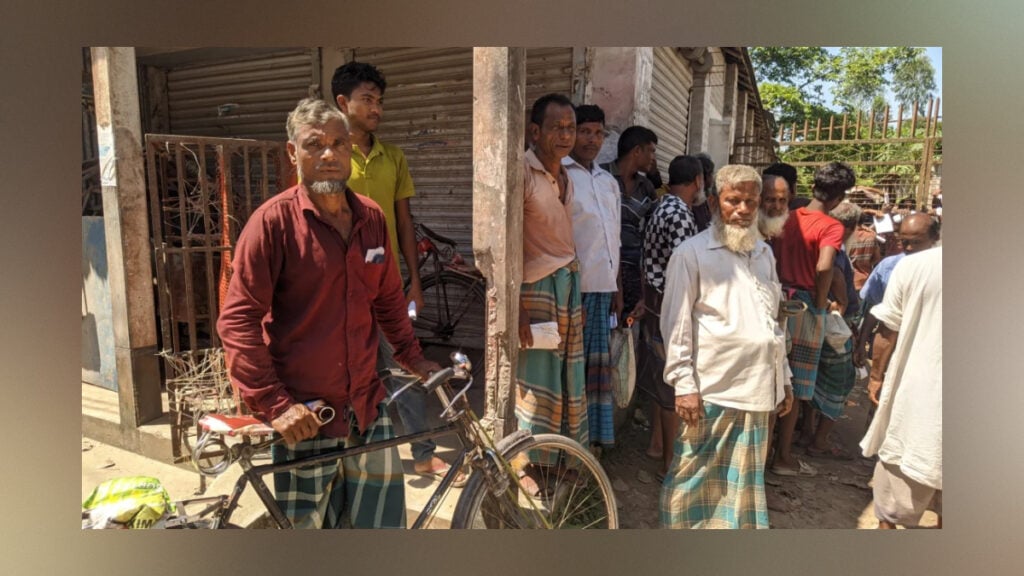
Kurigram is witnessing mounting frustration among farmers over the distribution of fertiliser, with repeated incidents of disorder, protests and confrontations reported across the district. Farmers say they are being forced to spend hours at dealers’ points without any guarantee of receiving the fertiliser they need. The situation has also exposed growing tensions between farmers, local administration and agricultural officials.
Local BNP leaders, police and officials from government intelligence agencies said a decision had been taken to distribute fertiliser through ward-based, listed retail sellers rather than concentrating supplies at dealers’ warehouses. However, the arrangement has reportedly not been implemented effectively. As a result, hundreds of farmers are gathering at individual dealer points, creating overcrowding and making orderly distribution difficult.
The local administration, meanwhile, has said it has repeatedly urged the Department of Agricultural Extension to implement the ward-based system. Officials have attributed the delay to a lack of cooperation and initiative from the agricultural authorities.
The latest incident occurred on Tuesday (22 September) at a dealer point in Natun Anantapur of Hatia union in Ulipur. According to local sources, the dealer and a sub-assistant agricultural officer left the site after seeing the large crowd of farmers. Angry farmers subsequently blocked the road and set fire to materials on the road as a form of protest. The situation was brought under control after administrative officials and additional police reached the area.
Several other incidents have been reported in recent weeks.
On Sunday, severe disorder broke out at fertiliser distribution points in Ghogadaha and Bhogdanga unions of Kurigram Sadar. In Ghogadaha, farmers waiting outside a dealer’s warehouse reportedly assaulted a sub-assistant agricultural officer after distribution was delayed.
Two days earlier, on 18 September, farmers in Ballabherkhas union of Nageshwari reportedly detained another sub-assistant agricultural officer inside a dealer’s warehouse. They also blocked a road and staged a protest. The officer was released after the upazila nirbahi officer arrived at the scene about four hours later.
On 16 September, angry farmers reportedly vandalised a dealer’s warehouse in Rajibpur Bazar in Char Rajibpur and took away fertiliser. Similar incidents had also been reported in Roumari on 7 September and Bhurungamari on 23 August.
The repeated incidents have raised concerns about the effectiveness of the existing distribution system and the relationship between agricultural officials and marginal farmers in the district.
Farmers argue that concentrating distribution at dealers’ points is creating unnecessary pressure. Many have to travel from distant areas, wait for long periods and still return without fertiliser. For those who also work as day labourers, spending an entire day at a dealer’s point can mean losing a day’s income.
They believe distributing fertiliser through registered retailers at ward level would reduce crowds and allow farmers to collect supplies closer to their homes according to their needs.
The issue prompted Rangpur Divisional Commissioner Shahidul Islam to visit Kurigram. On 19 September, he held discussions with local leaders and journalists in Roumari. The following day, he attended a meeting at the deputy commissioner’s conference room with officials from the administration and agricultural department, police, political representatives and journalists.
The meeting decided that, alongside dealer warehouses, fertiliser should also be distributed through registered retail sellers at ward level to make the process easier for farmers and improve distribution.
However, people who attended the meeting said the decision had yet to be properly implemented in the field. During the period of the meeting, disorder was reported outside dealer warehouses in Bhogdanga, Ghogadaha and Holokhana unions of Kurigram Sadar. An agricultural official was also reportedly assaulted.
At a dealer point in Panchpir Bazar of Durgapur union, Ulipur, the scale of the problem was evident on Tuesday. Farmers from across the union gathered at the Bangladesh Chemical Industries Corporation-authorised dealer point operated by Messrs Md Akbar Ali. Despite the distribution of one sack of fertiliser among five farmers, many remained without supplies and expressed frustration.
Farmer Ruhul Amin from the Jamuna area told Bangla Tribune that he had been searching for fertiliser for three days. He said he had brought the identity cards of five people after being told that five farmers would be required to receive one sack, only to find that the arrangement could not be followed. He questioned how farmers could leave their work and spend hours waiting for a relatively small quantity of fertiliser.
Another farmer from the same union, retired serviceman Soljer, also criticised the current arrangement. He said farmers previously obtained fertiliser through retail shops, allowing them to buy the amount they required without having to gather at a single point for hours.
BCIC fertiliser dealer Ramzan Ali said the retail distribution system had also been used the previous year. According to him, concentrating supplies at dealers’ points this year had resulted in farmers from the entire union gathering at one location, increasing the possibility of disorder. He said distributing fertiliser through retailers at ward level could help prevent such situations.
Ulipur Upazila Agriculture Officer Shahidul Islam acknowledged that a decision had been taken to distribute fertiliser through ward-based retailers, but said the system had not yet been introduced. At present, he said, fertiliser was being distributed from dealer warehouses. Similar arrangements have reportedly remained in place in other upazilas of the district.
District BNP convener Mostafizar Rahman Mostafa said the ward-based distribution decision had been reached with consensus and that failure to implement it was contributing to the disorder.
District Commissioner and chair of the District Fertiliser and Seed Monitoring Committee, Annapurna Debnath, said the agricultural department had repeatedly been urged to implement the decision. She said the administration was working in coordination with relevant authorities and that ward-based distribution would be introduced gradually.
The continuing disputes highlight a practical problem in fertiliser distribution: even when supplies are available, an inefficient delivery system can leave farmers struggling to obtain them. For farmers whose livelihoods depend on timely cultivation, delays can mean lost working hours and additional costs.
The administration now faces the challenge of ensuring that the decisions taken at official meetings are translated into an effective system at the local level. Until that happens, the concentration of farmers at a limited number of dealer points is likely to remain a source of frustration and tension across Kurigram.