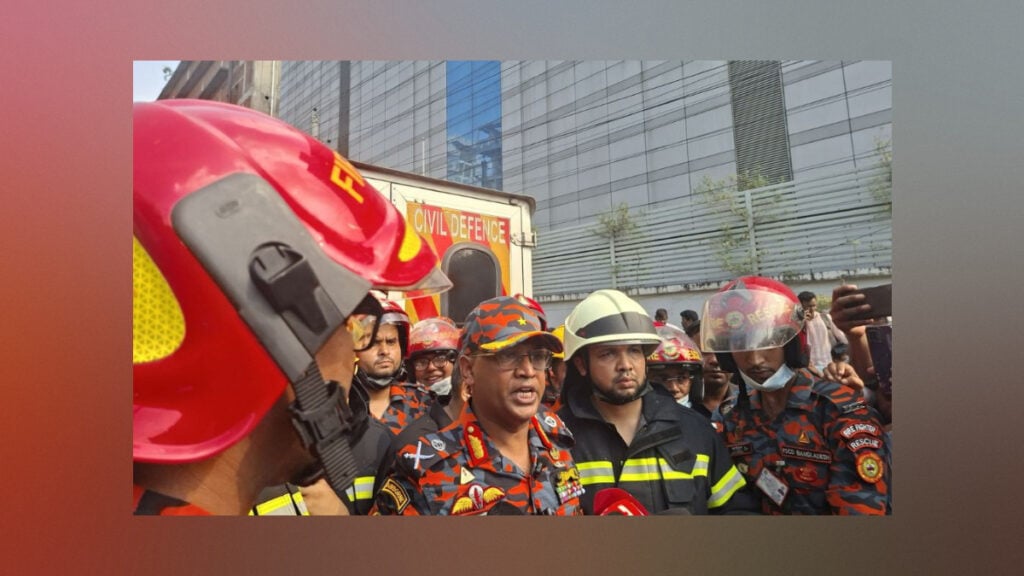
A fire at the Drug International Company Limited factory in the Cherag Ali area of Tongi, Gazipur, was brought under control at 1.35 pm on Wednesday, 14 October, following an extensive firefighting operation involving 21 units of the Fire Service.
No civilian casualties were reported, although one firefighter suffered breathing difficulties while responding to the incident and received medical attention. The fire broke out at around 10 am on the fourth floor of the factory’s seven-storey Unit-2 building before spreading to the second floor.
Fire Service Director General Brigadier General Sultanul Afreen Junayed confirmed that the blaze had been brought under control during a press briefing at the scene at 2.10 pm. He said firefighters had worked intensively to contain the flames and prevent the situation from deteriorating further.
According to the director general, the presence of essential medicines, including injectable drugs, created additional challenges during the operation. Smoke and conditions inside the affected areas also contributed to breathing difficulties among those involved in the emergency response.
He said the firefighting operation began urgently following instructions from the Prime Minister. A total of 21 Fire Service units were deployed, with personnel working to bring the fire under control by early afternoon.
The incident occurred at the company’s factory on Squibb Road in the Tongi industrial area. When the fire was first detected at around 10 am, factory personnel attempted to extinguish it using the facility’s own firefighting arrangements. However, the flames intensified, and the situation became difficult to manage. The factory authorities subsequently contacted the Fire Service for assistance.
Firefighters arrived from Tongi, Savar, Gazipur, Ashulia and Dhaka to tackle the blaze. Personnel from the army, Border Guard Bangladesh (BGB), police and Gazipur City Corporation also joined the response. The combined efforts of the agencies helped bring the fire under control after more than three hours of operations.
The fire caused considerable disruption in the surrounding area. Public transport and normal daily activities were severely affected within an area extending approximately two kilometres around the scene. Emergency vehicles, firefighting operations and the need to maintain safety around the premises contributed to traffic disruption, causing inconvenience for commuters and local residents.
Shafiqul Islam Badal, a manager at Drug International, said the company had initially tried to control the fire using its own arrangements. However, the intensity of the blaze made it necessary to seek support from the Fire Service and other relevant agencies.
Although the fire was brought under control at 1.35 pm, details about its cause and the extent of the damage were not immediately available. The authorities had yet to provide a comprehensive assessment of any losses involving the factory building, manufacturing equipment or pharmaceutical products.
The incident has drawn attention to the challenges of responding to fires at pharmaceutical manufacturing facilities, where medicines, packaging materials and industrial equipment can complicate emergency operations. Rapid detection, effective fire-safety arrangements and coordination with emergency services are important in limiting damage and protecting workers.
However, no information was immediately available to establish whether a failure in the factory’s fire-safety systems contributed to the incident. The precise cause of the fire and the scale of the financial losses remain to be determined.

/ Oct 14, 2026
Breaking News :