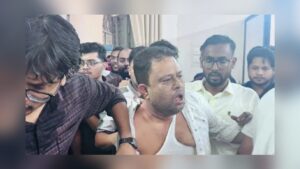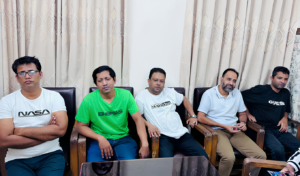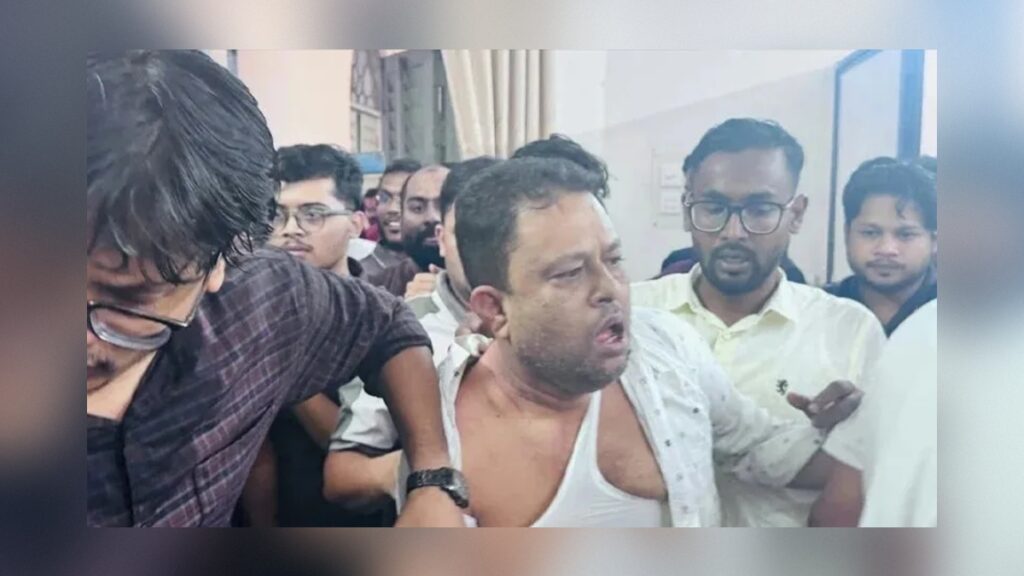
The incident took place on Monday (16 November), when activists from the two student organisations visited various administrative offices and academic departments on the university campus. The operation reportedly began at around 12.30pm and continued until 2.30pm.
The five officials who were assaulted have been identified as Himadri Shekhar Mondal, deputy director of the Controller of Examinations’ Office; Sanjay Kumar Pal, deputy director of the Finance and Accounts Office; Junaid Hossain, assistant registrar of the Film and Television Department; Nurul Huda, section officer at the Registrar’s Office; and Saidur Rahman Rony, deputy registrar.
Professor Mozaharul Alam Selim, chairman of the Department of Bangla, was also reportedly harassed over allegations of political affiliations.
Following the assaults, the activists took the five officials to the university’s Proctor’s Office and handed them over to the university authorities. They also demanded that the officials be handed over to the police for further investigation.
The student activists claimed that some university employees were involved in attempts to destabilise the country through arson and acts of sabotage. They alleged that the individuals had links to the Awami League and Chhatra League.
According to the activists, they have been compiling a list of teachers, officials, employees and students suspected of having connections with the Awami League and its affiliated organisations. They said efforts were under way to identify and locate those named on the list.
The allegations, however, have yet to be independently established. No details of specific evidence against the five officials were made public in the initial account of the incident.
University Proctor Professor Nasir Ahmad confirmed that five officials from different departments had been brought to his office by activists of Chhatra Dal and Chhatra Shakti.
He said the officials’ mobile phones had been confiscated and that those making allegations had been asked to submit formal complaints containing specific details.
The proctor said the university administration would examine the allegations and take appropriate administrative and legal action if necessary.
Asked whether student organisations had been authorised to identify and apprehend university employees suspected of political affiliations, Professor Nasir Ahmad firmly rejected the suggestion.
“Absolutely not,” he said, clarifying that the university administration had not assigned such responsibilities to any student organisation.
He explained that the administration had previously formed an investigation committee to examine allegations involving individuals associated with the Awami League. He himself was a member of that committee.
According to the proctor, the university administration had repeatedly issued notices inviting written complaints but had received none. Without formal allegations, he said, it was difficult for the administration to initiate disciplinary proceedings.
The incident has raised questions about the handling of politically sensitive allegations within university campuses and the responsibility of student organisations in maintaining an orderly academic environment.
While allegations of political involvement or participation in unlawful activities warrant proper investigation, any action against university employees must follow established institutional procedures and the law.
The administration’s position suggests that it intends to rely on formal complaints and an examination of evidence before deciding on further action. The immediate priority will be to establish the facts surrounding the incident, assess the allegations against the officials and determine whether any legal or disciplinary measures are justified.