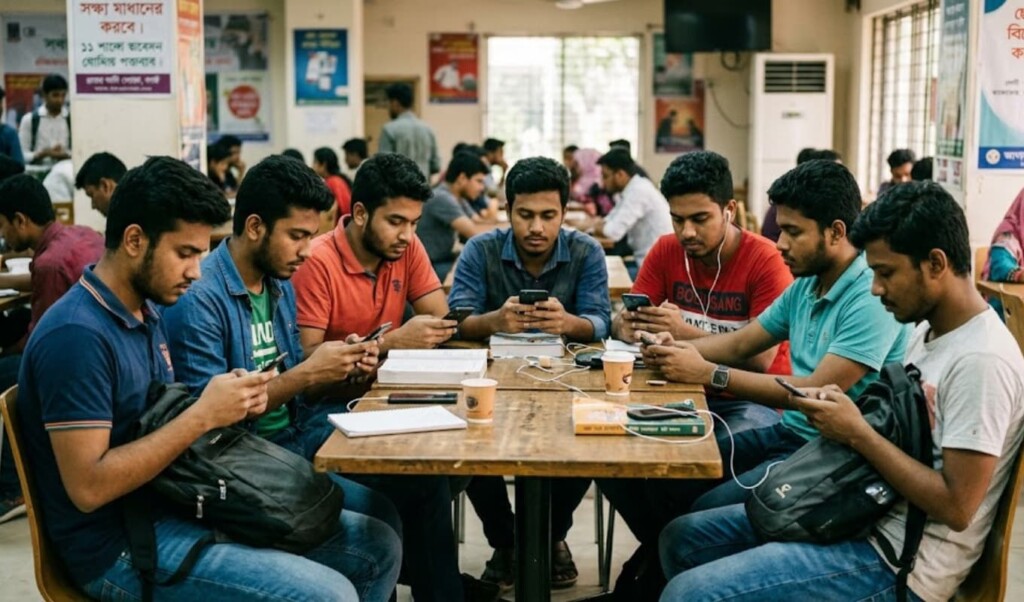
As the overcast skies of early August settle over urban landscapes, local cafés fill with young people huddled around glass tables—some conversing over tea, others fixated on the vibrant glow of their smartphone screens. On virtual walls across social media, digital tributes and nostalgic collages flood timelines to mark Friendship Day. First popularised in 1930 as a commercial initiative by Joyce Hall, the founder of Hallmark Cards, the occasion subsequently received official recognition from the United Nations in 2011. While the UN officially designates 30th July as the International Day of Friendship, countries such as Bangladesh and India traditionally celebrate it on the first Sunday of August. Yet, standing in the hyper-connected era of 2026, a fundamental query arises: has the true essence of human connection become entangled in the web of artificial intelligence and opaque social media algorithms?
The contrast with the late twentieth century could not be starker. In the 1990s, when modern digital technology was absent from daily life, relational depth was forged through genuine presence and patience. The gentle chime of a bicycle bell at the end of the lane, the shared rush to answer the single neighbourhood landline, and the anxious anticipation of the postman contained an authenticity unburdened by modern artificiality. On the eve of Friendship Day, youth spent hours meticulously crafting hand-woven friendship bands. Misunderstandings could not be instantly erased with a digital block or by unfriending someone; resolving disputes required face-to-face dialogue. In an era characterised by limited communication tools, emotional resilience and patience cultivated lifelong bonds.
Today, technological advancement has radically transformed this landscape. Paradoxically, as human society becomes the most interconnected in recorded history, it simultaneously faces an unprecedented epidemic of loneliness. Traditional physical gatherings have largely been superseded by AI-driven messaging applications, short-form video sharing, and algorithmically curated feeds. Whilst contemporary social media profiles boast hundreds, if not thousands, of online connections, this vast digital directory frequently conceals a profound sense of isolation. Finding a sincere companion to offer physical or emotional support during moments of crisis has become an increasingly rare experience. Recognizing this shift, the World Health Organization (WHO) recently classified global loneliness as a pressing public health crisis, citing research that demonstrates social isolation poses a health risk equivalent to smoking 15 cigarettes a day.
As individuals mature, professional responsibilities and family commitments naturally alter relational dynamics. In previous decades, a trusted friend served as a sanctuary for heartfelt expression. In 2026, however, hyper-connectivity often reduces these relationships to automated birthday wishes and passive likes. Yet, no digital emoji, graphic, or virtual reaction can replicate the psychological safety found in face-to-face conversations or empathetic voice calls.
Nevertheless, technological evolution is not entirely detrimental. Unlike the 1990s, geographical distance no longer threatens to sever connections permanently. High-definition video calls enable friends separated by international borders to maintain continuous dialogue, whilst digital platforms allow communities to mobilise rapid financial and logistical support during emergencies.
Ultimately, despite the commercialisation and changing mediums over the decades, the core requirement of friendship remains unchanged: a non-judgemental sanctuary built on unconditional trust. Stripping away the digital noise of online followers, the true measure of friendship endures in simple, authentic gestures—such as placing a direct call to an old friend to ask, “How are you?” That simple question bridges the gap beyond the blue light of smartphones, preserving the genuine human pulse that sustains meaningful relationships.