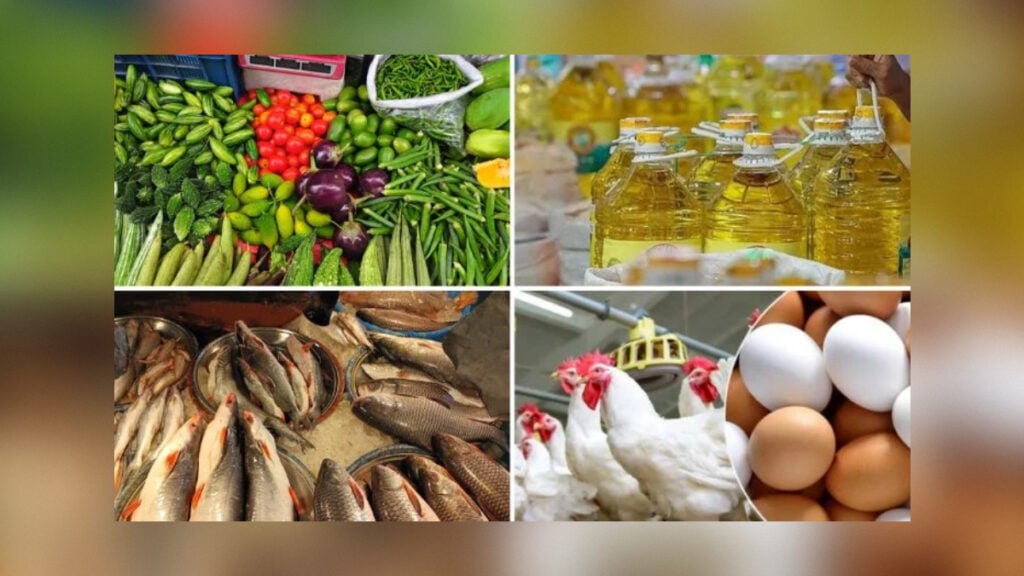
The recent rise in fuel prices has begun to put fresh pressure on food markets in Dhaka, with transport costs pushing up the prices of several vegetables and fish. The supply of bottled soybean oil has also tightened in some markets, adding to concerns among consumers already facing high prices for essential goods.
A visit to Karwan Bazar, Mohammadpur and New Market on Friday (25 September), along with discussions with buyers and sellers, found that the increase in transport costs is gradually feeding through the supply chain, from production areas to wholesale markets and finally to retail outlets.
Market traders said the government’s decision last Sunday to increase fuel prices had immediately raised the cost of transporting goods. Diesel, widely used for transporting agricultural and other commodities, has risen from Tk115 to Tk135 per litre. Petrol has been priced at Tk160 per litre, while octane now costs Tk165.
Traders say the additional fuel expense is reflected in the fares charged by trucks and covered vans. As goods pass through different stages of the supply chain, those higher costs can eventually be reflected in retail prices.
Vegetable prices move higher
Several vegetables have become more expensive compared with the previous week. Traders attribute part of the increase to higher transportation costs for bringing produce from different districts to Dhaka.
Prices vary according to quality and size. Brinjal is selling at Tk80–100 per kilogram, while local cucumber costs Tk70–80. Bitter gourd is around Tk80 per kilogram, local carrot Tk120, snake gourd Tk70, yardlong beans Tk80–100 and okra Tk70–80.
Sweet pumpkin is selling for about Tk40 per kilogram, green papaya Tk30, pointed gourd Tk70, and tomatoes Tk120–150 depending on quality. Kakrol costs Tk70–80 and ridge gourd around Tk80. Depending on size, individual ash gourds and bottle gourds are selling for Tk60–80.
Traders said prices have not increased uniformly across all vegetables. Availability, seasonal supply, demand and the distance between production areas and urban markets all influence the final retail price.
Fish prices also rise
The fish market has also experienced a noticeable increase. According to sellers, prices for several varieties have risen by Tk20–50 per kilogram within a few days.
Medium-sized farmed rohu is selling at Tk450–500 per kilogram. Pangas costs Tk250–270, tilapia Tk250–300 and medium-sized koi Tk200–250.
Local shing is priced at Tk500–600 per kilogram, while large pabda costs Tk400–450. Shrimp is selling for Tk800–1,000, and small mixed local fish for Tk600–700. Mola costs Tk600–700 and tengra Tk500–600.
Pomfret is selling at Tk1,400–1,500 per kilogram depending on size, while boal costs Tk700–900. A one-kilogram Padma hilsa is being sold for Tk2,000–2,200, while hilsa of the same weight from Chattogram is priced at around Tk1,800.
Consumers say these increases are particularly difficult to absorb because many essential commodities were already expensive before the fuel price adjustment. For households on limited incomes, even relatively small increases across several products can significantly affect daily spending.
Chicken and eggs remain expensive
Prices of chicken and eggs have also remained high for an extended period. Traders say these products have been selling at elevated prices for around one and a half months, leaving consumers with little relief.
Broiler chicken is currently selling for Tk180–200 per kilogram, while Sonali chicken costs Tk350–370. Beef is priced at around Tk800 per kilogram and mutton at Tk1,200.
Egg prices have also remained high. A dozen eggs are selling for about Tk150, with some retail markets charging Tk160. That puts the price of four eggs at Tk50 or more.
Bottled soybean oil supply tightens
Consumers are also facing difficulties finding bottled soybean oil in the quantities they want. The supply of one- and two-litre bottles has declined in some markets, while retailers also report a slight reduction in the availability of five-litre bottles.
Earlier this month, edible oil refiners and producers raised the price of bottled soybean oil by Tk5 per litre, taking the price to Tk204 per litre.
Retailers said supplies remained normal for several days after the price adjustment but later became tighter in some markets. Some sellers claimed that companies were releasing smaller quantities into the market.
A few retailers also said suppliers had told them that companies were considering another price increase. However, they stressed that this was not an official announcement by the companies, and there was no indication that supplies had fallen by the same degree in every market.
Flour prices have also increased. Over the past month, loose flour has risen by around Tk5 per kilogram, while loose refined flour has increased by as much as Tk10.
Loose flour is currently selling for around Tk50 per kilogram, while refined flour costs Tk65–70.
Other essential grocery items are also remaining at relatively high prices. Potatoes are selling at around Tk30 per kilogram, local onions at Tk50 depending on quality, local garlic at Tk100–140 and local ginger at Tk140–160.
Higher costs are changing shopping habits
The effect of rising prices is not limited to household budgets. Consumers are also changing how they shop.
Many families are now setting a fixed amount before going to the market and adjusting their shopping lists accordingly. Instead of buying everything they need, they are choosing between products based on price. A household that previously bought a certain quantity of fish, chicken and eggs may now buy smaller amounts or replace one item with another.
Private-sector employee Ariful Islam, a Mohammadpur resident, said he now prepares his shopping list according to the amount of money available. If fish is too expensive, he buys chicken; if chicken is also costly, he turns to eggs or other alternatives. The same amount of money, he said, no longer buys the same quantity of goods.
A housewife from Rayerbazar, Akleema Akter, said she previously bought fish, chicken and eggs for several days at a time. She now buys smaller quantities every two or three days because a larger purchase puts too much pressure on the household budget.
For people with irregular incomes, the adjustment can be even harder. Day labourer Abul Kashem from Hazaribagh said that when work is available, managing household expenses is possible, but when work declines, the shopping list has to be cut. Buying fish or chicken often means reducing spending on something else.
Retailers also face pressure
The change in consumer behaviour is affecting retailers. Sellers say customers are still coming to the markets, but many are buying less.
Chicken seller Didarul Islam at Karwan Bazar said customers now ask for the price before deciding how much to buy. Some who initially intend to purchase one kilogram reduce the quantity to half a kilogram after hearing the price. Others leave without buying anything.
Egg seller Jasim Hawladar at Mohammadpur Krishi Market said customers who once bought two or three dozen eggs at a time are increasingly purchasing only what they need. Some buy six eggs, while others limit their purchase to one dozen.
Retailers argue that the final price of a product is not determined solely by the shopkeeper. Wholesale purchase prices, transportation, labour, shop rent and other operating costs are all factored into the retail price. When wholesale prices rise, sellers say they cannot always reduce retail prices without taking losses.
Fish seller Shihab Molla at Karwan Bazar said high prices are also bad for retailers because customers buy less. But selling below the purchase price would result in a direct loss.
Another fish seller at New Market, Hasib Bepari, said many families that once bought two kilograms of fish are now purchasing one kilogram or less. Some customers are also buying half a kilogram of chicken instead of a full kilogram. Sales volumes are therefore falling, while transport and shop-related costs remain.
How far will the fuel shock spread?
The immediate impact of a fuel price increase is generally felt through transportation. Goods have to be moved from production centres to wholesale markets and then to retail outlets, and every stage can involve additional transport costs.
The effect, however, is not identical for every commodity. Production costs, availability, seasonal supply, demand, transport distance and conditions in wholesale and retail markets all influence the final price. A rise in fuel prices does not automatically mean that every product will increase by the same amount.
The concern among market participants is that if transport costs remain elevated for an extended period, the pressure could gradually spread to other essential goods and services. Agricultural products may face additional pressure if higher fuel costs also increase expenses related to irrigation and production.
For consumers, the impact is already becoming visible in everyday purchasing decisions. The issue is not simply that individual items are becoming more expensive. Many households are finding that the same amount of money now buys less food.
SM Nazrul Hossain, vice-president of the Consumers Association of Bangladesh (CAB), said higher fuel prices affect essential goods through increased transportation costs. As prices rise, consumers’ purchasing power can weaken, which may also reduce demand in the market. He said monitoring was needed to determine whether prices were rising unreasonably and to identify where additional costs were being added within the supply chain.
The coming weeks will show whether the latest increase in fuel prices remains concentrated in transportation and selected food items or creates wider pressure across the essential-goods market. For now, consumers and retailers are both adjusting to a market in which costs are rising while purchasing capacity remains under pressure.