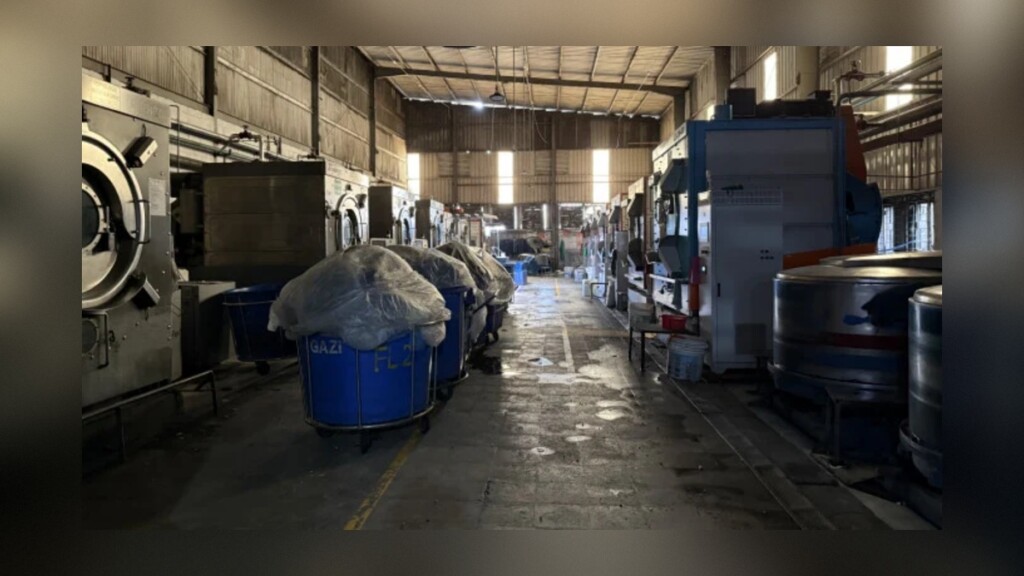
Severe gas shortages have brought production to a standstill at several gas-dependent factories in Ashulia, with manufacturers reporting steep losses, sharp declines in output and growing pressure to reduce their workforces.
At A R Wet Processing Ltd, a factory of Fashion Globe Group in the Kathgora Amtala area of Ashulia, production was running at reduced capacity for several weeks before being completely suspended yesterday morning. Operations continued until Wednesday night, but the factory was found shut across all three sections during a visit. Only security guards and a few officials were present, with no workers seen on the premises.
Output falls by up to 75%
Factory officials said production had fallen by as much as 75 per cent since the gas shortage began. The facility has a daily production capacity of around 50,000 pieces, but even after arranging gas from outside sources, it could produce a maximum of about 20,000 pieces. One section has nevertheless had to remain closed.
The factory has between 80 and 90 machines across its dry process, washing and finishing quality sections, 24 of which have had to be shut down. During the visit, the gas meter showed a pressure of 2.5 pounds per square inch (PSI). Officials said the factory requires a pressure of around 10 PSI for normal operations, while the actual supply fluctuates between zero and 2.5 PSI.
Even when the pressure reaches 2.5 PSI, officials said the gas cannot always be used because of concerns over its quality.
RAK Liton, company secretary of Fashion Globe Group, said production at the washing plant had dropped by up to 75 per cent. The company has attempted to bring in gas from outside and arranged a supply system similar to those used at compressed natural gas stations, but the measure has failed to resolve the problem.
The alternative arrangement is also proving expensive, costing the factory an additional Tk30,000 an hour. Liton said the gas pressure remains at zero for roughly half of the working day.
He added that most gas-dependent factories in the Savar-Ashulia industrial belt were facing similar difficulties.
The crisis has also affected Pakiza Group. An official, speaking on condition of anonymity, said the group’s textile factory had remained completely closed for 15 days because of the shortage. The factory was losing around Tk1 crore a day, the official claimed.
Security guards at the premises confirmed that no workers were currently inside the factory. Several workers arrived at the gate on Thursday morning but were reportedly turned away.
Dyeing factory operating only on paper
Ring Shine Textile Ltd is facing an equally severe disruption. Its managing director, Aniruddha Pial, said the dyeing factory remained officially operational but was producing virtually nothing because of insufficient gas pressure.
The factory has a daily production capacity of around 90 tonnes, yet it is currently unable to produce even two tonnes.
Pial said workers were being kept idle because the machinery could not operate reliably. He estimated the resulting loss at around Tk11 crore a day.
The irregular supply is making the situation worse. Whenever gas pressure rises slightly, the factory switches on its machinery, but the supply often disappears before the machines can reach the required operating temperature. This repeatedly interrupts production and creates the risk of damage or wastage involving high-value batches.
Pial said each batch could contain products worth between Tk8 crore and Tk10 crore.
The factory employs 975 workers, whose wages must still be paid despite the production stoppage. As the factory operates under the Dhaka Export Processing Zone, employees’ wages are required to be paid by the 10th of each month.
For manufacturers, the problem is therefore not limited to lost production. Factories continue to face wage bills and other fixed operating costs even when machinery remains idle.
Alternative fuels fail to restore normal output
Little Star Spinning Mill in Jamgora is attempting to keep production going by using several sources of energy. Even so, the mill is struggling to operate at 40 per cent of its capacity.
Its chairman, Khorshed Alam, said gas was currently contributing nothing to production. Electricity was being used to maintain around 25 per cent of output, while solar power and batteries were supplying part of the remaining requirement.
The shift towards alternative energy has increased production costs by about 12 per cent. The additional expense amounts to Tk14-Tk15 per pound of yarn produced.
Gas pressure at the mill rises to only around 1 to 1.5 PSI, which is not sufficient even to run its generators properly.
To conserve resources, the mill is rationing production across three shifts. Only two of its six sections remain operational. The company has also been forced to sell yarn at a loss in order to meet workers’ salary obligations.
Alam warned that if the situation continues, the mill may have no option but to reduce its workforce by at least 30 per cent.
Industrial police report fewer closures
The assessment from the industrial police, however, is less severe than the picture presented by factory owners and managers.
Mohammad Mominul Islam Bhuiyan, superintendent of Industrial Police-1, said they had received no information indicating that factories in the Ashulia area had been shut down because of the gas shortage.
He said Munnu Ceramics had remained closed for one or two days, while Priti Apparels and another factory had faced similar difficulties during the same period. According to him, the factories resumed normal operations when gas pressure improved.
The contrasting accounts underline the uneven nature of the crisis. While industrial police may not have received reports of widespread permanent closures, individual manufacturers say unstable gas supplies are already forcing them to suspend production, operate machinery below capacity and absorb substantial additional costs.
For gas-dependent industries such as textile processing, dyeing, washing and spinning, reliable pressure is essential because production depends on continuous operation of heat-intensive machinery. Repeated interruptions can leave equipment idle, disrupt production schedules and complicate delivery commitments.
The immediate concern for factories in Ashulia is therefore not only how much output they are losing, but how long they can continue paying wages and other fixed costs while operating below capacity. If the shortage persists, manufacturers warn that prolonged losses could eventually translate into wider production cuts and workforce reductions.