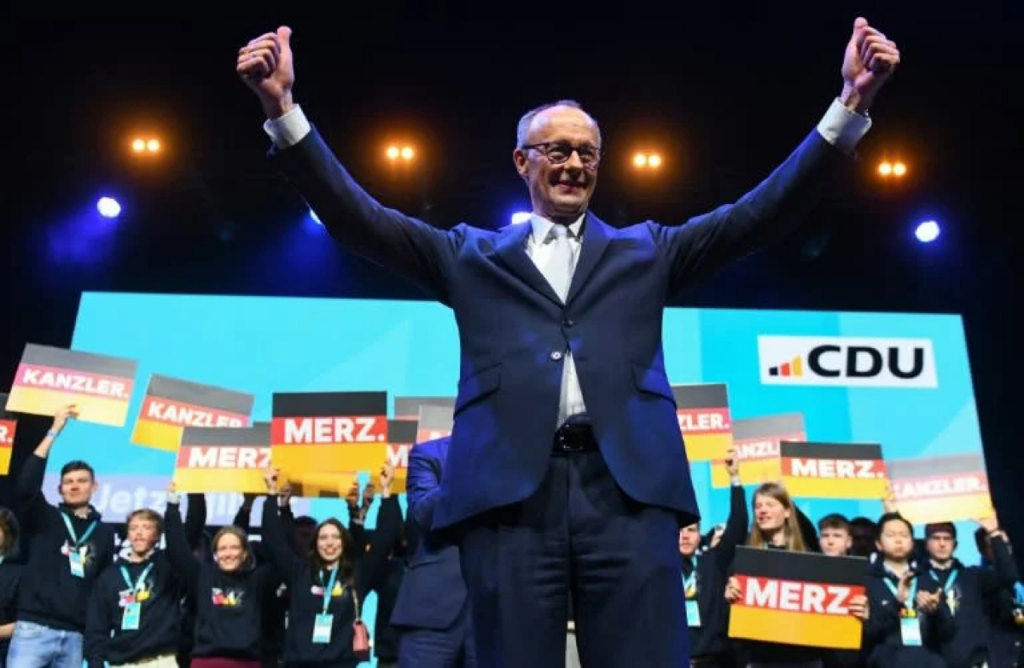
BERLIN, Feb 23, 2025 (BSS/AFP) – German voters head to the polls on Sunday in a high-stakes election dominated by the rise of the far-right and the dramatic return of Donald Trump to the White House. With conservative frontrunner Friedrich Merz widely expected to unseat Chancellor Olaf Scholz, the election could signal a significant shift in Germany’s political landscape.
Merz, leader of the Christian Democratic Union (CDU), has pledged a strong rightward turn to reclaim voters from the far-right Alternative for Germany (AfD), which is poised for a record-breaking result. The AfD’s surge follows a series of deadly attacks blamed on asylum seekers, fueling tensions over immigration policies.
If elected, Merz has promised to restore Germany’s global influence, vowing to provide a “strong voice” in Europe at a time of geopolitical uncertainty. His leadership would mark a stark departure from Scholz’s embattled centre-left government, which has struggled amid economic woes and coalition infighting.
The election takes place against the backdrop of Trump’s renewed influence on US-European relations, particularly his controversial outreach to Russian President Vladimir Putin in an attempt to negotiate an end to the Ukraine war. Across Europe, NATO allies remain on edge about the future of transatlantic security, particularly in Germany, which has long depended on the US-led alliance for stability.
AfD Gains Support Amid Immigration Debate
In an unusual twist, the AfD has received open backing from Trump’s circle, with billionaire Elon Musk endorsing the party as Germany’s only hope for “saving itself.” Trump, however, remained dismissive when asked about the election, remarking, “I wish them luck—we have our own problems.”
At his final campaign rally in Munich on Saturday, Merz projected confidence, declaring, “We will win the elections, and the nightmare of this government will be over.” Speaking to a crowd in a raucous beer hall, the 69-year-old former investment lawyer insisted that “there is no left-wing majority anymore in Germany” and promised strict border controls and economic revitalization.
AfD supporters have also voiced optimism. At a party rally in Berlin, Christian, a 49-year-old engineer, praised AfD leader Alice Weidel for her tough stance, claiming mainstream parties were now adopting AfD policies as their own. “That means she’s doing something right,” he said.
Economic and Political Uncertainty Looms
Beyond immigration, the election’s outcome could have far-reaching economic implications, particularly if a Trump-led trade war disrupts Germany’s already struggling economy. A prolonged coalition negotiation process could add to the uncertainty, with Scholz expected to remain in power as a caretaker until a new government is formed.
Polling stations opened at 8:00 am (0700 GMT), with over 59 million Germans eligible to vote. Initial exit polls are expected after voting closes at 6:00 pm (1700 GMT). Up to 30% of voters were still undecided in the final days, including 66-year-old Sylvia Otto, who expressed hesitation but said, “I want a change—to the right. That’s very important to me.”
Rise of the AfD Amid Security Concerns
Germany’s political shift was accelerated after Scholz’s fragile SPD-Greens-FDP coalition collapsed on November 6, the day of Trump’s re-election. The coalition had long been plagued by disputes over finances and policy direction.
The AfD, particularly strong in the former East Germany, has capitalized on public frustration, polling around 20%—its best-ever result. However, all major parties have vowed to keep it out of government.
The party’s rise follows a series of violent attacks, including:
- A December car-ramming attack at a Christmas market that killed six people, allegedly carried out by a Saudi man.
- A stabbing spree targeting kindergarten children and another car-ramming attack in Munich, both blamed on Afghan asylum seekers.
- A knife attack on a Spanish tourist at Berlin’s Holocaust memorial, allegedly carried out by a Syrian suspect who reportedly intended to “kill Jews.”
In response, Merz has pledged to tighten Germany’s borders and detain those awaiting deportation. However, the AfD has dismissed his policies as an imitation, claiming Germans will “vote for the original.”
As Germany braces for political transformation, the outcome of this election could reshape not just its domestic policies but also its role on the global stage.