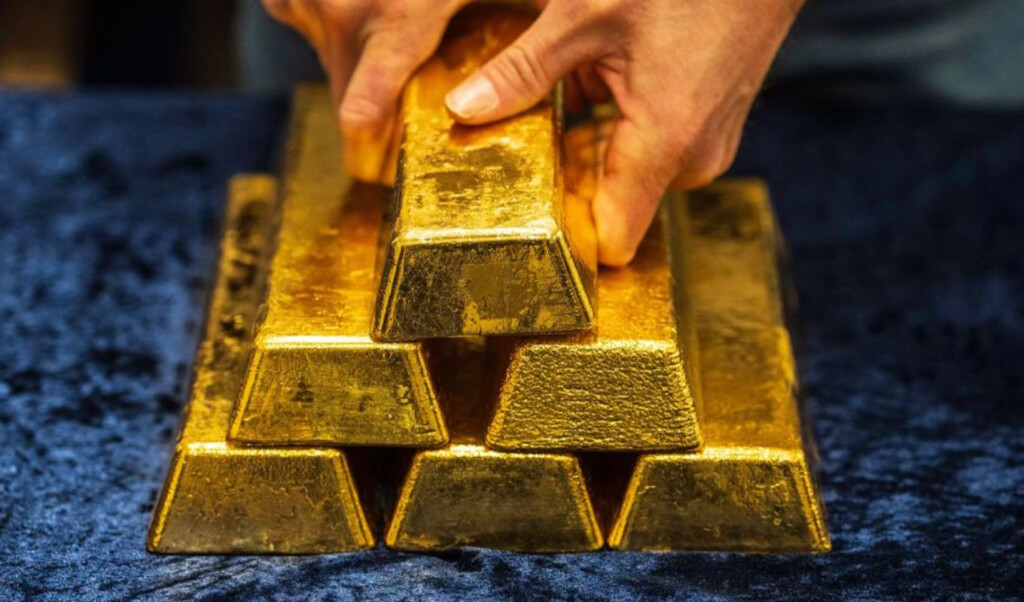
A sustained downturn in global gold prices appears increasingly likely as geopolitical tensions in the Middle East continue to unsettle commodity markets. Traders are warning that if gold fails to hold above the critical threshold of $4,100 per ounce, it could signal the beginning of a longer-term bearish cycle.
Earlier this week, gold prices fell sharply by more than 5%, slipping below $4,300 per ounce—marking their lowest level so far in 2026. The decline came amid heightened volatility triggered by escalating tensions involving Iran, Israel, and the United States, which initially had fuelled safe-haven demand before reversing investor sentiment.
At the start of the week, former US President Donald Trump issued a 48-hour ultimatum to Iran, demanding the reopening of the Strait of Hormuz, a vital global oil transit route. He warned of potential strikes on energy infrastructure if the demand was not met. In response, Iran threatened to close the strait entirely and target US-linked financial and military installations, further intensifying fears of a broader regional confrontation.
Market analysts in Bangkok, Thailand, note that gold is currently testing crucial technical levels. According to senior officials at the Hua Seng Heng gold trading firm, both $4,235 and $4,100 per ounce are acting as key support zones. A decisive break below $4,100 could open the door to a prolonged downward trend, with some forecasts suggesting prices may fall below $4,000 by the end of the year.
Despite gold’s traditional role as a hedge against inflation and uncertainty, the recent sell-off—exceeding 10% over the past week—has been driven by shifting expectations around global interest rates. Investors are increasingly anticipating that the United States Federal Reserve may maintain or even raise interest rates further this year, strengthening the US dollar and reducing the appeal of non-yielding assets such as gold.
Local markets have also reflected this volatility. In Thailand, domestic gold prices have dropped significantly, with trading levels falling from above 70,000 baht per baht-weight to around 65,000 baht. Prices have fluctuated sharply throughout trading sessions, underscoring heightened uncertainty among investors.
The Gold Traders Association has cautioned against speculative trading in the current environment. While short-term downside risk remains, some officials argue that a sustained fall below $4,000 is still unlikely, citing ongoing geopolitical instability and inflationary pressures that could eventually restore demand for safe-haven assets.
Key Gold Market Levels
| Indicator | Level | Market Significance |
|---|---|---|
| Recent high support | $4,235/oz | Short-term stabilisation zone |
| Critical threshold | $4,100/oz | Breakpoint for downtrend signal |
| Recent trading level | Below $4,300/oz | 2026 low range |
| Year-end forecast (bearish case) | Below $4,000/oz | Potential long-term downside target |
| Thailand domestic price | ~65,000 baht/baht-weight | Marked local decline |
As markets continue to react to geopolitical developments and shifting monetary expectations, gold remains caught between its traditional safe-haven appeal and pressure from a stronger interest rate outlook.